The Silver Stars

From the dark void, salvation came in the guise of argent stars.

Jarnail Solarion of the Inheritors chapter

The Silver Stars chapter are a creation of my good friend and regular opponent, Apologist. They are the instigators of the War of the False Primarch and the leaders of the Partisan faction, in opposition to my Flesh Eaters and the other Orthodox chapters sent to eradicate this threat to the High Lords of Terra. When I was building my Armies on Parade 2023 entry, “Interregnum at Interlude Quay”, I knew that I wanted some antagonists on the board for the Flesh Eaters to be fighting. So what better choice than the Silver Stars?

Modelling

Before anything else, it’s worth making the point that the Silver Stars are (out-of-universe) intentionally slightly unclear, and this has been intentionally built into their marking scheme. They are, after all, supposedly the returned Legion of a lost or forgotten Primarch; or possibly a renegade Chapter masquerading as such behind an abomination; or perhaps the time- or dimensionally-displaced results of some Other event.

Apologist on the Silver Stars

The Silver Stars are intended to look like they’ve stepped straight out of the 31st Millennium (the War of the False Primarch being set in the 34th Millennium), so I wanted to create a MkII or MkIII look for their armour. I also needed to ensure they measured-up to the Flesh Eaters, which are based on Primaris Marines converted to look like they are wearing MkVI armour.

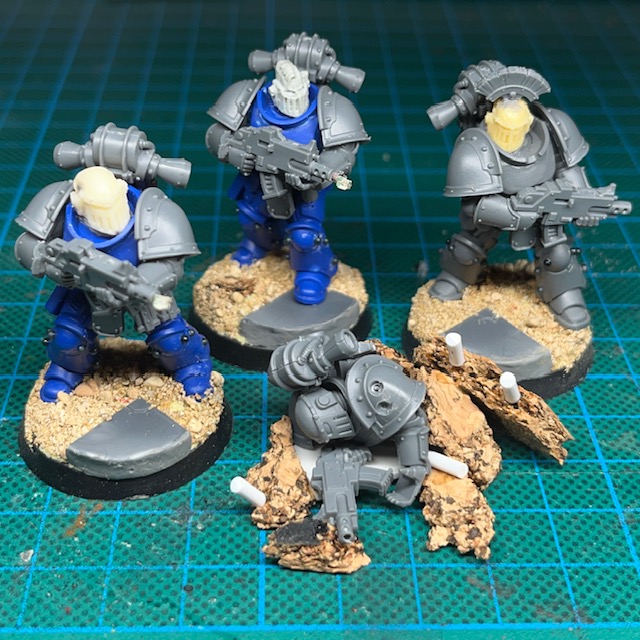
There were a number of ways I could have gone about this, including using third party 3D printable ’embiggened’ MkII legs and torso, or using Cataphractii Terminator legs. But in the end I decided to use what was already in my ‘bits box’, which was a lot of Primaris spares and some sprues of the old plastic MkIII armour.

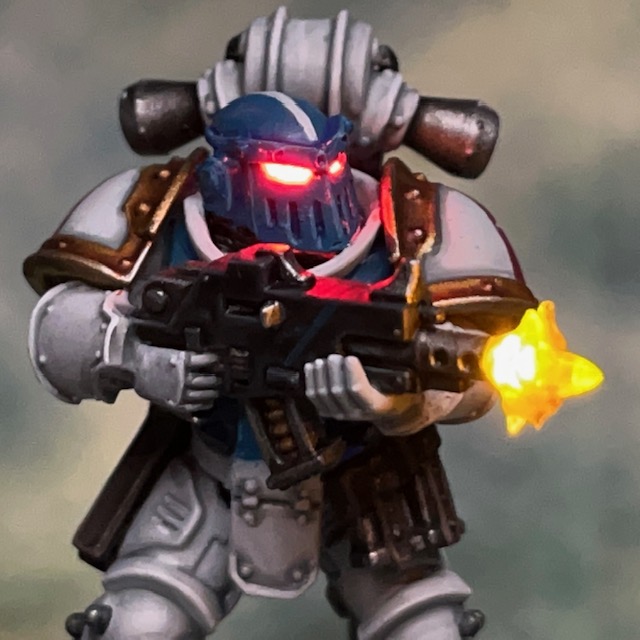
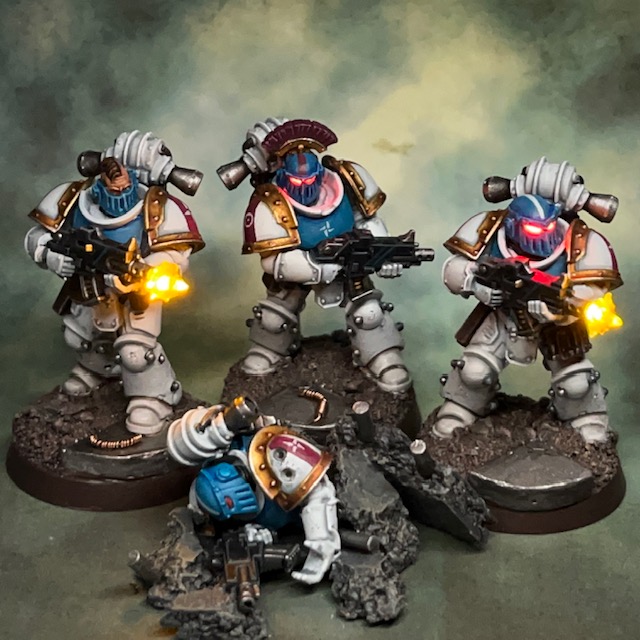
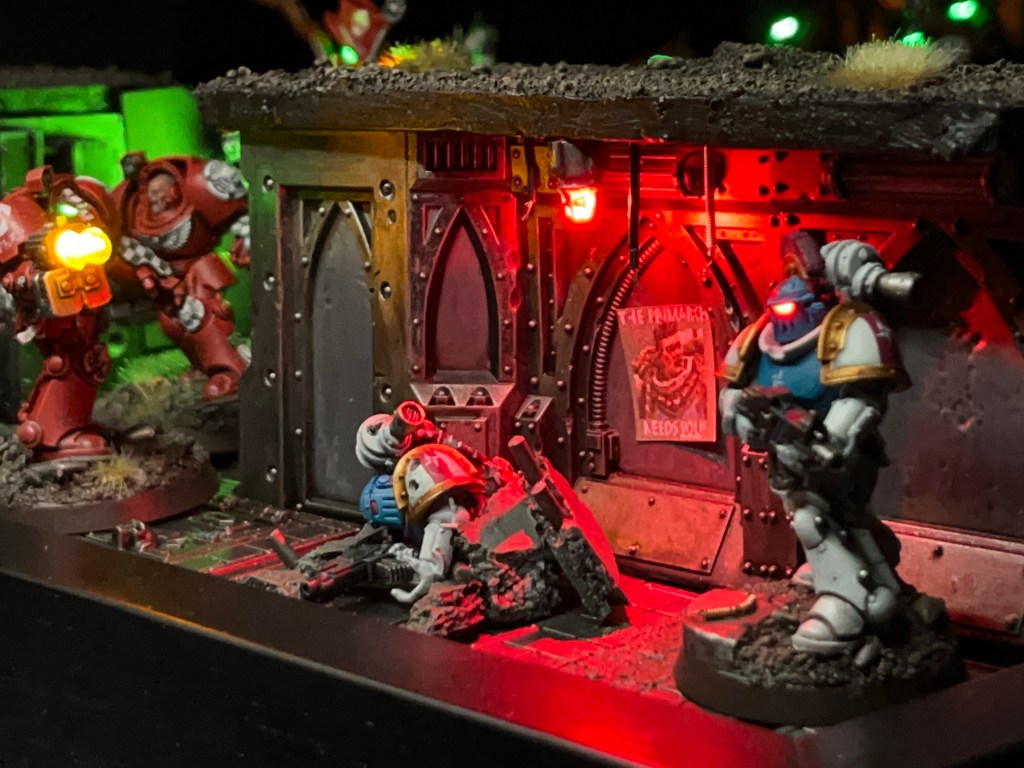
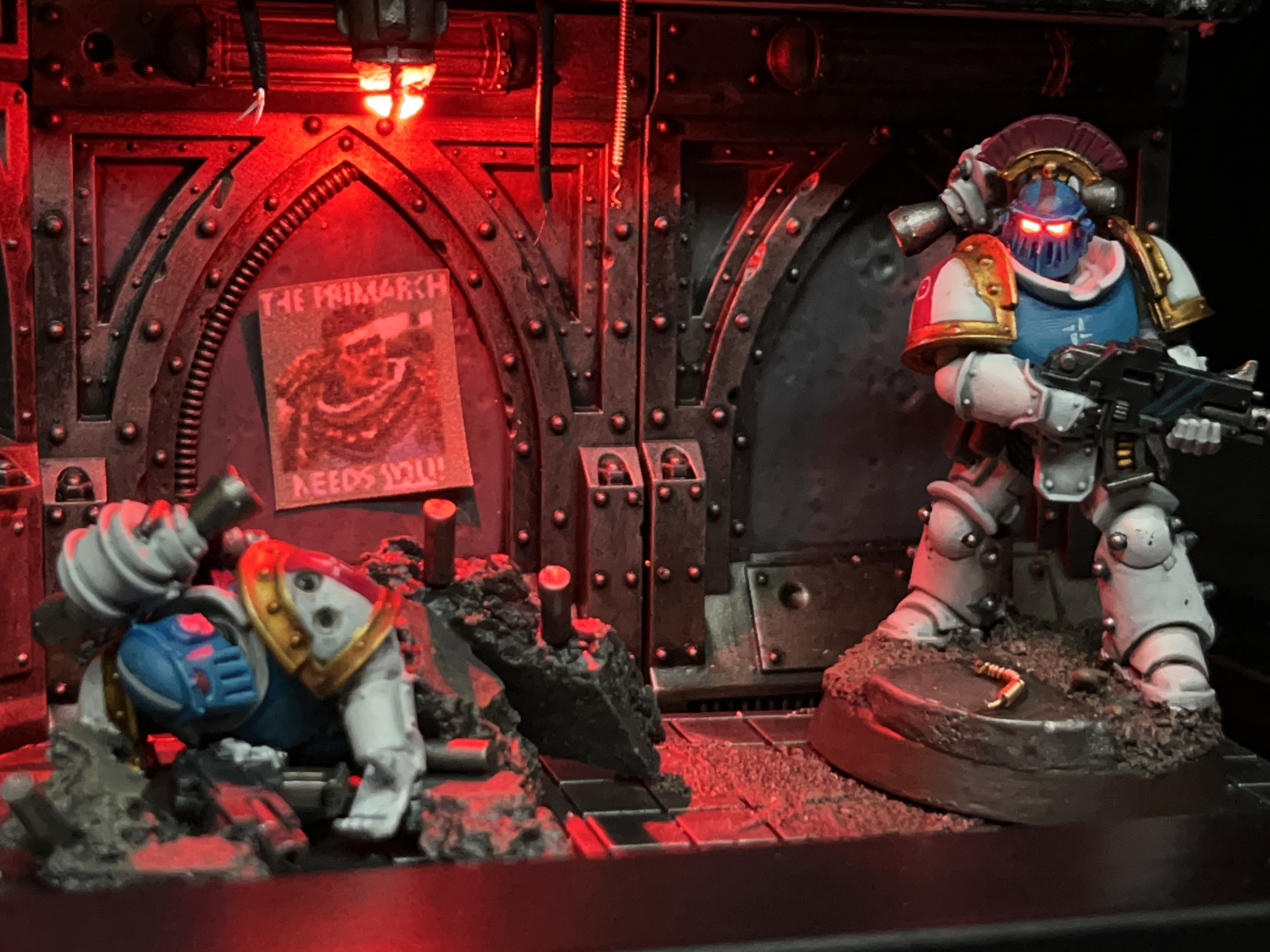
These Silver Stars are built around Primaris legs and bodies, plus the older plastic MkIII arms, pauldrons, backpacks, bolters and heads. To give the legs a more “antiquated” look, I added Mixed Micro Glass Balls from Green Stuff World as armour studs. I’d be the first to admit this isn’t perfect, and if I hadn’t been up against the Armies on Parade submission deadline, I may have spent a bit more time converting the legs. Still, I don’t think it looks too bad, and as Apologist says in the quote above, the provenance of their armour is supposed to be intentionally unclear.

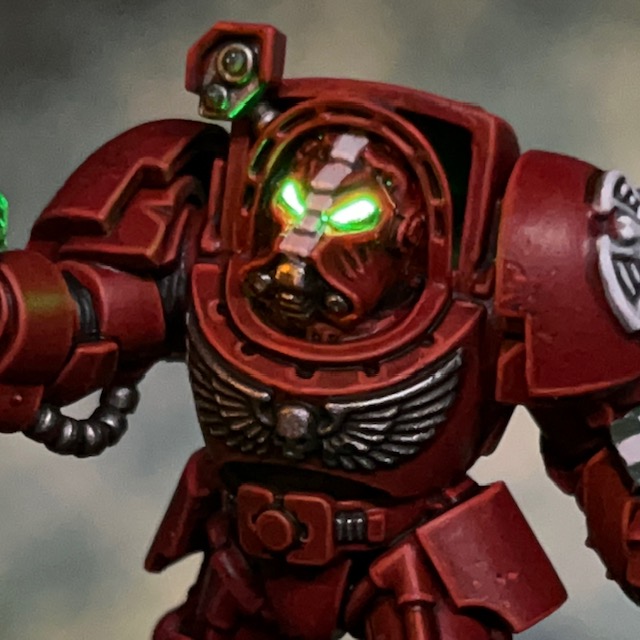
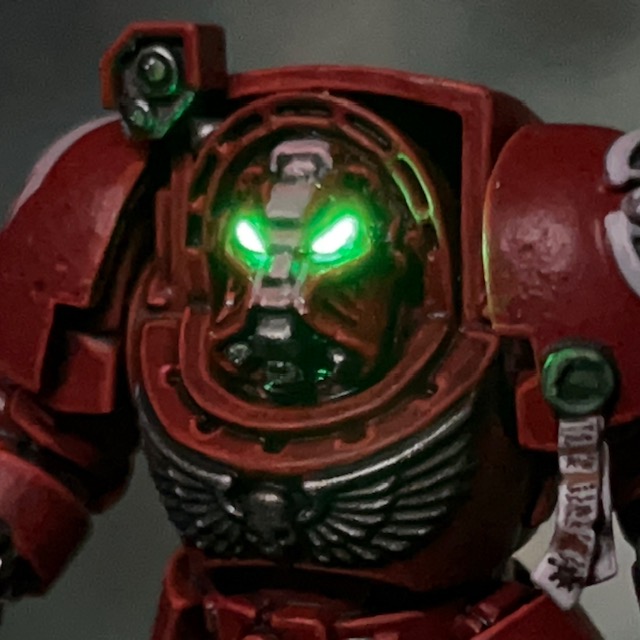
To make the LED effects, from left to right in the image above, I used the techniques detailed in my LED Muzzle Flare tutorial, Simple LED Muzzle Flare tutorial, and LED Eye Lens tutorial, respectively. The ‘dead’ Silver Star has no LEDs – his armour systems have powered down!

Painting

The basics of the scheme are armour as white as bone, as green as the ocean, as rose as coral; and with gold accents.

Apologist on the Silver Stars

Apologist has published a couple of guides to painting the Silver Stars on his website, including an article on their paint scheme and another on insignia and heraldry. Apologist and I have slightly different painting styles, so I used his guides as a starting point for my own, slightly tweaked interpretation which I have shared below.

All paints listed are from the Citadel range, unless stated otherwise. The miniatures were primed with Halfords Primer Grey, which is a good quality and cost effective undercoat spray for those based in the UK.

  • White Armour
  • Ulthuan Grey basecoat (two thin coats)
  • Apothecary White Contrast shade
  • Ulthuan Grey layer (one thin coat, but I didn’t worry about getting a super smooth finish, as it added to the battle worn look)
  • Corax White highlight
  • Skull White fine highlight
  • Blue Armour
  • Sotek Green
  • Talassar Blue Contrast shade
  • 50:50 Sotek Green:Corax White hightlight
  • Gold Trim
  • Retributor Armour
  • Reikland Fleshshade shade
  • Druchii Violet shade (applied to deepest recesses while previous shade is still wet)
  • Runefang Steel highlight
  • Rose Helmet Crest
  • Screamer Pink basecoat
  • Nuln Oil shade
  • Screamer Pink layer
  • 50:50 Scream Pink:Corax White highlight
  • Rose Shoulder Banding
  • Screamer Pink layer
  • Silver Equipment
  • Black Templar Contrast basecoat
  • Leadbelcher layer
  • Nuln Oil shade
  • Runefang Steel highlight
  • Rubber Undersuit
  • Black Templar Contrast basecoat
  • Dark Leather
  • Dryad Bark basecoat
  • Nuln Oil shade
  • Gothor Brown highlight
  • Karak Stone fine highlight
  • Chapter Insignia & Squad Markings
  • Corax White layer

Silver Stars bear what appear to be Legion symbols both on their left pauldron (as typical for Space Marines), and on the centre of their torso. The marking is a white, four-pointed star made up of four small, unconnected right-angled triangles. They typically appears to be rotating anti-clockwise on the pauldron and clockwise on the torso (both suggesting forward movement); but occasionally run in the opposite direction, which indicates a form of intra-Legion specialism or honorific termed Manawa.

Whatever the direction of travel, and wherever it appears, the Silver Star symbol is near-universally rendered in white (that is, heraldic silver). 

Apologist on the Silver Stars

The chapter insignia and squad markings were painted freehand with a slightly thinned down Corax White. Once you’ve practised it a few times, it’s a fairly easy chapter symbol to freehand compared to many others. If this article has inspired you to have a go at painting your own Silver Stars, then I would definitely recommend reading Apologist’s article on insignia and heraldry.

So, there we have it, the mysterious Silver Stars! Are they saviours of mankind or an existential threat to the Imperium? That’s a question I will leave to the reader. In any case, these miniatures were great fun to make and paint, a real palate cleanser from the Flesh Eaters. In fact, now their job on the display board is done, I thought it might be fun to expand these three into a six-man Intercessor squad for games of Kill Team. Otherwise it seems a shame for them to languish in a box somewhere not getting used. So keep an eye out for a few more Silver Stars over the coming months – reporting all sightings to the proper authorities in you sector, of course! And if this has piqued your interest in this enigmatic chapter, then I encourage you to check out Apologist’s excellent blog on the War of the False Primarch project.

Thanks very much for reading today’s post, and please remember if you’re on InstagramThreadsTwitter/XBluesky or Mastodon you can also find me posting my work there.

“Interregnum at Interlude Quay”, Flesh Eaters ‘Armies on Parade’ 2023

“The War of the False Primarch was a dark and bloody episode of the Imperium’s history, now largely lost to myth and purged from all records, that plunged the Segmentum Pacificus into anarchy from 780.M33 to 860.M33. The conflict was finally ended when the High Lords of Terra convened the Pentarchy of Blood and tasked five loyal Chapters to destroy eleven others that had been declared Traitoris Perdita for their actions during the war.”

IMPERIAL ARMOUR VOLUME TWO – SECOND EDITION PG. 17

Concept

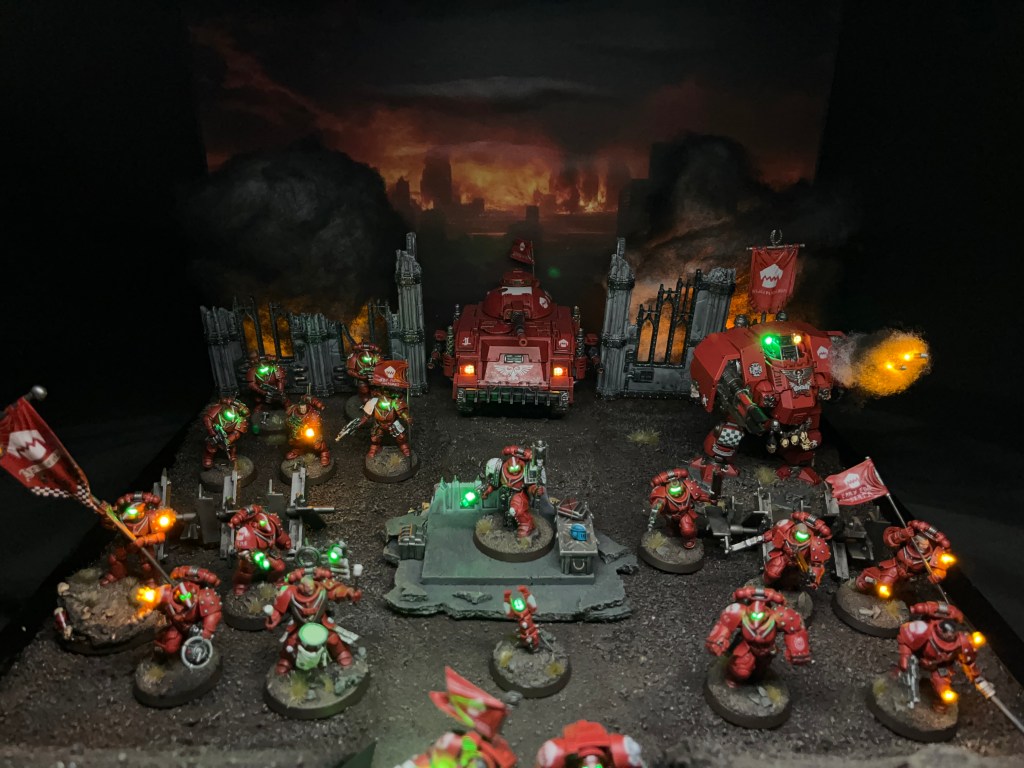
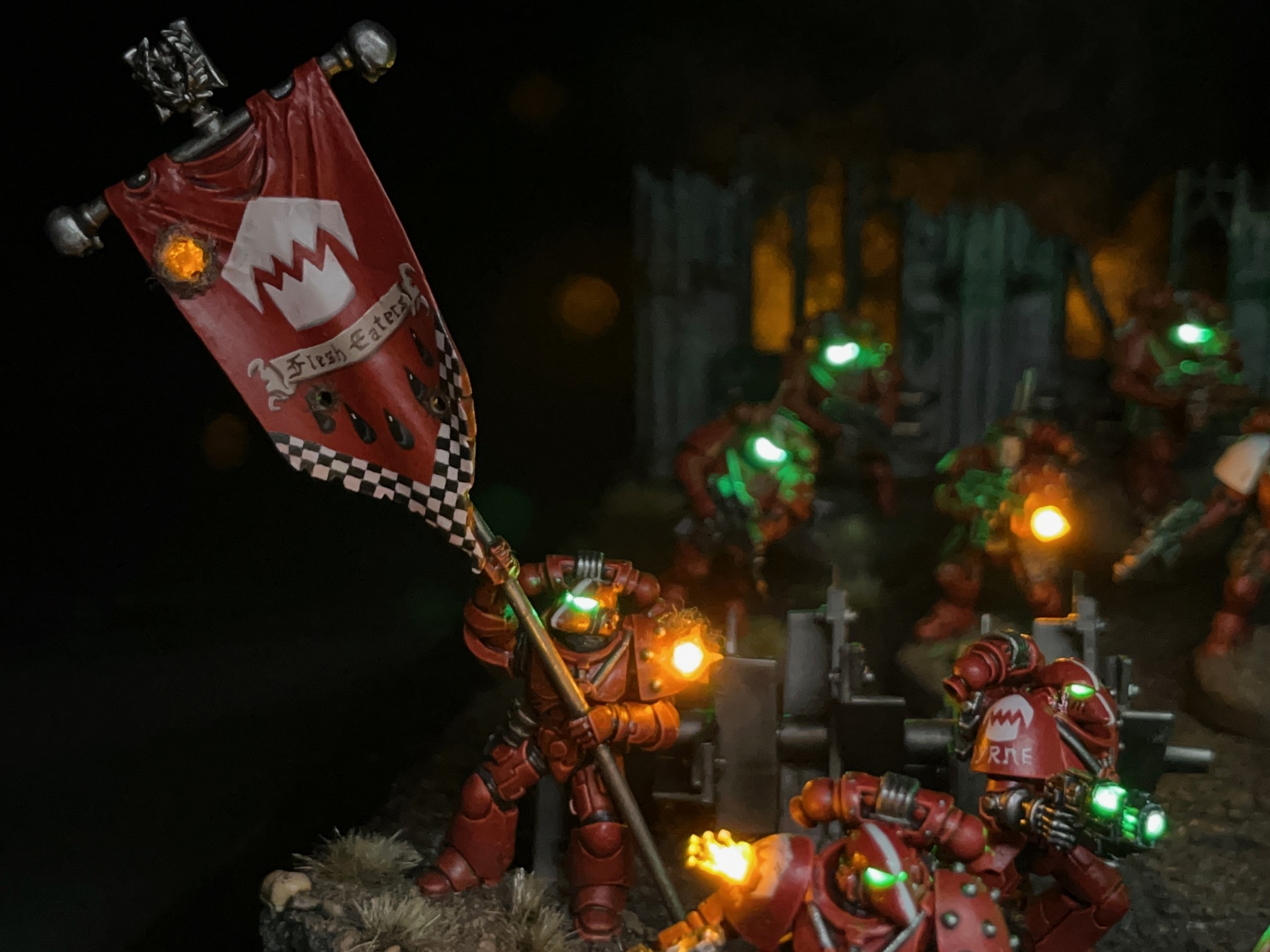
The Flesh Eaters space marine chapter, a key member of the Pentarchy of Blood, bring the will of the High Lords to the Partisan naval base of Interlude Quay deep within Segmentum Pacificus. Following the trail of intelligence gained from civilians captured during the Pacification of Logan’s World, Brother-Chaplain Uriah Grimm sets the world of Interlude Quay aflame, disrupting Partisan supply lines. Amidst the chaos, elements of the Flesh Eaters first and third companies launch a strike against hidden bases belonging to the Silver Stars chapter. The hunt continues for the Abomination known as the “False Primarch”.

This year’s board is continuing the story from last year’s Armies on Parade contest entry, the Pacification of Logan’s World. The army has grown over the past year, so a larger board would be required. I quickly arrived at the concept of an attack on a hidden base or bunker complex. This idea would allow me to showcase detailed close-up action and also a sweeping battlefield.

Designing & Building the Board

The board was built from a large picture frame, giving it a pre-made border. The middle of the frame was filled with layers of foam board, which are cut into the shape of the hill at the rear, and the earthworks disguising the hidden bunker at the front. The foam boards were then textured with a mix of sand and Vallejo model texture paste.

The various structures on the board are mostly made from Games Workshop kits. The ruins at the rear of the board are made from the Sector Imperialis Ruins kit. The tank traps are from a very old Games Workshop battlefield scenery kit. The partially ruined defence line in the middle of the board is made from part of the discontinued Wall of Martyrs kit and layers of cork board.

The fires burning in the ruins are made from flickering LED tealights covered in soft toy stuffing. The stuffing was given a spray of Chaos Black to make the smoke darker. The burning ruins were intended to both hide the transition to the background image and sell the idea of the burning city. I wanted to give the impression that the Flesh Eaters were pouring out of the city to overwhelm the hidden base of their enemies.

The background image of the burning city skyline was a royalty-free image taken from Freepik.com, printed out A3 size, and then glued to a sheet of foam board. Unfortunately, now that I’ve looked more closely, I’ve realised this was an AI generated artwork, which I don’t support on principle. Next year I think I’ll investigate painting the background myself.

The Silver Stars & The Hidden Base

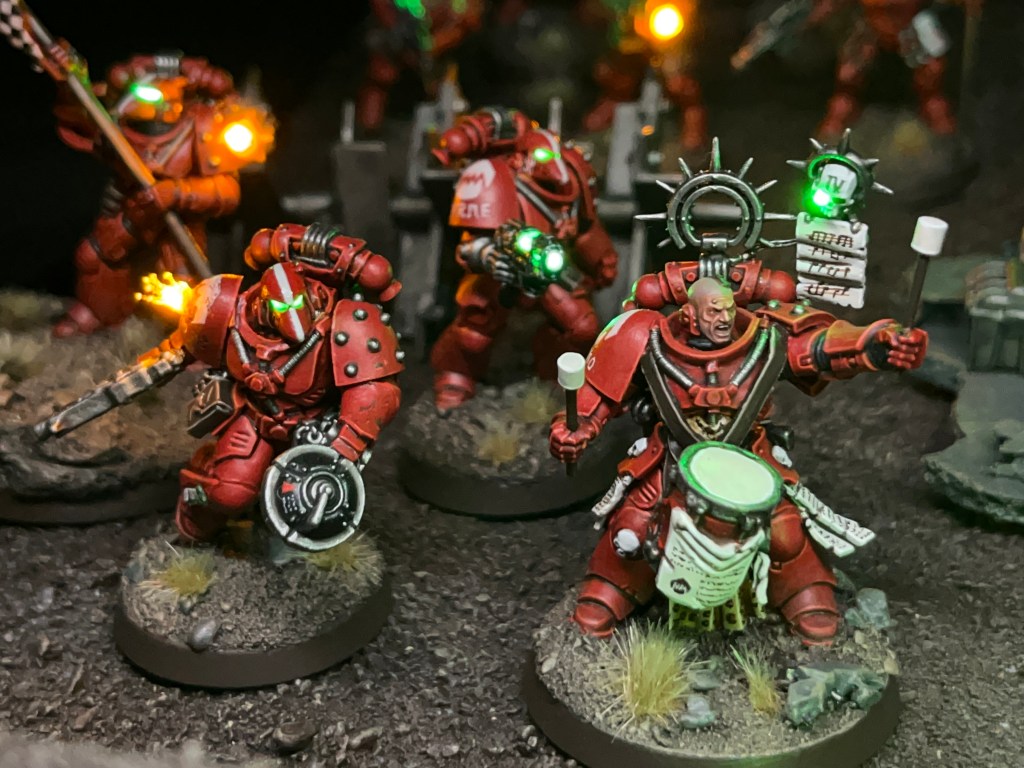
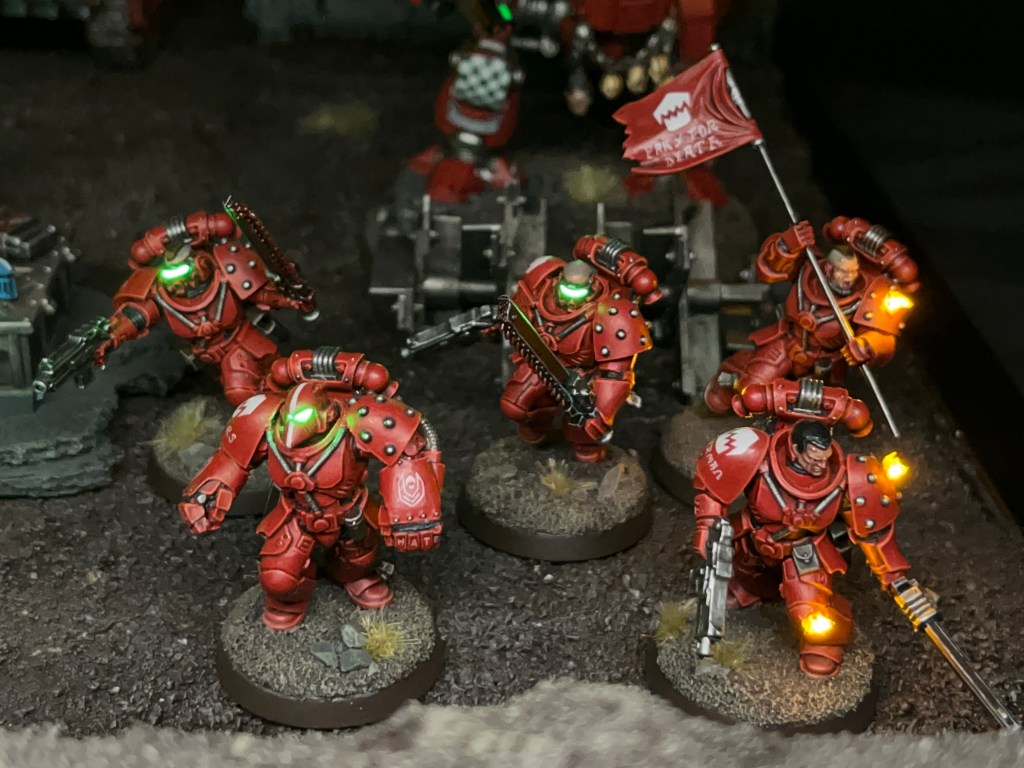
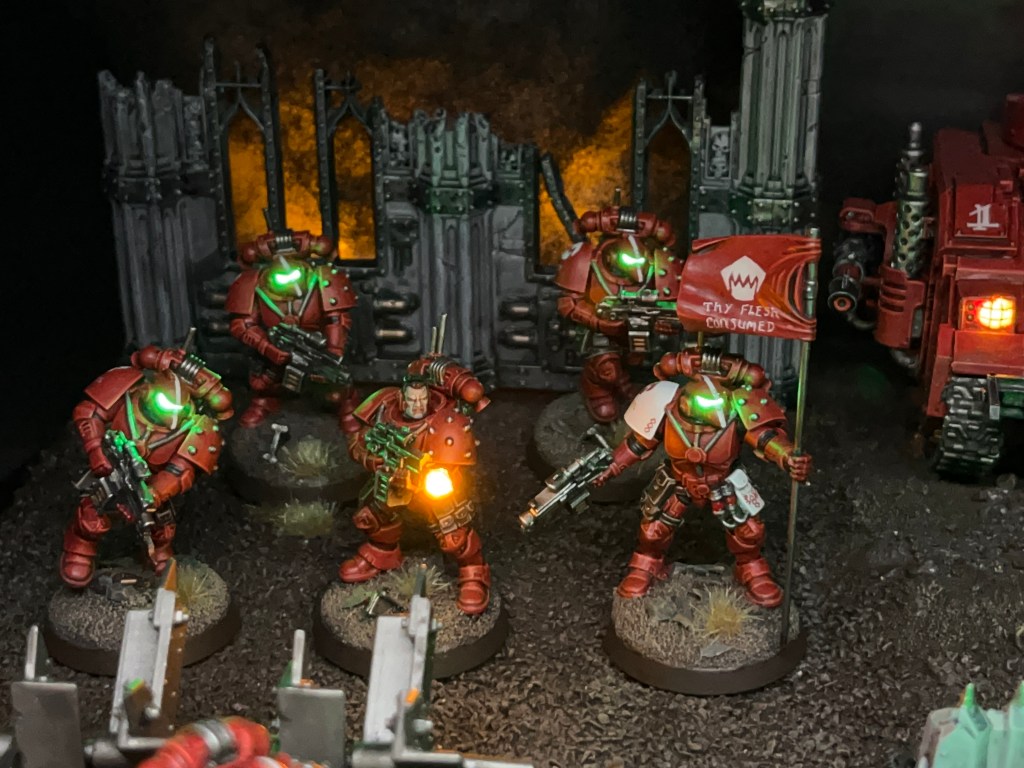
I knew from early in the planning that I wanted some antagonist miniatures on the board for the Flesh Eaters to fight against. It gives a sense of life to the battle scene and helps give context to the muzzle flares and bullet impact effects.

The Silver Stars chapter are a creation of my good friend and regular opponent, Apologist. They are the instigators of the War of the False Primarch and the leaders of the Partisan faction. I have quite a lot to say about modelling and painting the Silver Stars, so I’m going to devote an entire separate article to them soon.

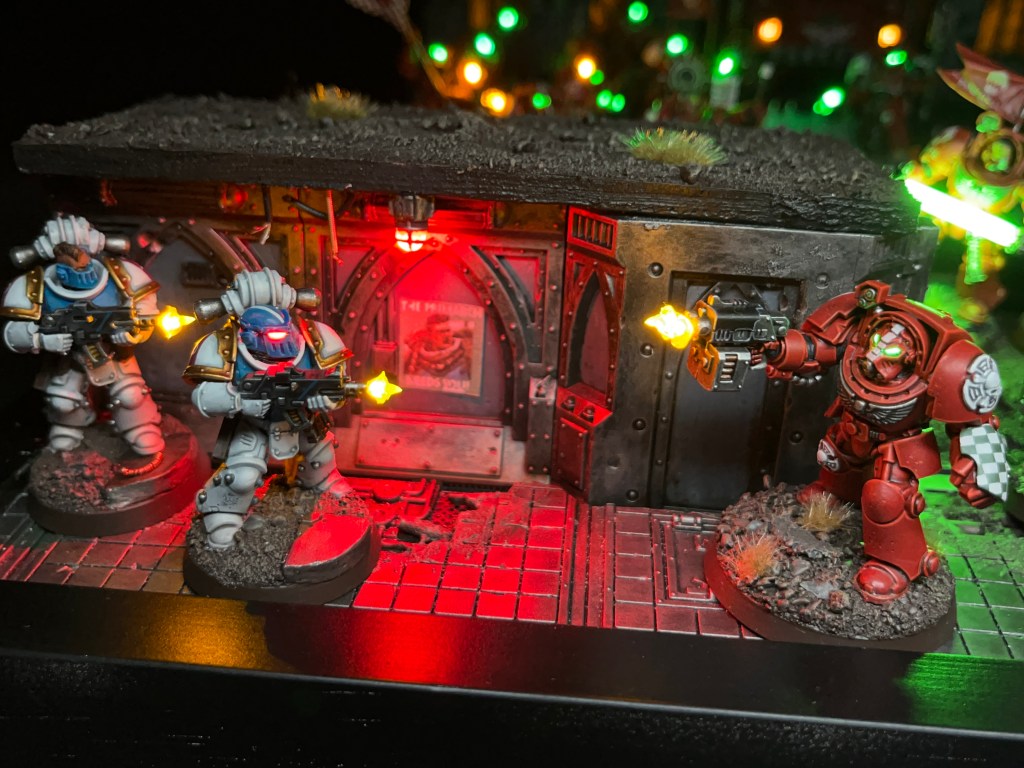
Going back to the board and the hidden bunker, he internal walls were made from the Zone Mortalis Columns and Walls kit. The lighting is simply two red LEDs connected to resistors, a switch and a battery pack underneath the bunker floor. I bulked-up the shape of the LEDs with acrylic gel and then painted a silver frame around them to give a utilitarian look. The propaganda posters were designed digitally and printed on paper, which I then stuck to the walls using Pritt stick.

Conclusion

There we have it, another ‘Armies on Parade’ project concluded! If you were following this project via any of my social media accounts, then you may have seen that it all came together very hurriedly in the end. In fact, I only finished painting it on the evening of the deadline, and only finished photography and sent the submission email with ten minutes to spare! Despite all this, I’m pleased with the outcome, especially the hidden bunker elements. I’ll start earlier next year, although I always say that…

Given a bit more time, would I have done anything differently? In hindsight, the bunker foreground could have been lower, and the rear of the battlefield could have been higher. This would have allowed a better lower angle for photography to capture a sweeping panorama without the bunker walls blocking the miniatures behind them. I would also have liked to have had some Partisan Imperial Guard fighting alongside the Silver Stars, if I’d had the time.

What’s Next?

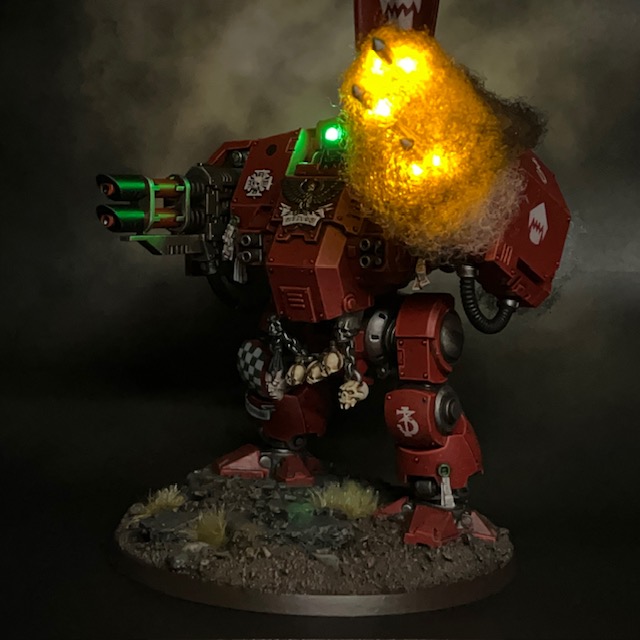
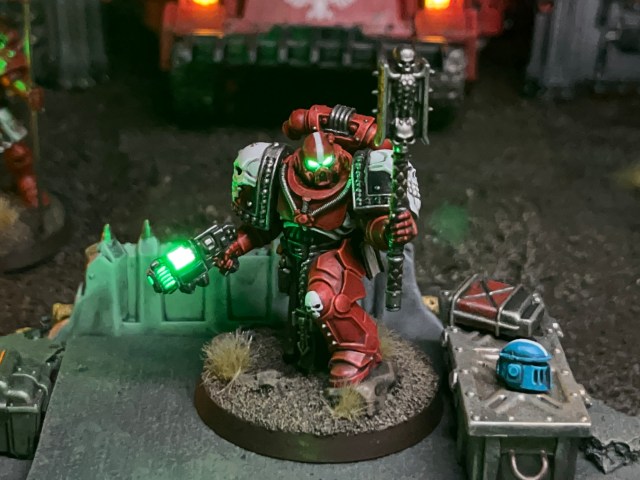
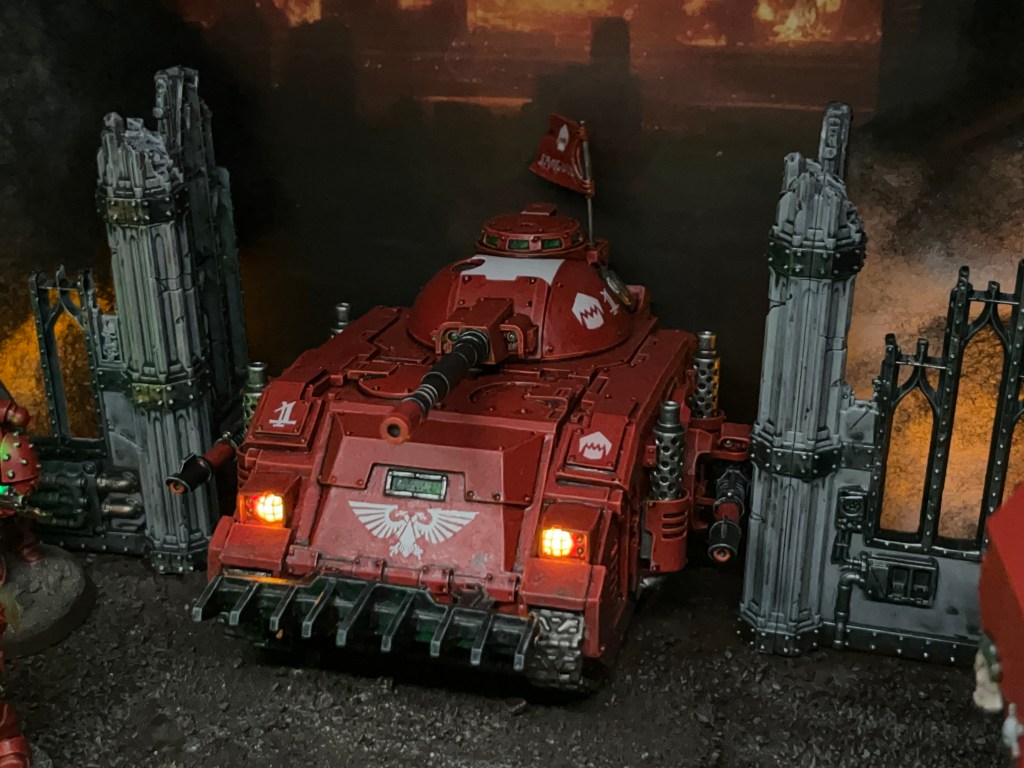
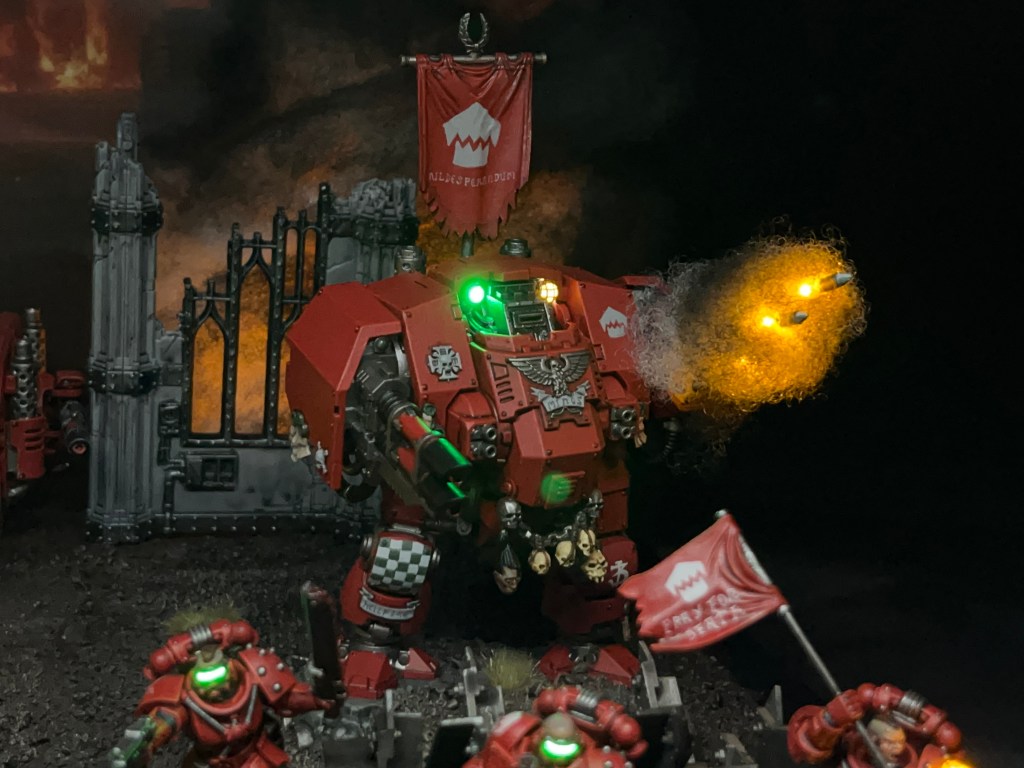
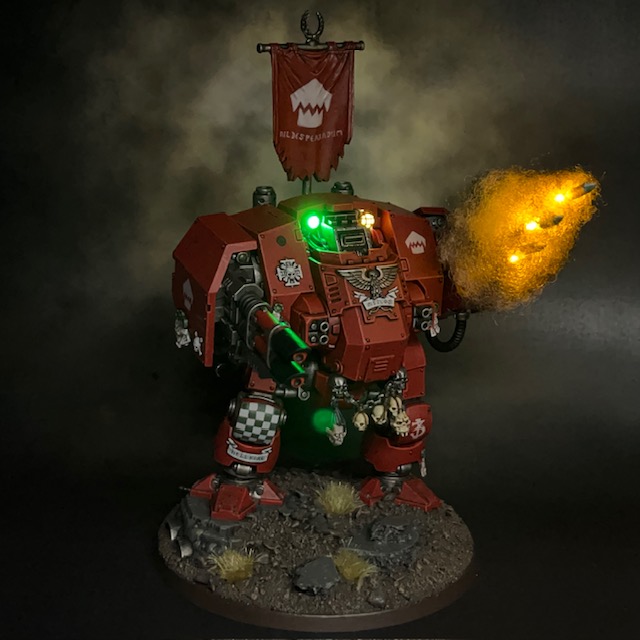
What’s next for the Flesh Eaters? This certainly isn’t the end of the project. You may have noticed a Dreadnought in the pictures which I haven’t shown elsewhere yet, so he will be getting his own photography session and blog article soon. I also have more Assault Intercessors to finish, plus a Terminator Librarian, Terminator Captain and a rather large tank! I’m already thinking about what next year’s Armies on Parade board theme will be, but I think it’s safe to say it will be a continuation of Brother-Chaplain Uriah Grimm’s adventures in the War of The False Primarch.

That’s all for today, I hope you’ve enjoyed this year’s Armies on Parade project. Thanks very much for reading today’s post, and please remember if you’re on InstagramThreadsTwitter/XBluesky or Mastodon you can also find me posting my work there.

Kommissar Yarrork, Blood Axe Warboss

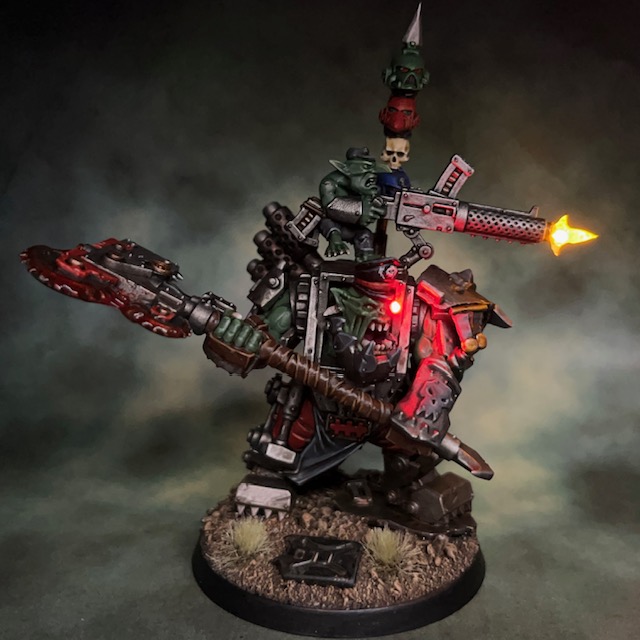
What beats a Kommissar like ol’ Yarrick? An even BIGGA Kommissar! Stands to reason, don’t it?

Armageddon Ork wisdom

I’m taking a slight detour this week to a side project, a brand new Ork Warboss! I have a Blood Axe Ork army that has languished without updates (other than the Kommandos) for the past few editions of Warhammer 40K. But I’m going to blow the dust off them to play a game with Apologist this weekend, as part of his Ashes of Armageddon project. I’ve used my Orks in a lot of different narrative campaign settings over the years, and when I enter a new one, I like to make a new Warboss. I new warlord can often help an existing army feel fresh and new.

Modelling

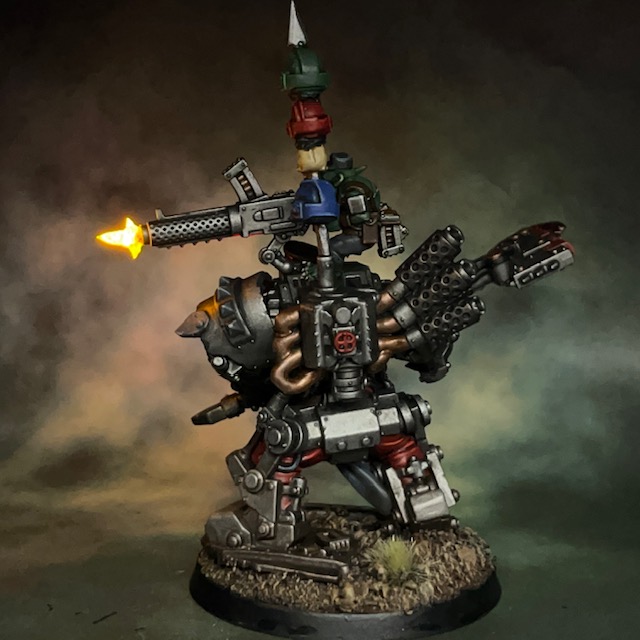
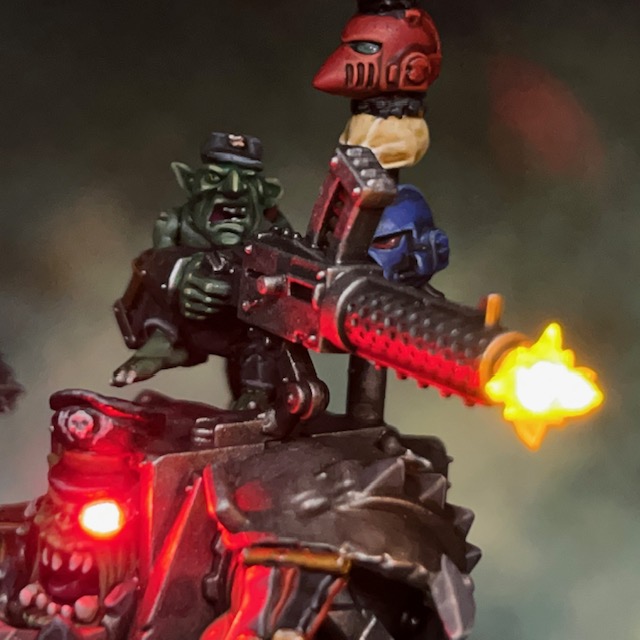
When I picked up the Ork Warboss in Mega Armour, the LED potential was clear. I knew I had to get that big shoota firing, and I had to do a cool bionic eye to go with the “Yarrork” theme I had planned. The LED techniques used on this model can be found in my LED Muzzle Flare Tutorial. The only difference is for the bionic eye I used a single Red 0805 Chip LED (3V) and 100 ohm resistor from Small Scale Lights, rather than the TruOpto 1.8mm LED mentioned in the tutorial. This LED is sculpted into a bionic eye mounted on the Warboss’s face, rather than being embedded in a resin head.

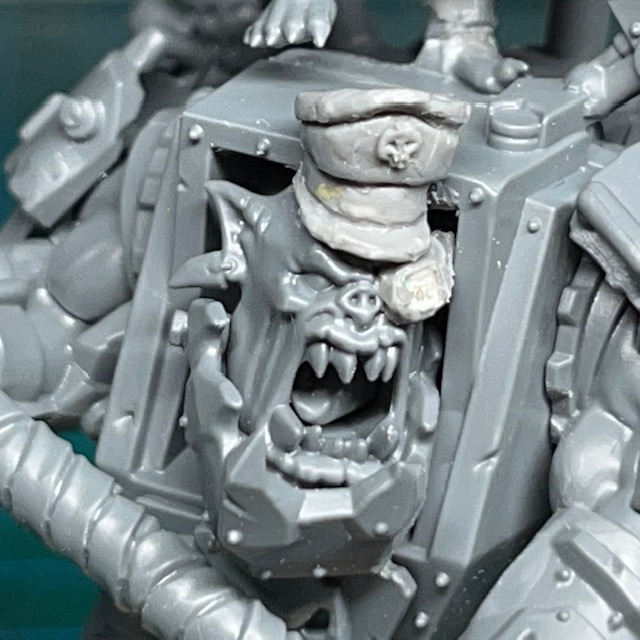
The Blood Axe officers cap was sculpted from ProCreate modelling putty. When sculpting something like this, I find it’s best to work one layer at a time, allowing the first layer to dry before adding the next. I started by sculpting the peak/visor directly onto the head of the miniature, followed by the section that would become the red band. Next, I added the main bulk of the cap, and then I added the top layer that would form the rim. Finally, I sculpted the skull insignia. This is quite time consuming, but it’s probably easier and produces better results than trying to sculpt the whole thing in one go.

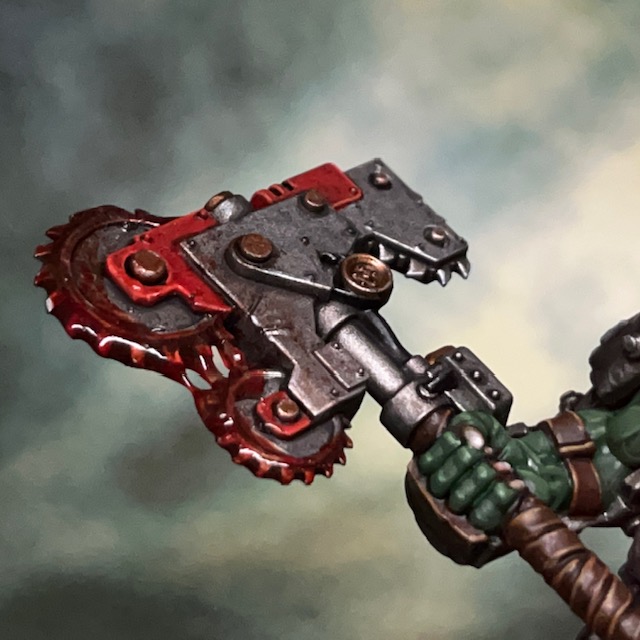
The blood on the axe (geddit?) is created from Araldite two-part epoxy resin. This might not actually be the best material for this, but it’s the only type of epoxy I had to hand. I mixed it up and allowed it to cure for a few minutes until it was partially cured and tacky. Then I used a spare piece of plastic rod to apply it to the blades, being sure to string it between the two saws. Once the epoxy had dried, I applied one thin coat of Citadel Blood for the Blood God technical paint. Both the epoxy and this paint are semi-transparent, which creates a very effective liquid gore effect.

The so-called “Kommissar Yarrork” was most likely born from an Orky desire to emulate an intimidating opponent like Commissar Yarrick, and the typical Blood Axe need to ape the most effective parts of the Human military machine. This hulking brute formed part of Ghazghkull Thraka’s “Counsill of Clan-bosses”. It is unknown whether he was already part of the council when he assumed the Yarrork identity, or whether this persona resulted in his elevation. In any case, it was all for nought, as there are no confirmed recorded instances of the greenskin imposter getting within a hundred miles of the honourable Commissar Yarrick during the war.

Extract from ‘The Second War for Armageddon: A Final Definitive History’ by Scribe Primus Howtopher Buxcraft

Painting

I wanted to keep the mega armour fairly neutral, so I settled for a Leadbelcher and Nuln Oil scheme. This utilitarian scheme is in keeping with the ‘Commissar’ and Blood Axe theme of the model, and helps to frame the points of interest like the face, gun grot and axe head. This is also why the armour glyphs are grey, to provide a little bit of visual interest but not draw the eye away too much. For all other elements, such as the skin, leather and red trousers, I followed the paint recipes detailed in this post. The only exception was the grot skin, which I wanted to appear as a slightly different tone from the boss. So I substituted Straken Green for Warboss Green for and Nurgling Green for Skarsnik Green in my normal Ork Flesh recipe.

It was tempting to sculpt Shootit the grot some fancy clothes since he is obviously the boss’s favourite, but in the end, I decided to keep him fairly drab and utilitarian, so that he didn’t draw focus. I did give him a gold cap badge though, just to show he is a bit more important than the average grot.

The helmets on the boss pole are painted in the colours of the three Space Marine chapters that were cannonically involved in the Second War of Armageddon: the Blood Angels, Ultramarines and Salamanders. I stuck to canonical MkVI and MkVII helmets, which are probably the most appropriate for the era.

That’s all for today, I hope you’ve enjoyed this detour to Armageddon. Thanks very much for reading today’s post, and please remember you can also follow my work on social media at InstagramThreadsTwitter/XBluesky and Mastodon. And of course don’t forget to check out Apologist’s Ashes of Armageddon project blog!

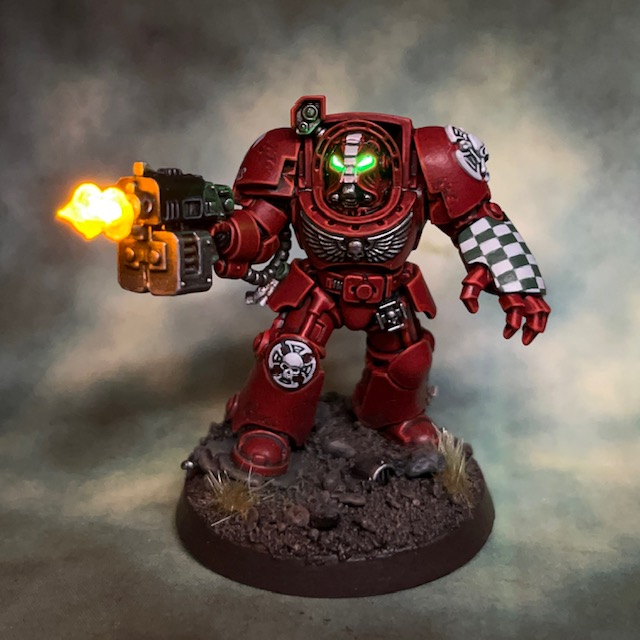
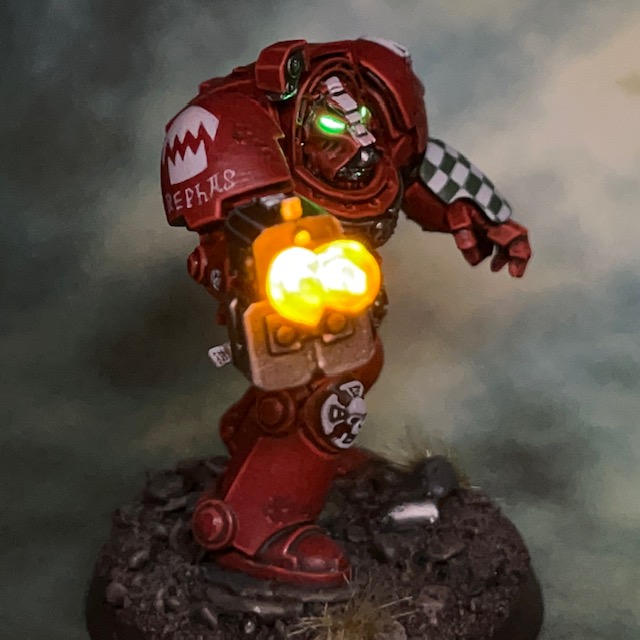
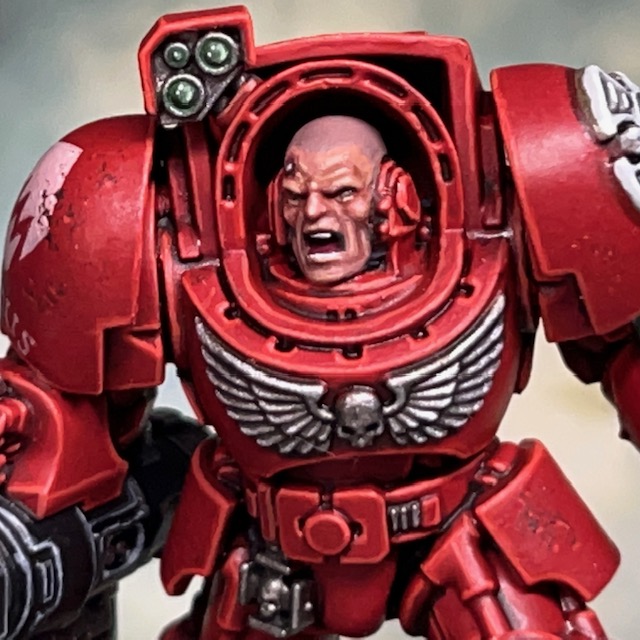
Flesh Eaters Terminator Squad ‘Naismith’

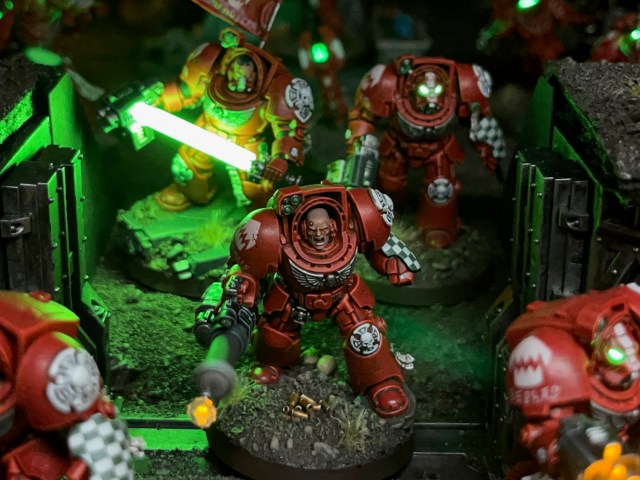
Terminator Squad ‘Naismith’ is complete, just in time for Armies on Parade 2023. So now is a good chance for some group pictures and a look back at the design and development of this unit.

Design Philosophy

I’m very pleased with how this unit turned out, especially now I’ve seen all of the models together. I wanted to continue the ‘Rogue Trader’ era aesthetic and the ‘War of the False Primarch’ army theme of my Flesh Eaters with this unit. Thankfully the Leviathan Terminators are still very close in aesthetics to the original RT09 Terminator squad, so I didn’t feel the need to convert how they looked. With a little retro iconography, they fit right in with the look of the army.

If you’re seeing my Flesh Eaters space marine project for the first time and you’re interested in how the LED effects are achieved, then you can find detailed explanations on my LED Miniature Tutorials page. My painting recipes for Flesh Eaters armour, freehand checks, and Terminator iconography can also be found in previous posts.

Squad Members

Brother-Sergeant Naismith is the leader of the terminator squad. He likes to look his enemies in the eye as he cuts them down with his power sword. You can read the full article about this model here.

Brother Lazarus is widely believed to be one of the best shots in the 1st company. Whether serving in the sternguard or the terminators, his marksmanship is beyond reproach. You can read the full article about this model here.
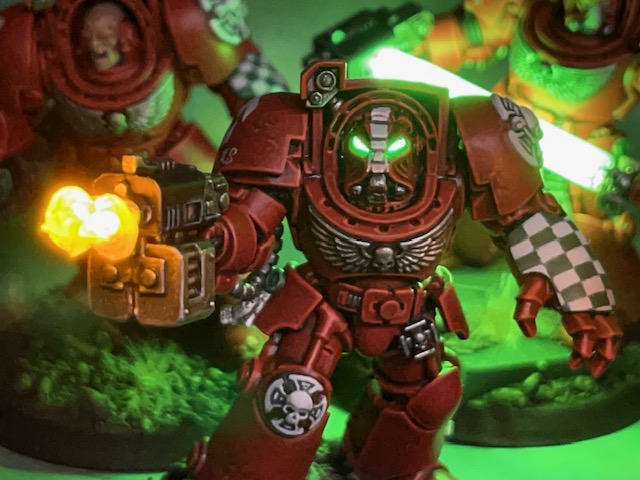
Brother Furian has an unerring ability to identify the weak points of any obstacle, whether that is an armoured bulkhead, xenos vehicle or fleshy Partisan during the War of the False Primarch. You can read the full article about this model here.
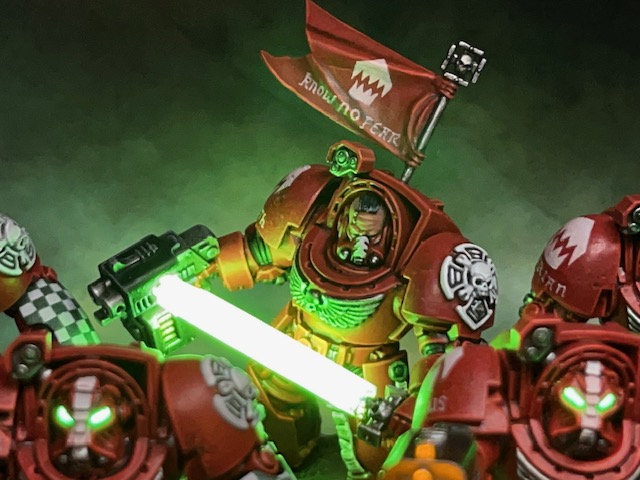
Brother Rephas is a zealot of the High Lords cause. He is equally happy blasting Partisans apart at range or pulling them to pieces in close combat. You can read the full article about this model here.
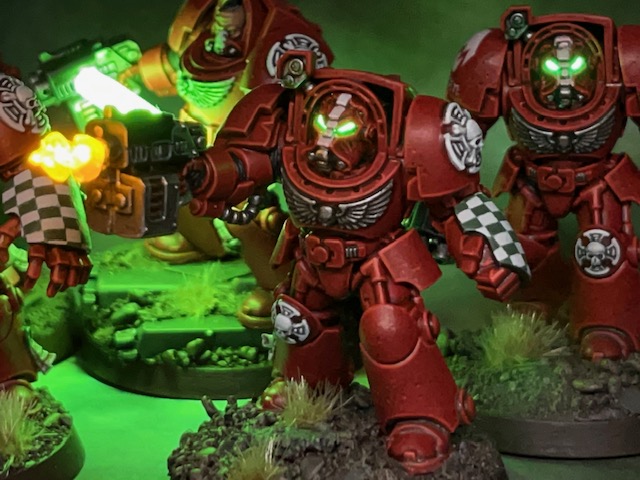
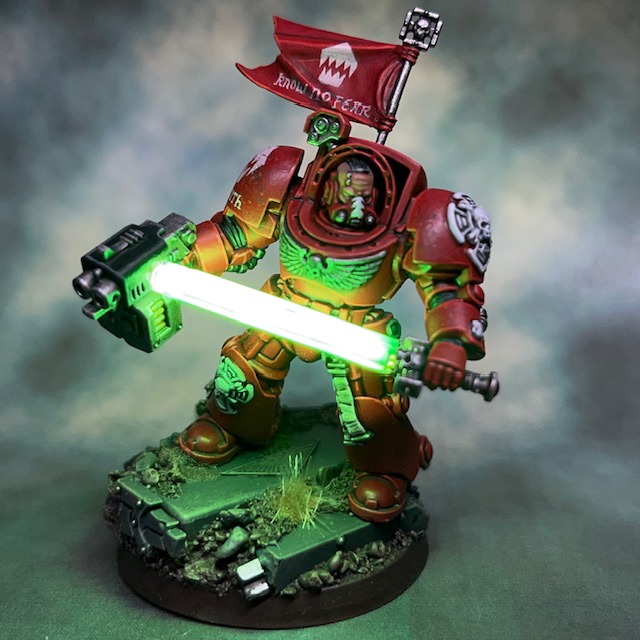
Brother Erasmus is known for lacking a sense of humour. The task of liaising with the machine spirit of his assault cannon to monitor ammunition levels and barrel wear takes his full concentration. You can read the full article about this model here.

Last, and probably least, is the squad teleport homer with flashing beacon! You can read the full article about this model here.

Now the squad is complete I have to ask myself, should I have done anything different? If I were to go back and make any changes, it would be to add small variable resistors under the bases of the sergeant to tweak the power sword brightness, and the assault cannon to tweak the motor rotation speed. I might also have made the assault cannon muzzle flare slightly larger. Other than that, I’m extremely satisfied with how this squad turned out!

I hope you’ve enjoyed following the progress of this unit over the last couple of months. That’s all for today, but I’ll be back again soon for more Flesh Eaters, plus a few side projects.  In the meantime, thanks very much for reading today’s post, and please don’t forget you can also follow my work on social media at InstagramThreadsTwitter/XBluesky and Mastodon.

Brother Naismith, Flesh Eaters Terminator Sergeant

Heresy is like a sword. If you don’t cut it then it will cut you.

Brother-Sergeant Naismith

I’m back with the final model in the Warhammer 40,000 ‘Leviathan’ Terminator squad – Brother-Sergeant Naismith, a Flesh Eaters Terminator with filament LED power sword! This model took quite a bit of work as it was my first attempt at a completely new power sword technique.

Modelling

The best way to make an LED power sword is something that has been troubling me since I first started putting LEDs into miniatures almost ten years ago. To my mind, the biggest issue is achieving an evenly illuminated blade. I know many of my fellow miniature LED enthusiasts like to put the LED in the hilt of the sword, facing upwards into a transparent blade to achieve power sword or lightsabre effects. I mean absolutely no disrespect to any of them as it’s a great technique that takes a lot of skill to achieve! But the drawback of this technique that I personally don’t like is that the sword blade appears brighter near the hilt and dimmer at the tip. This effect can often appear dim in bright ambient light.

So, for many years I’ve been trying to figure out a convincing and reliable way to evenly illuminate the entire blade. In the meantime, I did come up with the solution of using millimetre-sized chip LEDs embedded in the blade to simulate the power field generators, which you can read about in my LED Power Weapon Tutorial. However, I think I may have finally found a better solution with filament LEDs.

Filament LEDs are long and thin with a single connection at either end. I’ve used them before on other projects, most notably “Burn Traitor!”. These types of LEDs are often used in lightbulbs or similar applications and are available in a variety of colours and voltages. I get mine from a UK seller on eBay.  The type used here was a 38mm 12V ‘yellow-green’ LED. I went with 12V to ensure plenty of brightness, but this meant having to switch to a single 12V MN21 battery rather than trying to fit four of my normal 3V CR2032 batteries in the base, which wouldn’t have been physically possible.

As I’ve said before, if you are attempting this yourself then please remember filament LEDs are extremely fragile!  They are built around a thin strip of plastic that holds an array of sub-millimetre LEDs. This strip of plastic cannot take any real amount of bending or pressure and will snap at the least provocation. If you are using them in a project, I’d strongly recommend buying twice as many as you need, just in case of accidents.

The circuit is extremely simple. One end of the filament LED is hidden in the hilt, the other is concealed in the storm bolter. A wire runs down through each arm to connect to the battery holder and switch in the base. You can see the battery holder in the picture above – it’s the black rectangle in the base. Because this is a lot larger than my normal battery holders, it made the base quite tall. I decided to turn this problem into a feature and make it look like the sergeant was striding down some steps as he prepares to swing his sword. Hopefully this adds to the dynamism of his pose.

To conceal the filament and give it a sword shape, I covered it with thin strips of plastic. The filament is so bright that it shines through the plastic, which also diffuses the light in a pleasing way. I then gave the sword blade three or four thin glazes of Citadel Hexwraith Flame technical paint to make the blade look interesting if the LED was switched off. After the above pictures were taken, I decided I wasn’t happy with the tip of the blade and used a scalpel to carefully shave it into a more pointed end. Hopefully in the illuminated pictures it looks like the tip of the sword is just held near the storm bolter, rather than being driven into it!

This model was something of an experiment and making it was mostly about teaching myself the technique, so I haven’t put together a full tutorial yet. I do plan to use this method again for other models though, so next time I will take some step-by-step photos.

I chose to use the unhelmeted head for two reasons. Firstly, it meant I didn’t have to worry about illuminating the helmet eye lenses while working with a different battery type. Secondly, I knew a bare head would look more dramatic when underlit by the blade.

The other thing I should mention about this model is the banner. All the units in this army are carrying a flag, and I wanted the Terminators to have one too. But it seemed a waste to dedicate a Terminator to holding a flagpole in their power fist, so I decided to add the flag as a back banner to the sergeant. But rather than the traditional hanging back banner shape, I kept the flag design used by the other units, for consistency.

Painting

As with the rest of the Terminator squad, I painted Brother-Sergeant Naismith using my normal Flesh Eaters armour and Terminator iconography recipes. As mentioned above, the power sword blade was given three or four thin glazes of Citadel Hexwraith Flame technical paint. LEDs aside, thin glazes of Hexwraith Flame over a white basecoat is a great way to produce a quick, cheap and cheerful powered blade effect.

For the banner slogan, I decided to keep it simple and go with ‘Know No Fear’. This is a classic Space Marine motto, and echoes the classic John Blanche Terminator artwork shown above. The Brother-Sergeant’s name is a nod to veteran Citadel miniature scultpor Bob Naismith, who I believe had a hand in the original Terminator prototype designs. I decided that Sergeant Goodwin would be too on the nose!

Now that I’ve finished the sergeant, that’s the entire Terminator squad complete! I’m sure I’ll be back again soon with some group pictures of the unit. Then of course it’s getting everything ready for Armies on Parade. In the meantime, thanks very much for reading today’s post, and please don’t forget you can also follow my work on social media at InstagramThreadsTwitter/X, Bluesky and Mastodon.