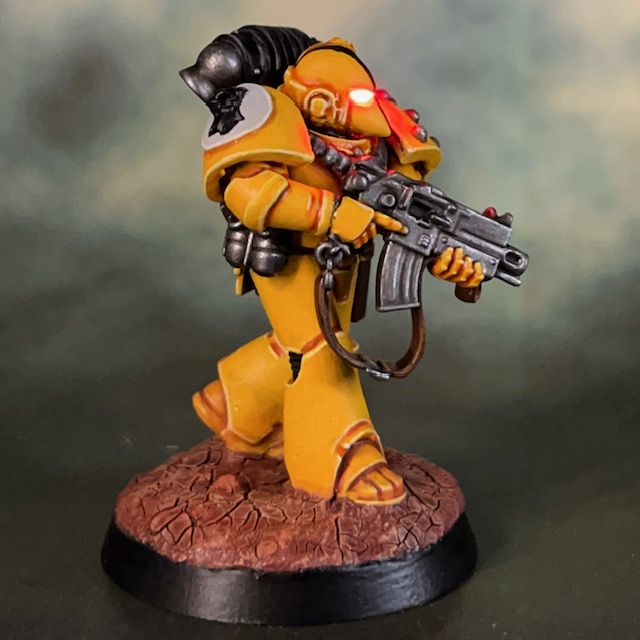
Ultramarine Veteran Sergeant, Golden Demon 2023

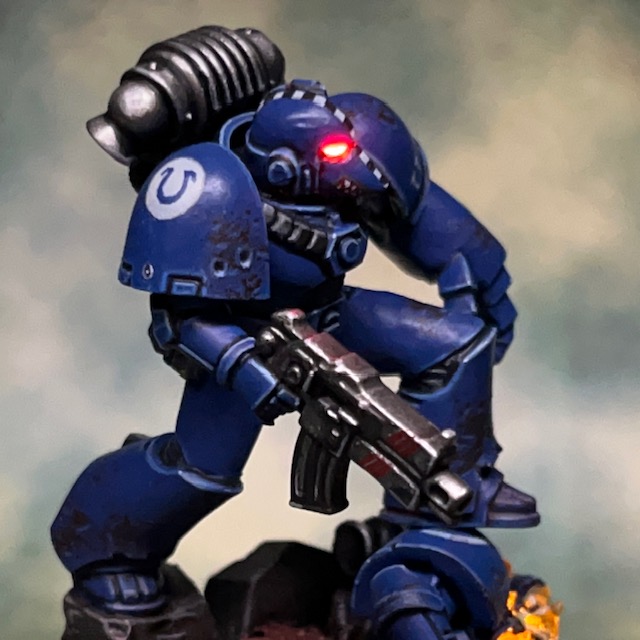
Allow me to present the Ultramarine Veteran Sergeant, my entry to the ‘Warhammer 40,000 Single Miniature’ category at this year’s Golden Demon. So now you know why I haven’t posted many new miniatures since the end of February!

The Road To Golden Demon

I originally started on a different model for the single miniature catergory, but after a few rounds of testing I couldn’t quite get the LED effects to look how I wanted, so I shelved that project and decided to have a re-think. Then, while browsing old rule books for inspiration, I rediscoved the classic art shown below, and was suddenly inspired!
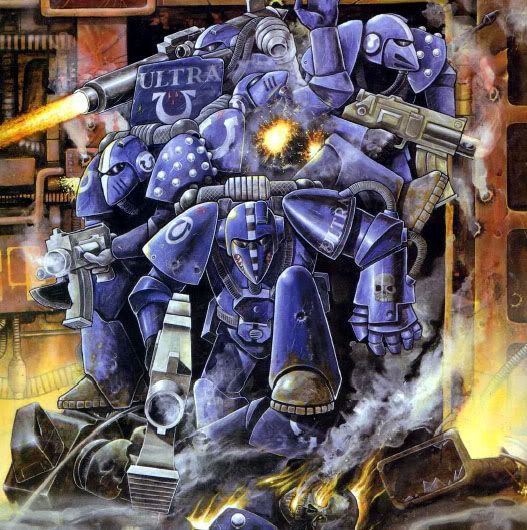
This art was reused a number of times, on everything from colour inserts, book covers, and even on the box art of the short-lived Ultramarines board game. I think it is one of the iconic pieces of Rogue Trader art, so I decided to give it a modern reimaging – with a little added LED magic of course. I did briefly consider planning the whole unit as a ‘Warhammer 40,000 Squad’ category entry, but decided that was a little ambitious in the time available. I decided to concentrate on the veteran sergeant at the front of the unit, as he is definitely the most recognisable part.

Painting & Modelling

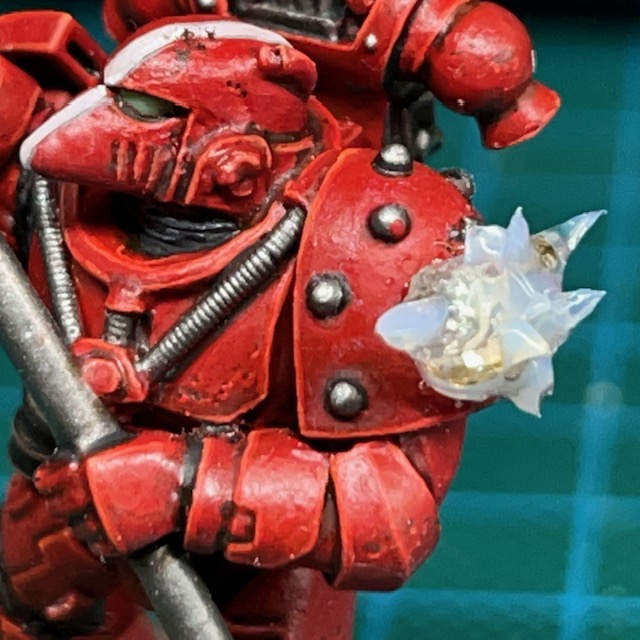
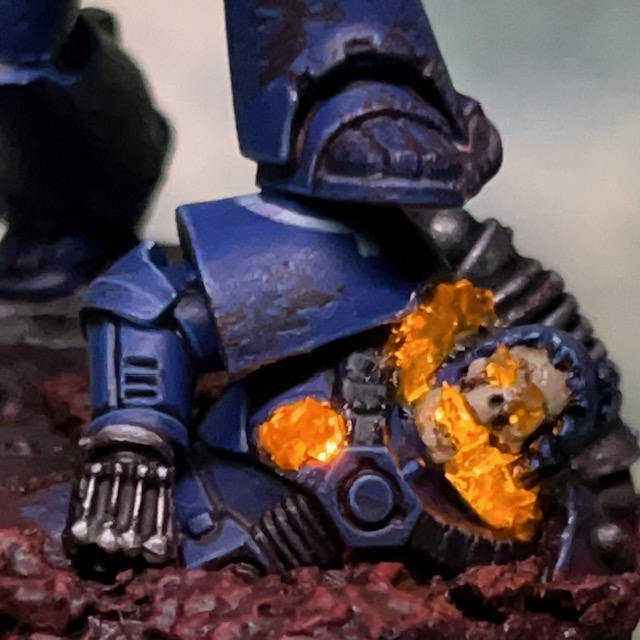
Both the sergeant and his fallen comrade are made almost exclusively from the Legion MkVI Tactical Squad kit, with a couple of minor exceptions. The power fist came from my bits box, and I think it’s from an older version of the Space Marine Tactical Squad sprue, and I chose it because it was a closer match to the art. The skull in the fallen marine came from the Citadel Skulls set. The LED helmet eye lenses are achieved using the technique described in my LED Eye Lens Tutorial. I did the same thing for the fire inside the casualty’s skull, only in this case I used an LED from a LED Tea Light to achieve that flickering fire effect. The flames themselves are sculpted from acrylic gel. Both LEDs are connected in parallel and operated by a single switch and coin cell battery. I’ve tested it, and fingers-crossed the battery will last for 48 hours in the Golden Demon cabinets!

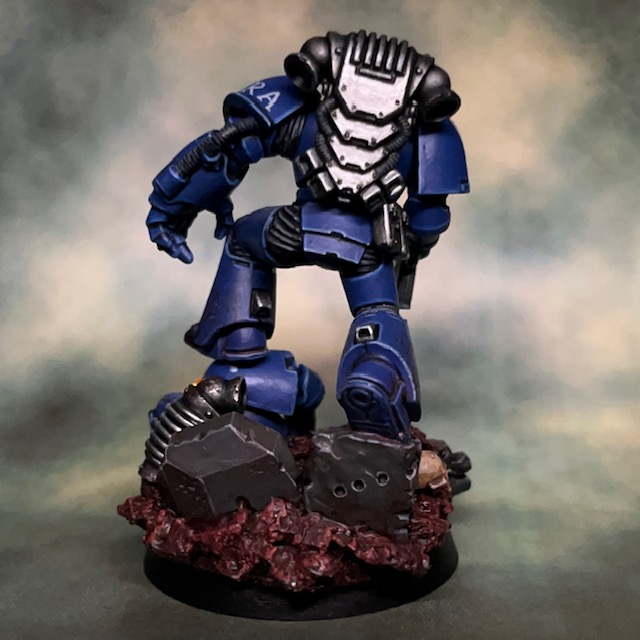
My recipes for the Ultramarines blue armour and the silver metallics are below, if anyone is interested. The whole model was undercoated Chaos Black.

  • Ultramarine Armour
  • Macragge Blue basecoat
  • 50:50 Kantor Blue:Abaddon Black shade
  • Altdorf Blue highlight
  • Calgar Blue fine highlight
  • Fenrisian Grey fine highlight on top edges and corners
  • Blue Horror dot highlight
  • Silver Metallics
  • Leadbelcher basecoat
  • Nuln Oil shade in deepest recesses
  • Gryph-Charger Grey shade
  • Ironbreaker specular highlight
  • Runefang Steel edge highlight
  • 60:40 Runefang Steel: White Scar edge highlight on sharp edges and corners

This model included quite a lot of freehand, much of which you can see above. My biggest tip for this type of freehand is to “sketch” the words or shapes with thinned Administratum Grey, and then go back and fill it in more firmly with Corax White. I try to avoid using White Scar, as it’s just to bright. I normally then finish off with a thin glaze of the base colour over the freehand – in this case that’s Macragge Blue. This helps to dull it down a bit and make the insignia look weather-worn and faded. As an aside, while studying the word ‘ULTRA’ on his shoulder, I noticed the font used in the artwork was Times New Roman! It’s good to see some things never change, even in the grim darkness of the far future!
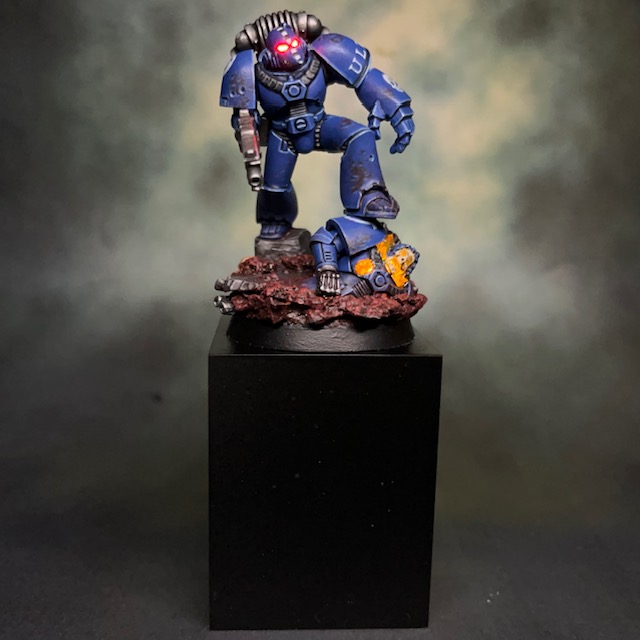
I think it’s also worth discussing the base. Not a lot of the ground is visible in the artwork, so I felt I had essentially free reign. I’ve always interpreted this picture as showing the Ultramarines breaching a wall or fortification, and I’ve tried to echo that feeling with the way the veteran sergeant is clambering over the fortifcations and even his fallen battle brother. There’s no time to commend his soul to the Emperor, the breach is not yet secured!

The ground in the artwork is a red-brown, and I decided to skew red. This was to enchance the “retro” nature of the model, and call back to some of the weird battlefields you saw in White Dwarf in the late 1980s, before everything became uniform green flock grass in the early 90s. Dark red is also quite an 80s colour by itself. This is also why I chose a square plinth for the model, rather than a round one, to further enhance that retro vibe. Now I think about it, I kind of wish I’d put the miniature on a square base!

  • Red Rock Base
  • 50:50 Rhinox Hide:Gal Vorbak Red basecoat
  • Seraphim Sepia shade
  • Gal Vorbak Red drybrush
  • Wazdakka Red drybrush
  • Wild Rider Red drybrush
  • Trollslayer Orange drybrush

That’s it for today, but I should mention that this is the first of two Golden Demon entries that I will be submitting this year, so there will be more from me again soon. As always, thanks very much for reading, and please don’t forget you can also follow my work on social media at TwitterMastodon and Instagram.

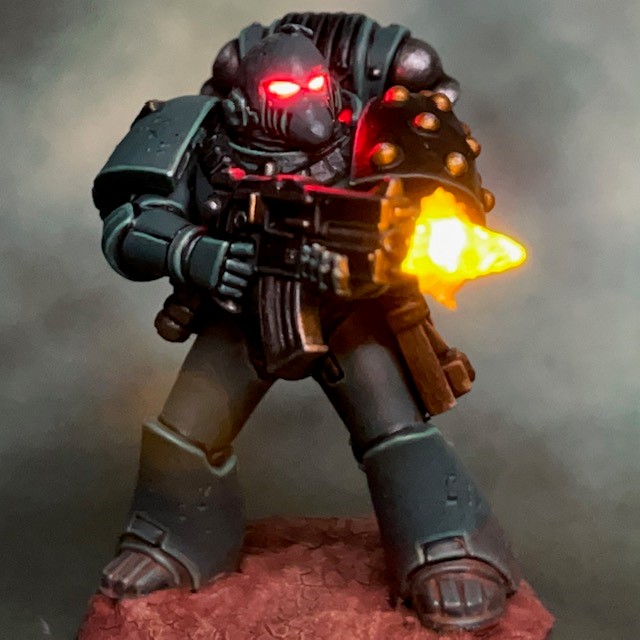
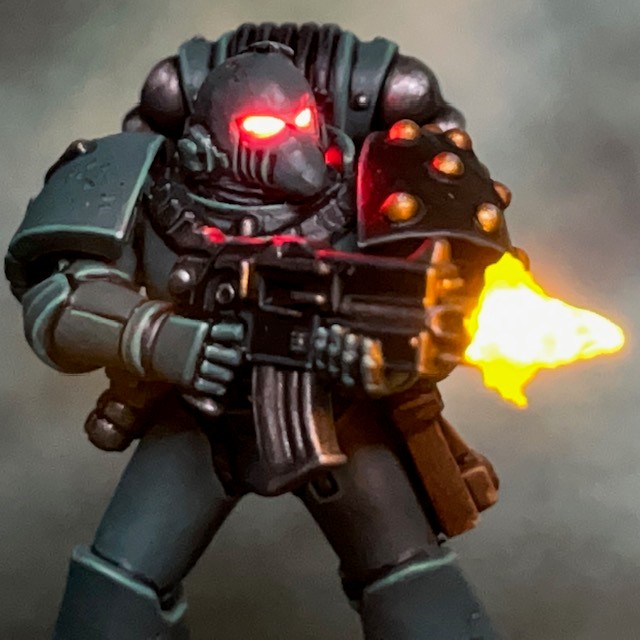
Brother Amset, Sons of Horus

Let the galaxy burn!

Warmaster Horus, Primarch of the Sons of Horus

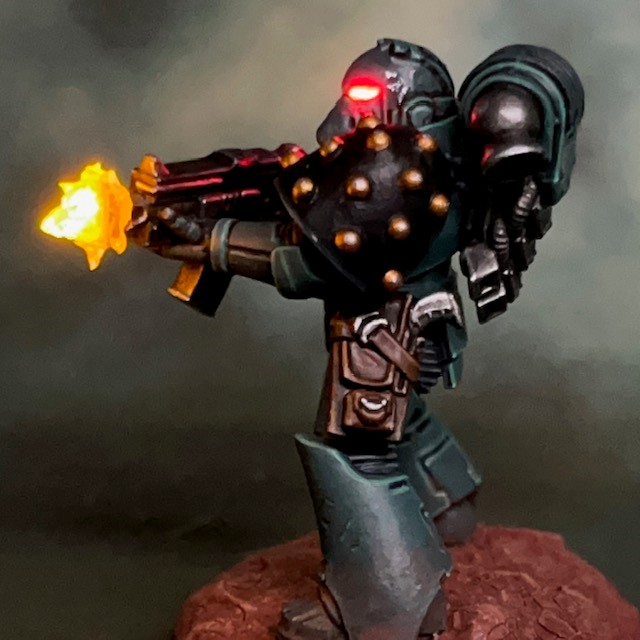
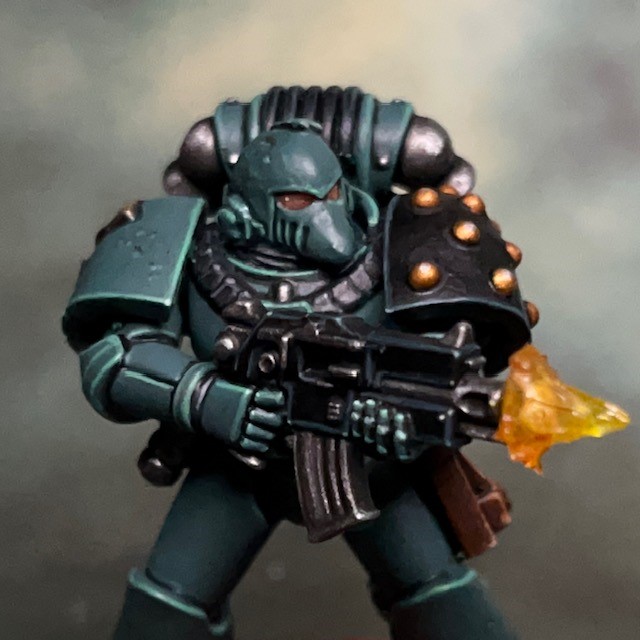
In a surprise to absolutely no one, I’m back again this week with another MKVI Space Marine. What is surprising is that it’s not a loyalist painted in a primary colour – red, blue or yellow – but in a lovely sea green traitor! Brother Amset of the Sons of Horus is a test model for an upcoming project, just like my Custodian and Imperial Fist from recent weeks. It’s been many years since I’ve painted a Marine who has spat on his oaths to the Emperor, and it felt a bit strange!

Modelling & Painting

Brother Amset was built straight from the Legion MKVI Tactical Squad kit, apart from being given the LED helmet eye lens and bolter muzzle flare treatment, as detailed in my LED Muzzle Flare tutorial. As there wasn’t anything too complex about this build, I took the opportunity to document the process and refresh my LED Muzzle Flare tutorial. I’ve made some significant changes to this tutorial to reflect improvements I’ve developed in this process over the years. The original June 2019 version of this tutorial has been archived here in case anyone still wants to reference it.

The paint recipes I used for this model draw heavily from the Warhammer+ Citadel Masterclass tutorials. I found painting an entirely new colour of power armour a refreshing change! The whole miniature was spray undercoated with Chaos Black spray. All paints are Citadel unless specified otherwise.

  • Sons of Horus Armour
  • Sons of Horus Green basecoat (2-3 thin coats)
  • 50:50 Incubi Darkness:Abaddon Black shade
  • 50:50 Sons of Horus Green:Sybarite Green highlight
  • Sybarite Green fine highlight
  • Gauss Blaster Green dot highlight
  • Black Armour
  • Abaddon Black basecoat
  • Incubi Darkness highlight
  • Sons of Horus Green fine highlight
  • 50:50 Sons of horus Green:Deepkin Flesh dot highlight
  • Silver Metallics
  • Leadbelcher basecoat
  • Nuln Oil shade
  • Stormhost Silver highlight
  • Gold Metallics
  • Scorched Brown basecoat
  • Retributor Armour layer
  • Reikland Fleshshade shade
  • Stormhost Silver highlight
  • Martian Base
  • Mournfang Brown basecoat
  • Martian Ironearth technical paint
  • Reikland Fleshshade shade
  • Jokareo Orange drybrush
  • Lugganath Orange drybrush
  • Doombull Brown glaze on model’s feet and ankles
  • Tuskgor Fur glaze on model’s feet, ankles and shins

I also continued my experiments with making the eyes and special effects look better when the LED is switched off. I applied a very thin glaze of red all over each eye lens, followed by a thin glaze of orange towards the bottom of the lens. Lastly, a very watered down dot of white in the opposite corner. The muzzle flare was shaded with Fuegan Orange at the widest point nearest the barrel of the bolter. Once that was dry, the whole muzzle flare was given a watered down glaze of Imperial Fist contrast paint.

That’s it for this week. I had a lot of fun painting a Son of Horus and am looking forward to revisiting this colour scheme again (which is just as well really). As always, thanks very much for reading, and please don’t forget you can also follow my work on social media at TwitterMastodon and Instagram. I’ll see you again soon for some more LED miniatures!

Brother Lydus, Imperial Fists

A man’s soul needs to be a fortress.

Rogal Dorn, Primarch of the Imperial Fists

I’m back again with another MKVI Space Marine, but this time it’s not a converted Primaris Marine! Brother Lydus is built straight from the new(ish) Legion MKVI Tactical Squad kit. Just like my Custodian from a few weeks ago, this Imperial Fist is an individual test model for another upcoming project.

Modelling & Painting

I haven’t done a lot of conversion work on this model, by my standards at least. I’ve just given it the very basic LED helmet eye lens treatment, as detailed in my LED Eye Lens tutorial. As this model was so straightforward to make, I took the opportunity to document the process and refresh my LED Eye Lens tutorial. It is essentially the same, with a few minor improvements and clarifications, as well as new, clearer photos. I know from my website stats that this particular tutorial is one of the most visited pages on my website, especially as many of the other more complex tutorials reference it as a starting point. It’s a few years old now so I thought it was worth bringing up-to-date. I haven’t deleted the original August 2018 version though, that is now archived here in case anyone still wanted to reference it.

Previously I’ve used blue LEDs for Imperial Fists, but I decided to switch to red for this project. This is for two reasons: firstly it more closely matches the current Horus Heresy artwork for the Imperial Fists, and secondly I find the red LEDs are more vibrant than the blue equivalents, especially on camera.

For the paint scheme, I mostly stuck to my traditional yellow recipe, but with a few tweaks, detailed below. I decided to try applying the shades slightly later in the process, but also applying different levels of shades in different areas of the yellow armour to give a bit more depth to the large smooth surfaces that characterise MKVI plate. The whole miniature was undercoated with Chaos Black spray.

  • Yellow Armour
  • Averland Sunset basecoat
  • Yriel Yellow layer (2-3 thin coats)
  • Casandora Yellow shade
  • Fuegan Orange shade in darker areas (slightly watered down)
  • Mournfang Brown shade in deepest recesses
  • Yriel Yellow edge highlight
  • Flash Gitz Yellow fine highlight
  • Dorn Yellow fine highlight on sharpest edges
  • White Scar dot highlight on sharpest edges
  • Black Armour
  • Chaos Black basecoat
  • Eshin Grey highlight
  • Dawnstone fine highlight
  • Silver Metallics
  • Leadbelcher basecoat
  • Nuln Oil shade
  • Stormhost Silver highlight
  • Martian Base
  • Mournfang Brown basecoat
  • Martian Ironearth technical paint
  • Reikland Fleshshade shade
  • Jokareo Orange drybrush
  • Lugganath Orange drybrush

The Martian base was a bit of an experiment, but I’m mostly pleased with how it turned out. I think I’ll go a bit less heavy on the drybrush stages next time. But it still provides a lovely contrast for the yellow armour of the Imperial Fist.

While I was carrying out experiments with the model, I also decided to have a go at making the eyes look better when the LED is switched off. These models spend the majority of their time in my display cabinet with the electronics turned off to save batteries, so I thought it might be nice to not simply have ‘blank’ resin eyes. I applied a very thin glaze of red all over each lens, followed by a thin glaze of orange towards the bottom of the lens. Lastly, a very watered down dot of white in the opposite corner. As you can see in the images below, it works very well – the off-white colour of the resin is an excellent base for the glazes, and the glazes are still thin enough that it doesn’t noticeably effect the LED glow.

That’s it for this week. The plastic Legion MKVI kit is absolutely wonderful – although I might be slightly bias as a real ‘Beakie’ fan boy – and I’m looking forward to revisiting it in the very near future. Anyway, as always, thanks very much for reading, and please don’t forget you can also follow my work on social media at TwitterMastodon and Instagram. I’ll see you again soon for some more LED miniatures!
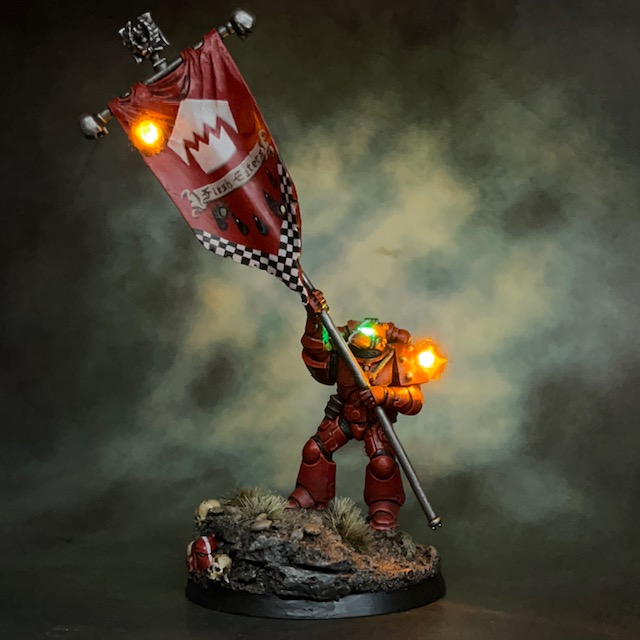
Flesh Eaters Ancient, Golden Demon 2022

Raise the colours high, Ancient Harlon! Let the enemy see who comes to claim their lives!

– Flesh Eaters Chaplain Uriah Grimm

Allow me to introduce Brother Harlon, Flesh Eaters Ancient. This model is my entry into the Golden Demon painting contest this weekend at Warhammer World.

The Long Road To Golden Demon

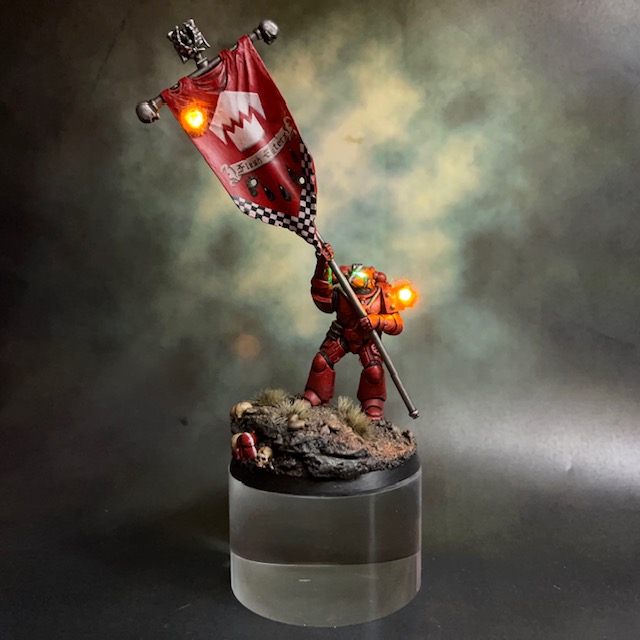
I know I say this increasingly often, but this was one of the most fiddly LED projects to date. I had already planned to make this model for my Flesh Eaters army project, but decided it might make a good Golden Demon entry. I was lucky enough get a Golden Demon ticket in the first round at the start of August, so I had a little time to plan and think. My initial idea for what I would build and submit was actually not part of the Flesh Eaters project, but I couldn’t get the prototype of the circuit to run for long enough off small batteries. With the current multi-day format the model will be on display somewhere between 24 – 36 hours, so it had to be long lasting. Unfortunately the prototype for my original project only lasted a mere 5 hours! So I decided to put that one on the back-burner (no details yet, as I may revisit it later) and instead tackle the Primaris Ancient. So with one project abandoned and two weeks in August “lost” to a summer holiday, I didn’t properly start the Ancient until the 1st September.

My initial iteration of this project involved using filament LEDs to represent energy beams lancing past the Ancient and through the banner. You can see some WIP shots of this version below. Unfortunately there were two drawbacks with this version:

  1. They required a 12V battery, which meant a different base design.
  2. The ends of the filament were not illuminated. No matter what I did to try and hide this they drew the eye and spoiled the effect.
  3. They were ridiculously bright! So bright in fact that I couldn’t take a decent photo and it was difficult to see the details of the paintjob.

I tried my best to persevere, telling myself it would all come together when it was finished, but I had my doubts. Finally, when I accidently snapped one of the filaments while making fine adjustments two days before the contest, I finally said “screw it”, and removed both filaments and the 12V battery from the painted model! Making such a huge, fundamental change to a competition entry just 48 hours before submission was the stuff of stress-dream nightmares! But I managed to do it after a couple of hours and without inflicting too much damage on the paintwork.

Painting & Modelling

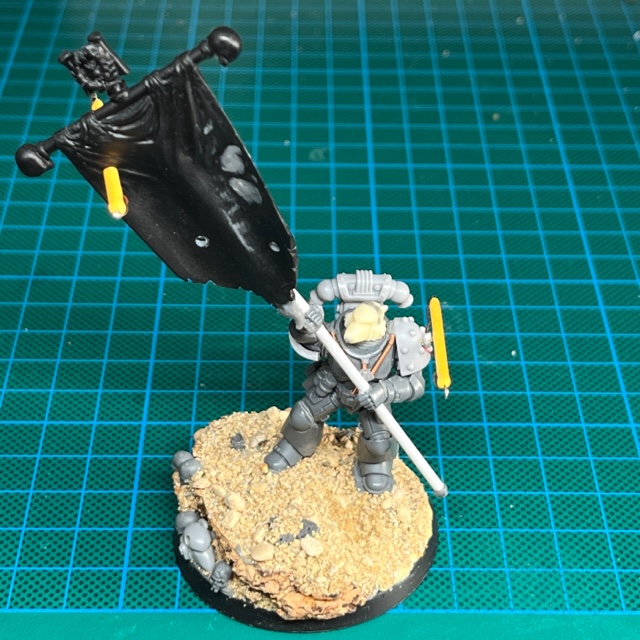
The standard bearer in picture above is one of my primary influences for this piece. This photo is taken from one of the colour sections of the ‘Rogue Trader’ first edition Warhammer 40,000 rulebook. I’ve always thought this was a really cool model.

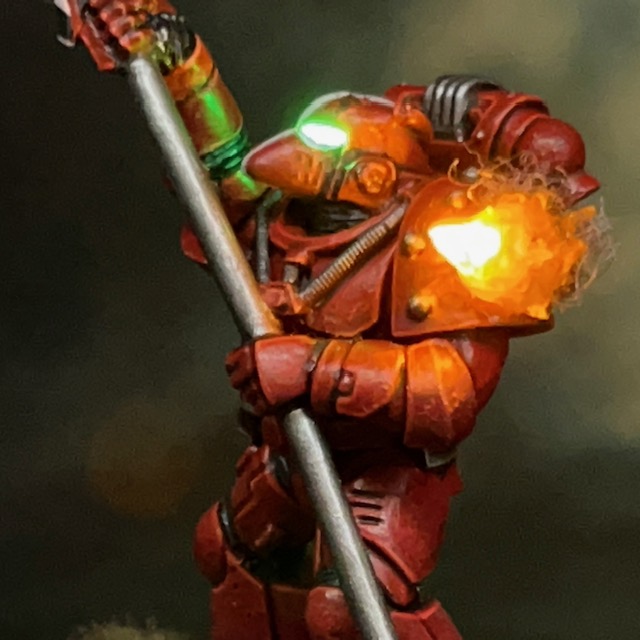
The base model for my version is a Primaris Ancient. As you can see in the images below, the model required some serious reposing. I wanted to banner to be on the viewer’s left as they looked at the model, while the stock Primaris Ancient holds the banner to the viewer’s right. The reason I wanted to change this is two-fold: one was to emulate the pose of the model that inspired it, the other was because when humans view an image their eyes start in the top left and track down diagonally to the bottom right (interestingly this is regardless of cultural influences). So I wanted the visual story to begin with the banner under fire, followed by the Flesh Eaters heraldry announcing who you were looking at, then on to the heroic Marine himself with the glowing eye lenses firmly in the centre of the image. Finally, the eyes take in the second round of incoming fire and the damage to the pauldron, bookending the visual story with the fact that this is a Marine in the heart of battle!

In the end the LED effects were achieved using some of my standard techniquies. The green eye lenses were achieved using my LED Eye Lens tutorial and a Green 1.8mm Tru-Opto LED. The bullet impacts were achieved using my Simple LED Muzzle Flare tutorial, only with two Yellow 1.8mm Tru-Opto LEDs connected in parallel. You can see some WIP pictures of the bullet impacts below.

To paint this model is used my normal red armour receipe, but with a few extra steps; a Rhinox Hide glaze shade at the bottom of large panels, a Trollslayer Orange point highlight, and a Bloodletter glaze. I wanted to do an extra nice paint job for Golden Demon, while not having the model look out of place with the rest of the army. If you look at the close-up shots then hopefully you’ll notice some subtle battle damage as well.

For the banner, I was trying to emulate the look of the banner from the Rogue Trader book. I decided not to extend the chequered pattern the whole way around the border. This was partially to save time, but also because I thought it would draw the eye too much. I thought it was worth adding the chapter name as the Flesh Eaters are relatively obscure and some viewers may not recognise the chapter symbol alone.

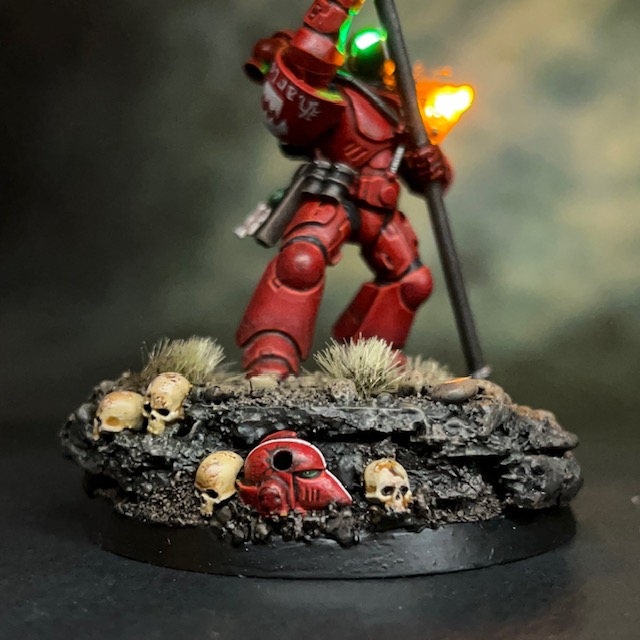
The final thing to talk about is the display plinth, seen in the picture below. I went for a transparent Perspex base, rather than the traditional black, to demonstrate that the miniature was entirely self-contained. This way you can see that there are no batteries or circuits hidden in the plinth.

So there we have it! Of course I will keep you all updated on how it goes. It would be weird for an LED model to win a painting contest, so I’m not holding my breath for any trophies, but it’s the taking part and the fun of being there that counts! As ever, thanks for reading, and please don’t forget you can also follow my work on Twitter and Instagram.

Iron Duke, 15mm Scale Land Raider

The Land Raider is to other vehicles as the Astartes are to baseline humans.

Rogal Dorn, ‘A Treatise on Tanks’

Here’s something a little different – a 15mm scale Land Raider! This cool little model was printed as a gift by a good friend who owns a 3D resin printer. He also threw in some 15mm MkVI Space Marines and a few other bits and pieces to go with it. Models at 15mm scale sit somewhere in between the 6mm scale of Epic miniatures and the 28mm scale of Warhammer 40,000. They’re small enough that they don’t take super long to paint, but large enough to tackle some interesting details.

Painting & Modelling

Like so many of my other projects, initially I said “no LEDs”. But in the end I couldn’t resist putting a few in the Land Raider to make it seem as though the lascannons were firing. This was quite fiddly in terms of drilling, and as you can see in the WIP picture above I ended-up replacing the lascannon barrels with plastic tubes to make drilling the wire holes easier. Each lascannon has a 3V Red Ultra Nano SMD Chip LED (available from Small Scale Lights) at the aperture. The LEDs are in series with their supplied 100Ω resistor and then in parallel with each other. The whole circuit is supplied by a single 3V CR2032 coin cell battery and switch in the base.

The muzzle flare effects around the LEDs – simulating scattered laser light on the dusty battlefield – are made from acrylic gel. I have an explanation for how this is done in my Simple LED Muzzle Flare Tutorial.

The banner is an addition from my bits box, which I think may have come from an old Black Templar accessory sprue. The miniature is mounted on a 65mm base.

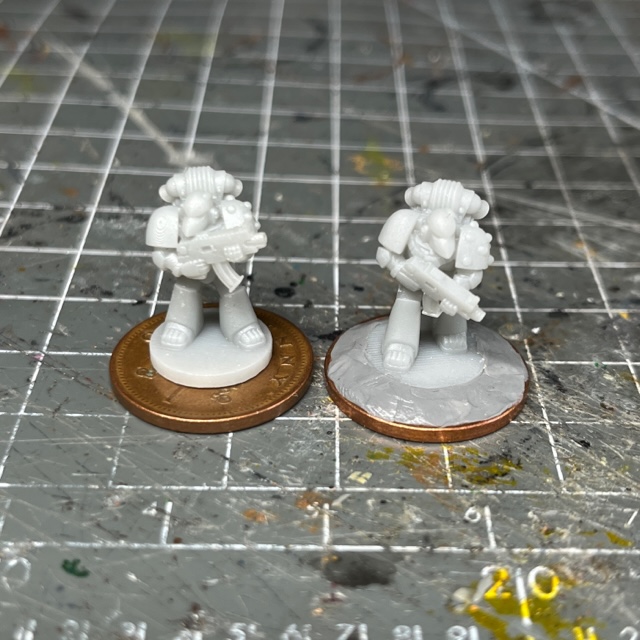
15mm scale Land Raider next to Warhammer 40K model ‘Sergeant Scale

I decided this Land Raider would essentially be a 15mm scale version of my classic 30K Land Raider ‘Iron Duke’. To paint the yellow, I fell back on my tried-and-tested recipe:

  • Corax white undercoat
  • Averland sunset base
  • Cassandora yellow shade in recesses
  • Yriel yellow (two thin coats)
  • Flash Gitz yellow edge highlight
  • Dorn yellow final edge highlight

Although this gives a nice bright yellow, it is quite time consuming, especially with the multiple applications of Yriel yellow. In hindsight I wish I’d invested in the new Imperial Fists contrast paint and given that a go instead as I imagine that would have been much quicker. Ah well!

So now I have this model, what am I going to do with it? Well my good friend Apologist also recieved some of these 15mm miniatures, and decided to paint them as Emperor’s Children so we could have a cool Horus Heresy themed game with them! You can read the battle report on his blog.

That’s it for this week, I hope you’ve enjoyed this slightly unusual project! I have some more 15mm models to finish, so I’m sure we’ll see some more of this project again in the future. As ever, thanks for reading, and please don’t forget you can also follow my work on Twitter and Instagram.