Brother Orpheus on WarhammerTV

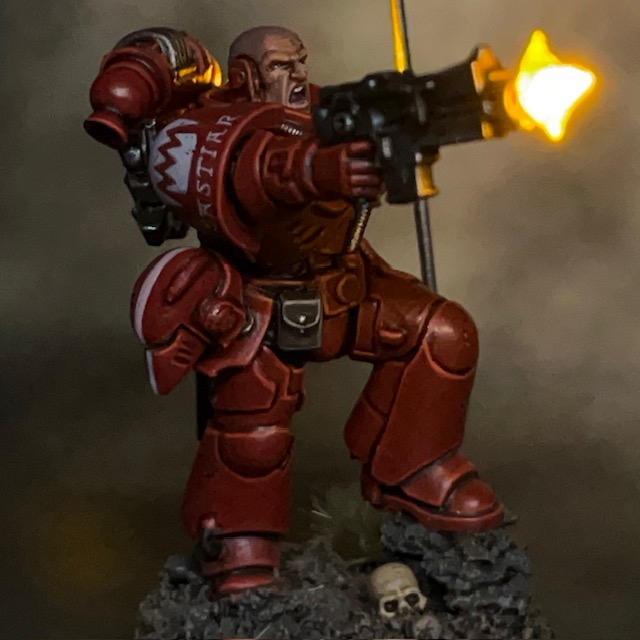
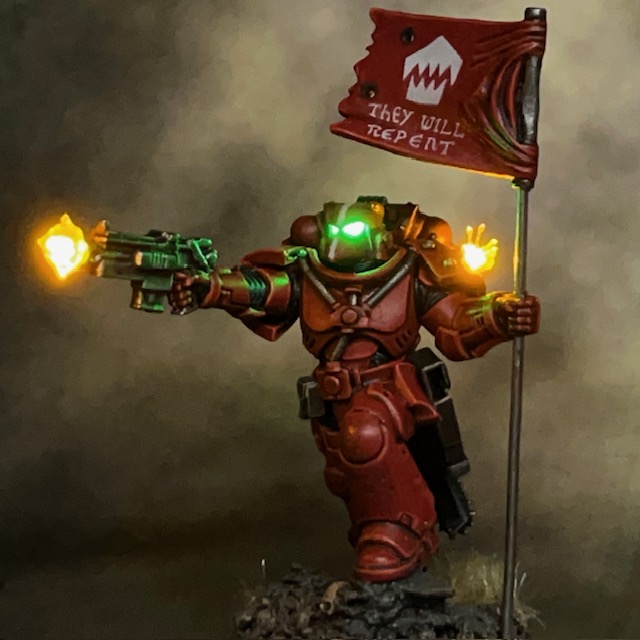
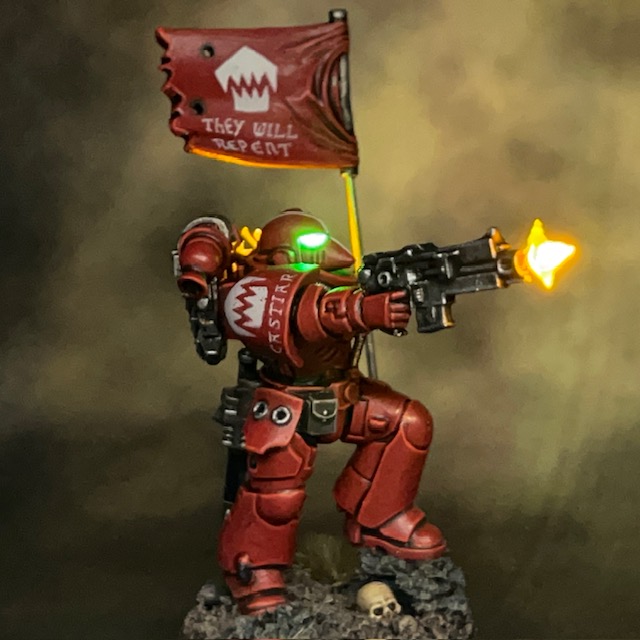
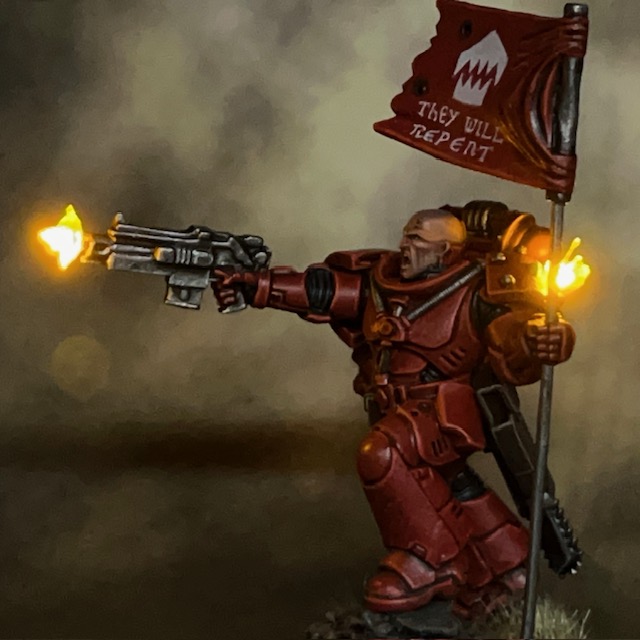
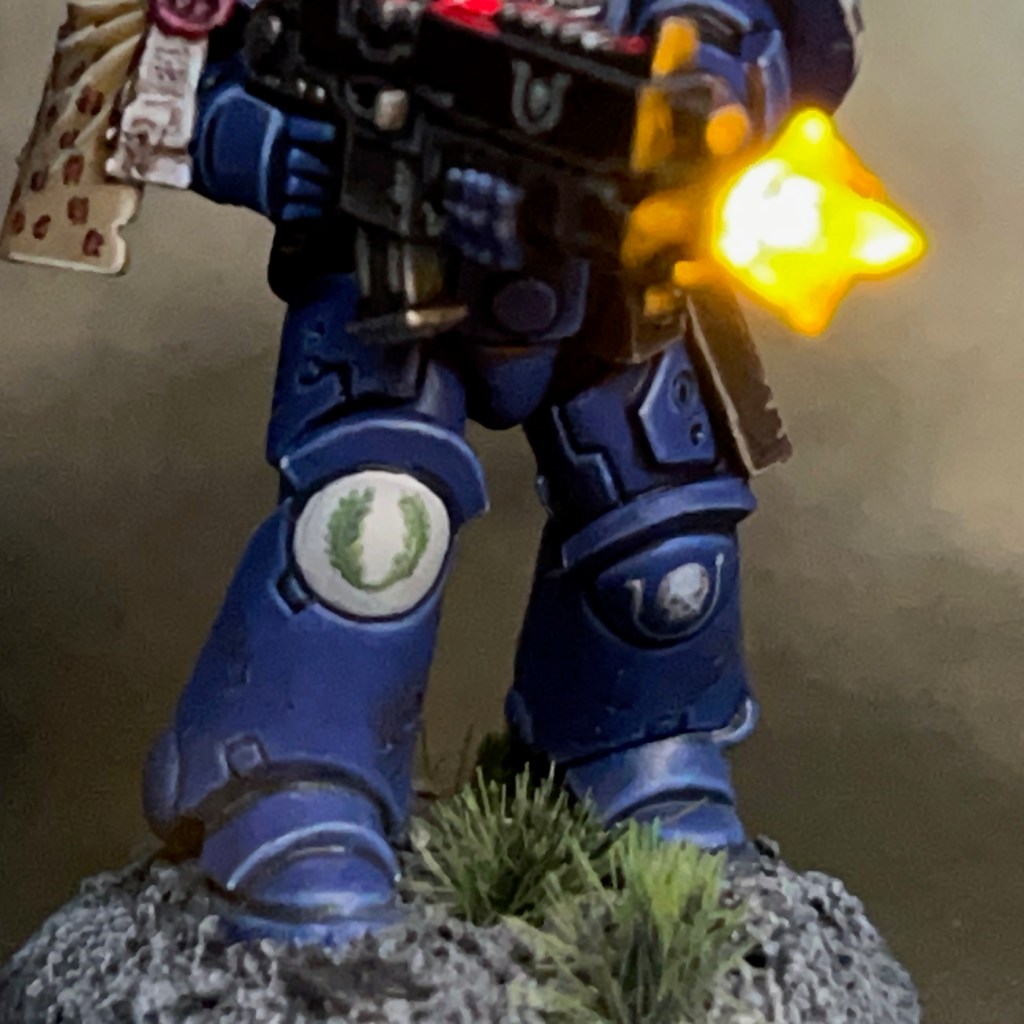
This evening I was fortunate enough to have one of my models make it onto the Warhammer TV Twitch channel again!

Brother Orpheus featured alongside the work of other hobbyists on today’s ‘March for Macragge Hang Out and Paint’ episode on Warhammer TV (Thursday 4th March episode, at around the 1 hour 13 minute mark, if anyone would like to see it).

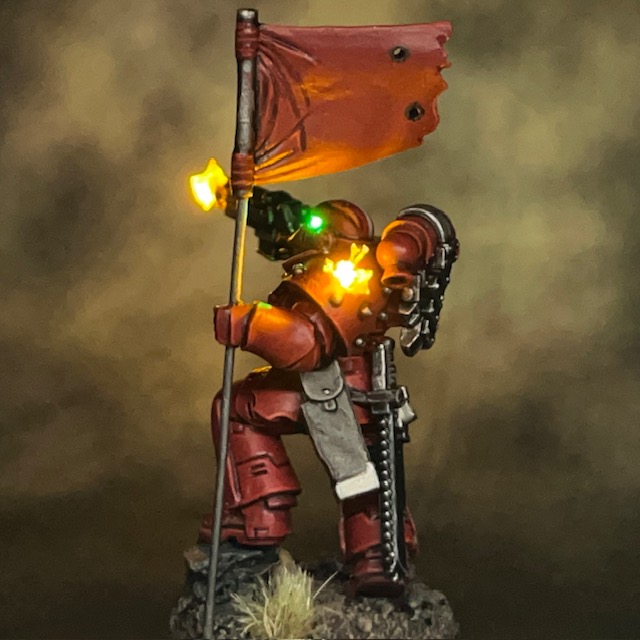
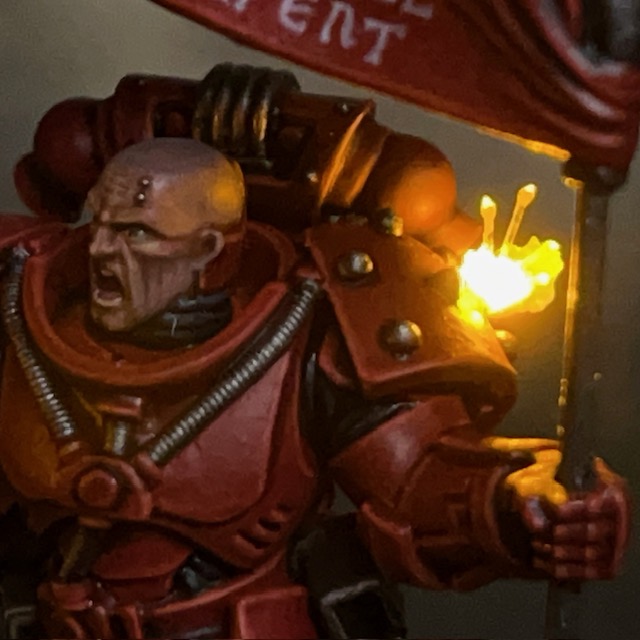
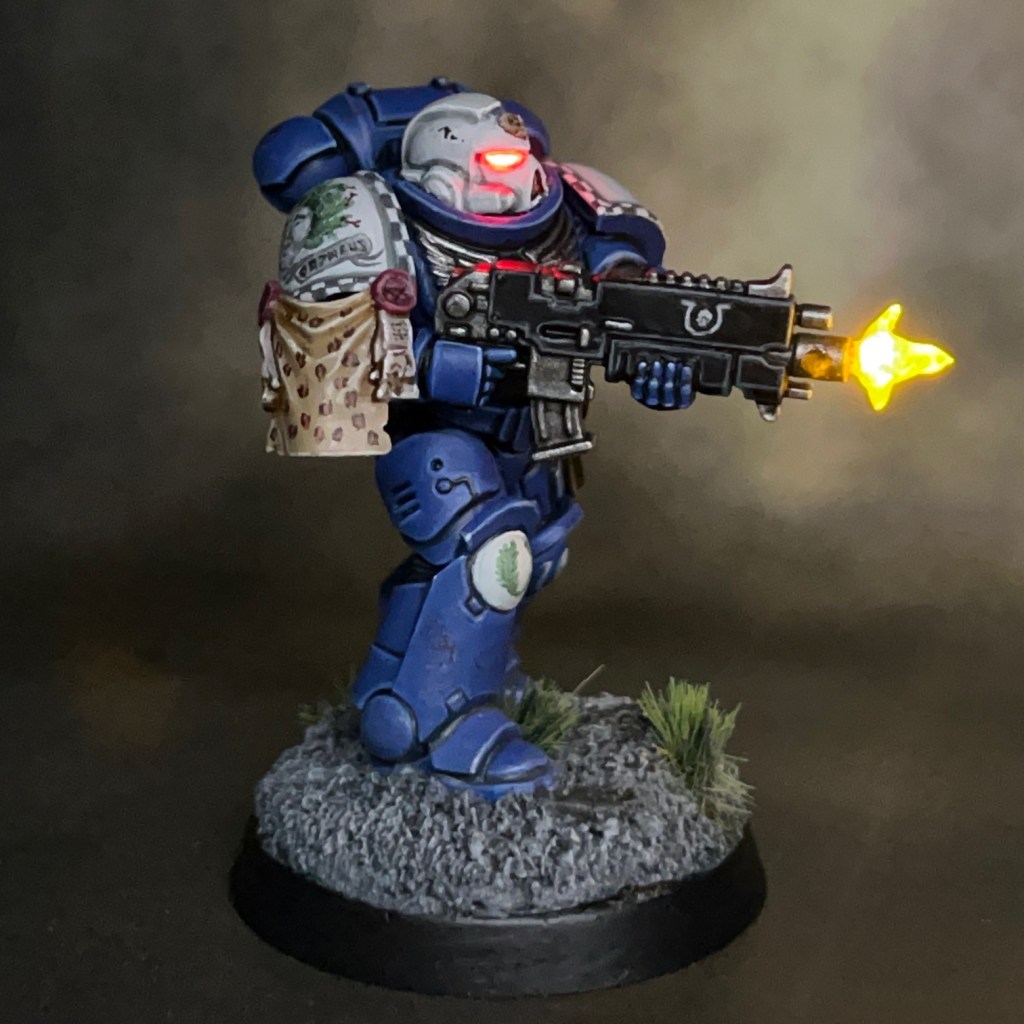
It’s always an honour to have had my work exhibited in this way, and a big thank you to Simon, Nick, and the rest of the Warhammer Community Team for their kind words about this miniature! And to answer Simon’s question from the episode, all the lighting effects on this miniature are purely achieved with the LEDs, there’s no painted OSL.

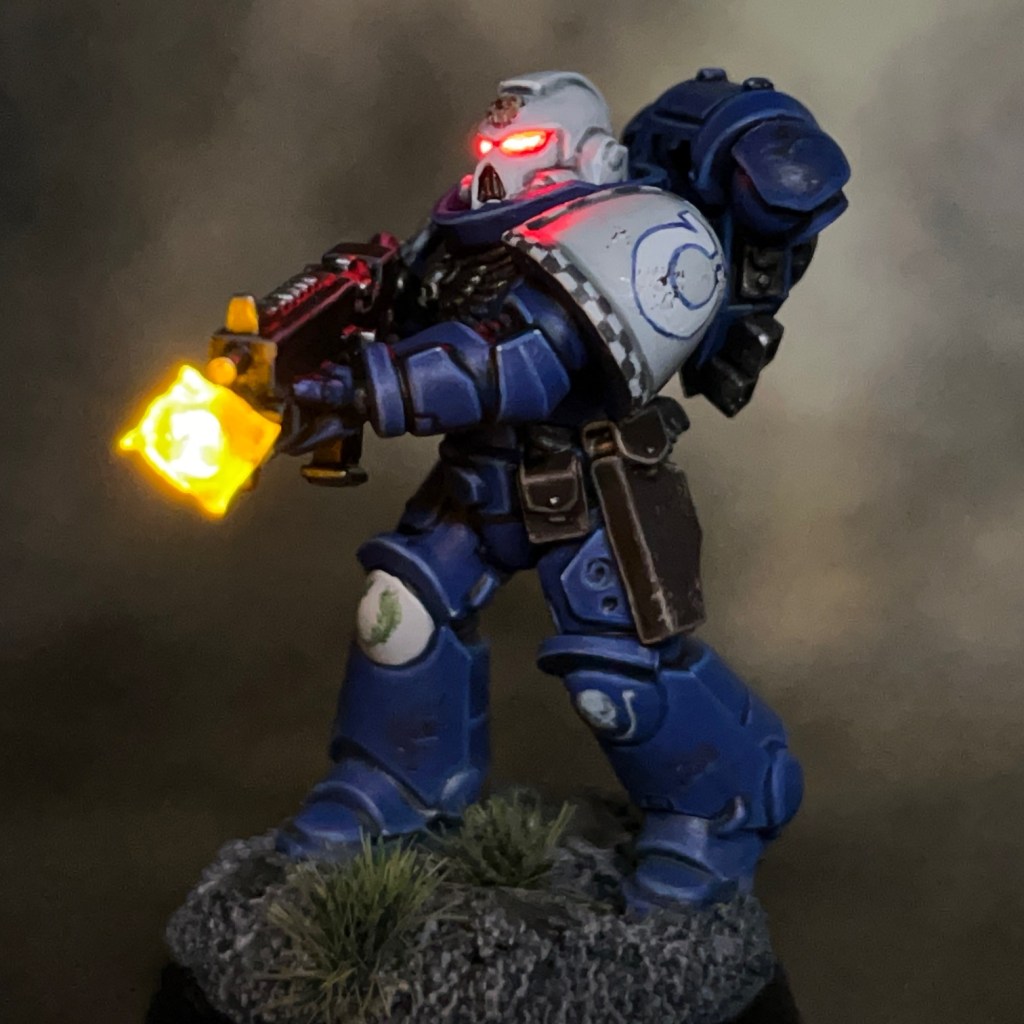
Brother Orpheus, Ultramarine Sternguard

We march for Macragge!

Ultramarine chapter battlecry

Today we’re looking at Brother Orpheus, my #MarchForMacragge project for this year. If you’re on the ‘hobby’ parts of social media then you may have seen the #MarchForMacragge hashtag being used a lot in the last few weeks. The premise is simple – paint something Ultramarine-related at some point during March and then share the results. 

Modelling

I’ll always have a soft spot for the Ultramarines, as I learnt to play 40K back in the day borrowing a friend’s Ultramarine army. For previous years #MarchForMacragge I’ve completed the Ultramarine ‘Imperial Space Marine’, Ultramarines Primaris Lieutenant, and Ultramarine Veteran Sergeant. Two of these are based on classic artwork, so I also looked to artwork for inspiration this time around.

I soon settled on the above image as the basis for this project. It’s such a cool vista with lots of exciting things happening and interesting details. This artwork appeared as a full page spread in one of the second edition 40K rulebooks, and I’ve always found it a source of inspiration (it has previously inspired the heraldry on Brother Dunn) . Rather than try to recreate Brother Orpheus exactly, I decided to bring him up-to-date with a Primaris version.

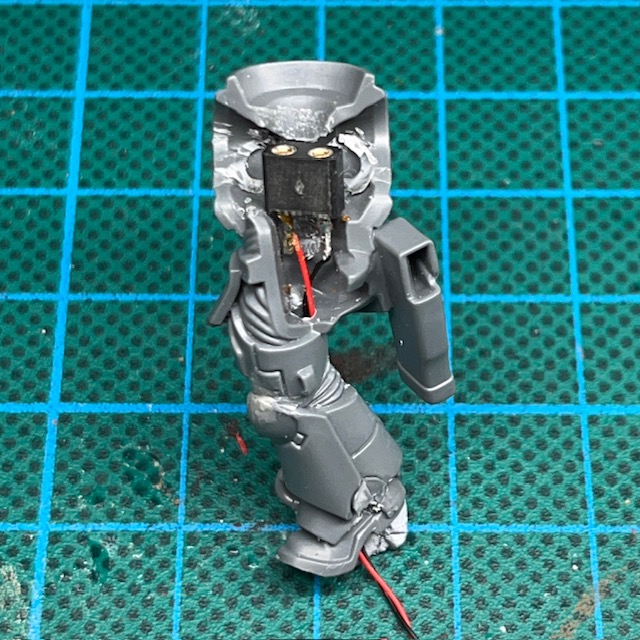
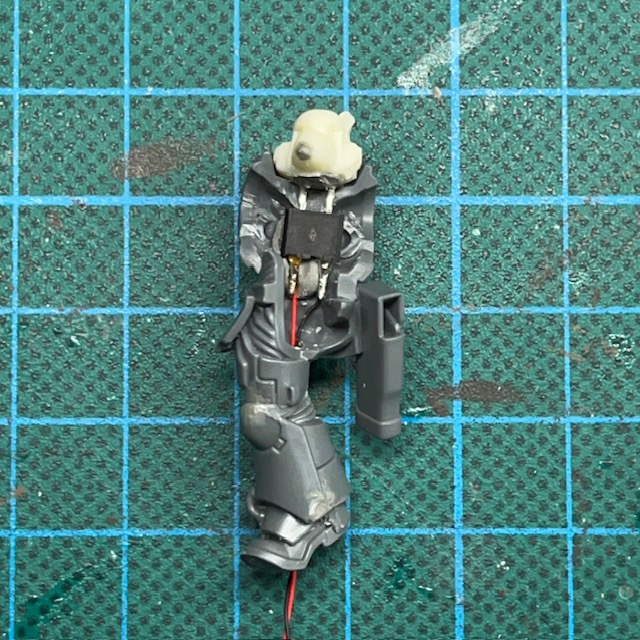
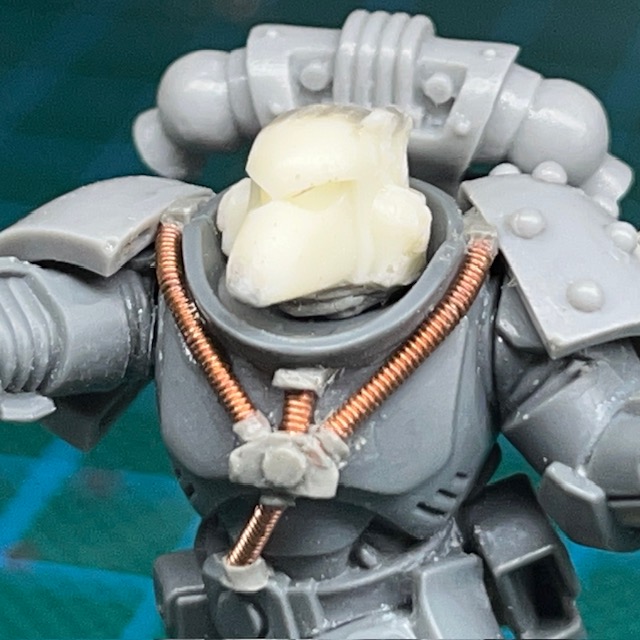
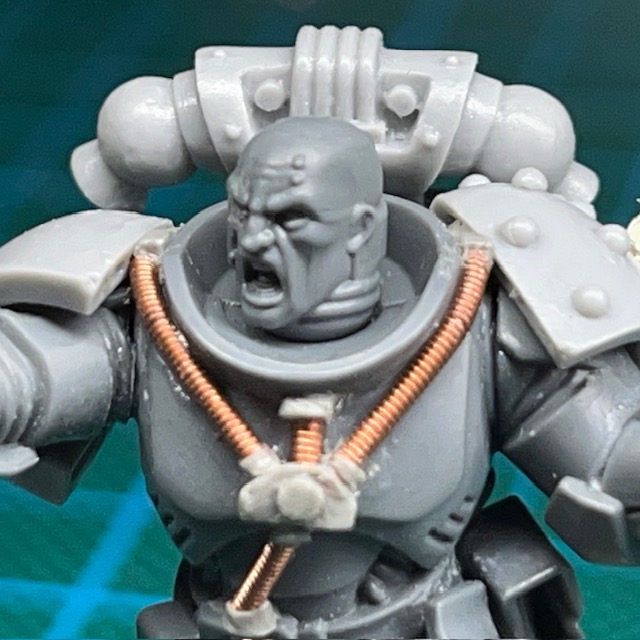
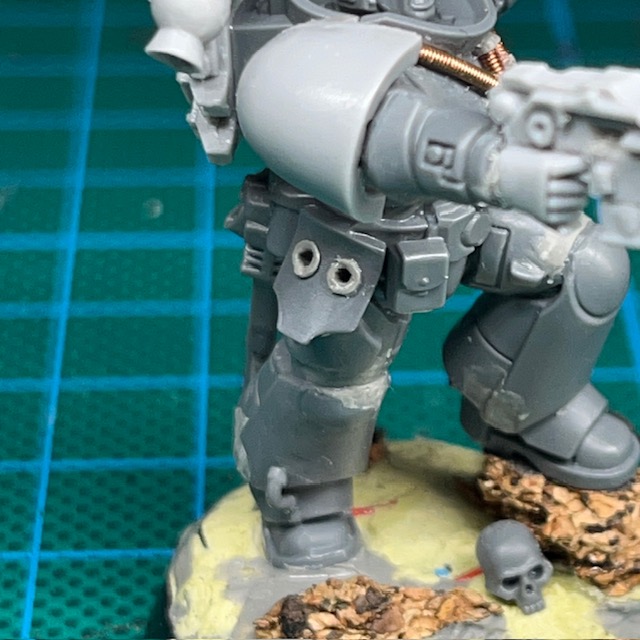
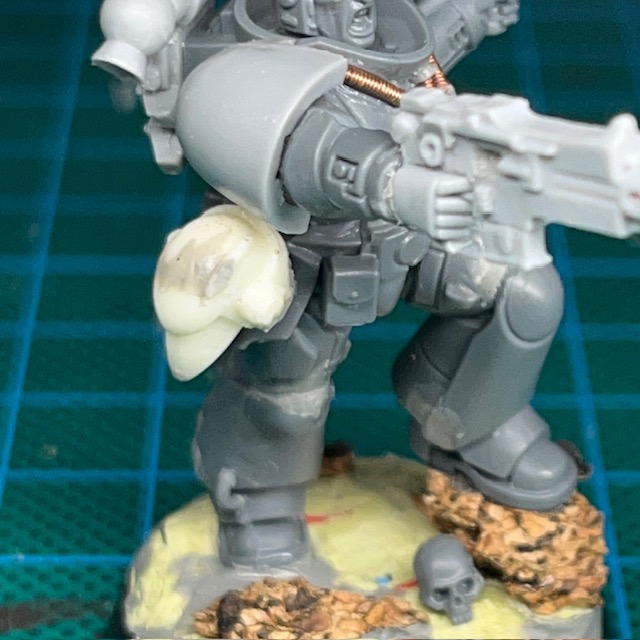
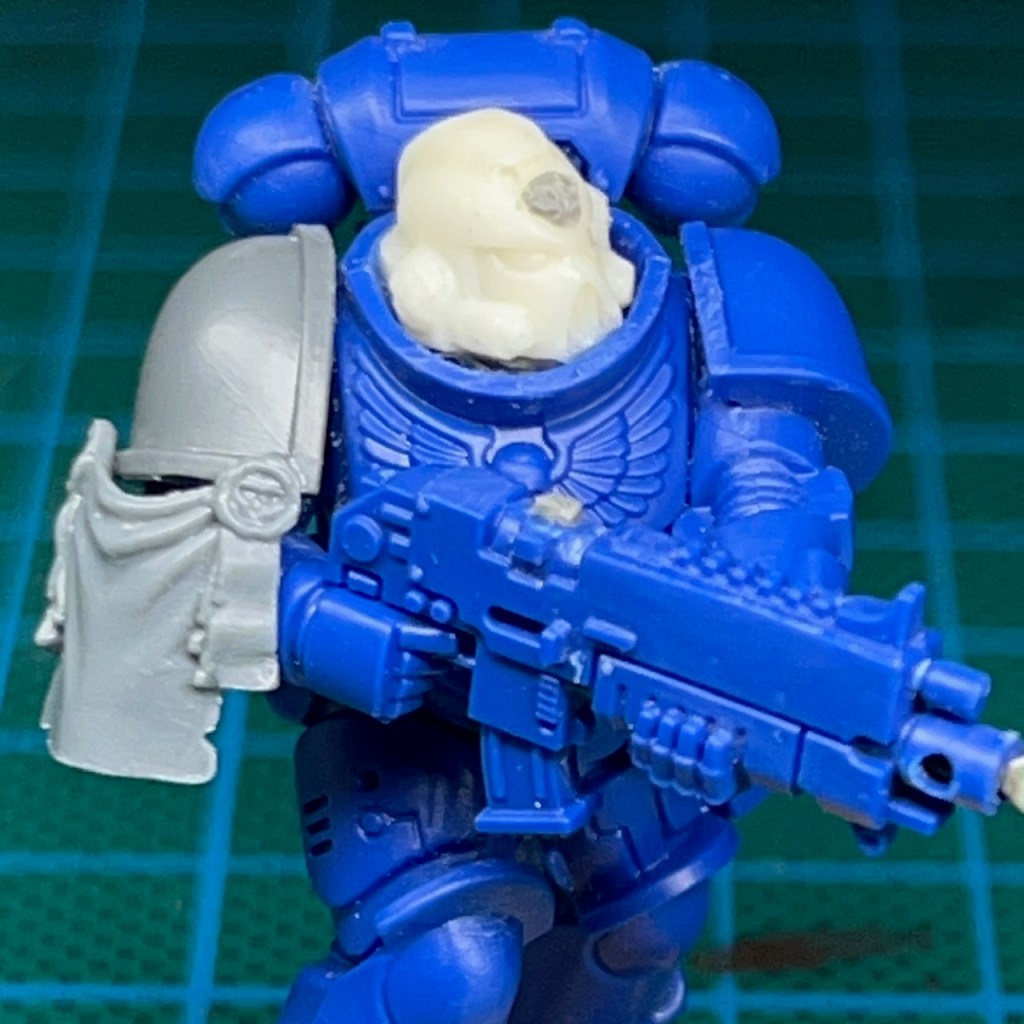
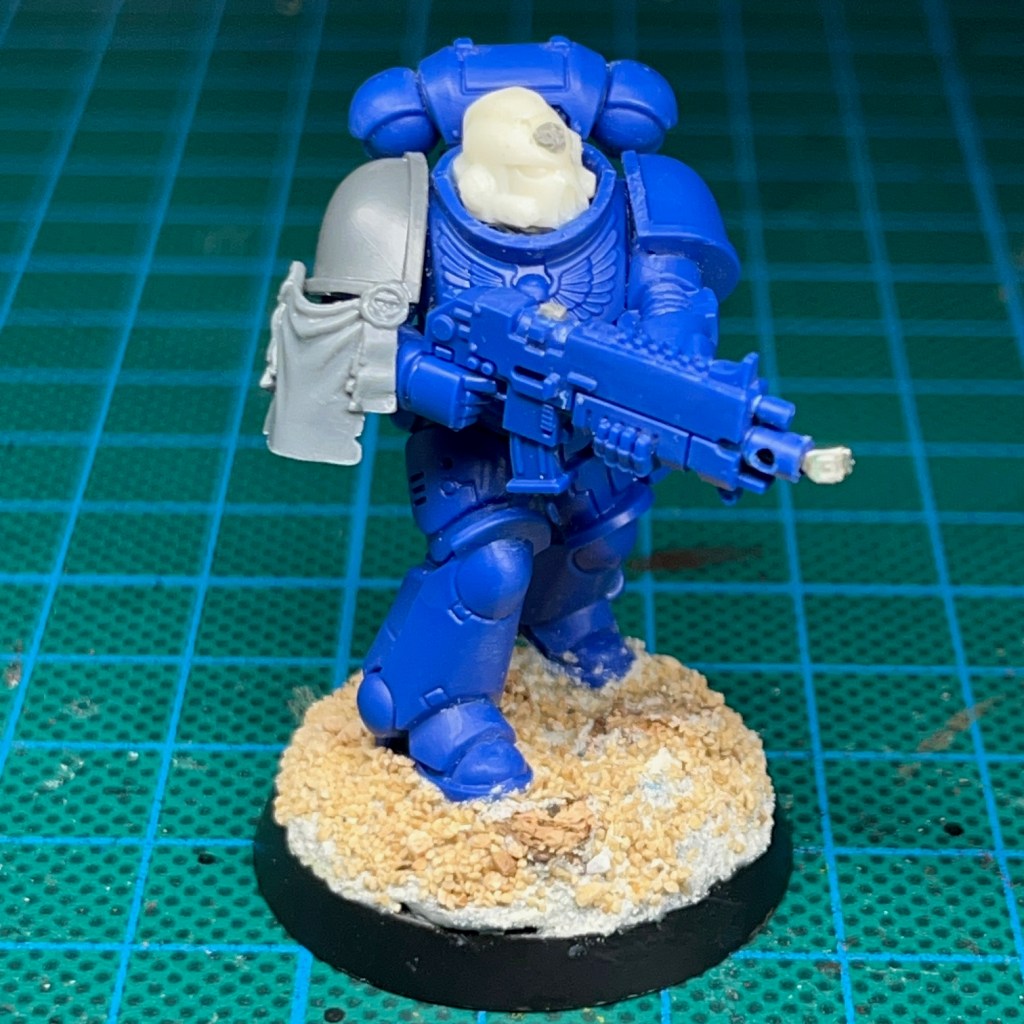
Brother Orpheus was built from spares found in my ‘bits box’, mostly left-over components from one of the 40K partworks magazines. I believe the legs and torso are originally from a Hellblaster marine.

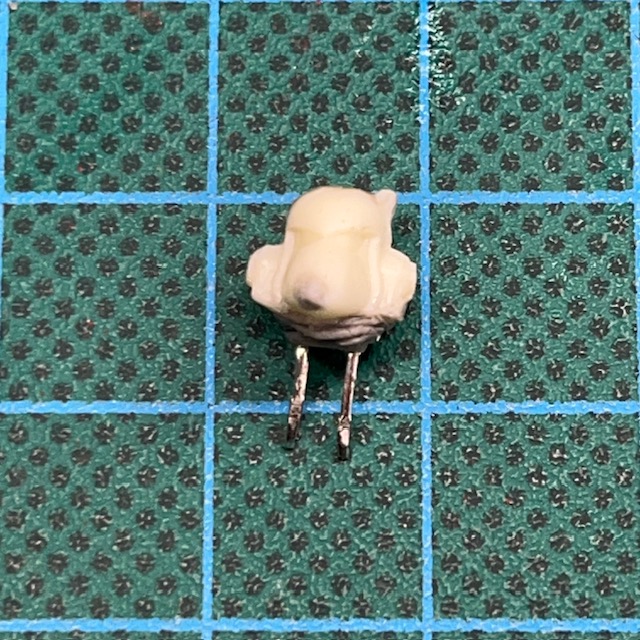
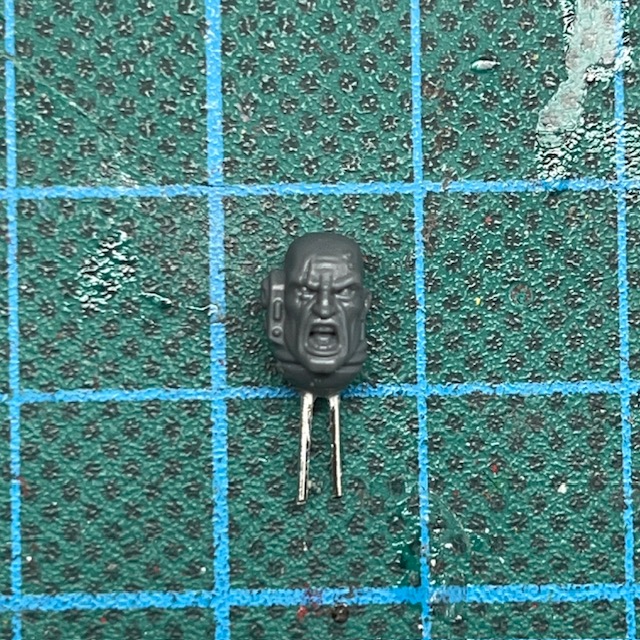
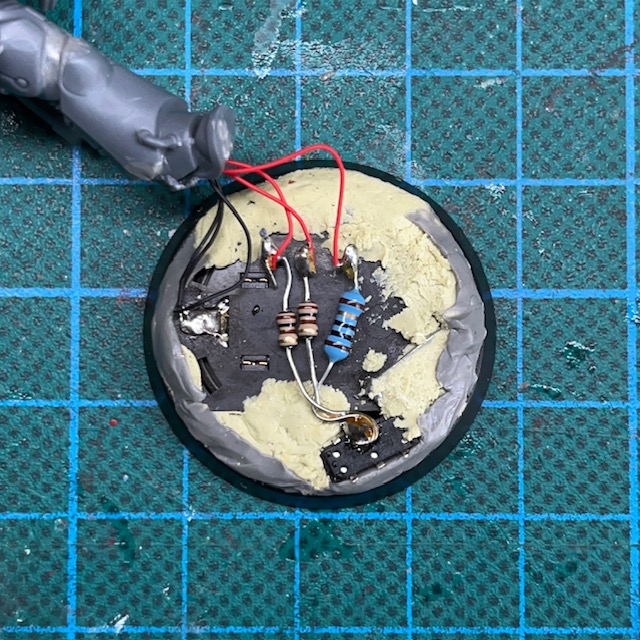
To create the helmet eye lenses and muzzle flare, I used the techniques exactly as described in my LED Muzzle Flare tutorial.

Painting

I’ve shared my recipes for some of the key colours on this miniature below. As this is a display piece rather than a gaming piece I added a few more stages to the armour recipe. All paints listed are Citadel unless stated otherwise. The miniature was spray undercoated Chaos Black.

  • Ultramarine Armour
  • Macragge Blue basecoat (two thin coats)
  • 50:50 Kantor Blue:Abaddon Black shade
  • Altdorf Blue highlight
  • Calgar Blue fine highlight
  • Fenrisian Grey fine highlight on top edges and corners
  • Blue Horror dot highlight
  • White Armour
  • Ulthuan Grey basecoat (two thin coats)
  • Apothecary White Contrast shade
  • Ulthuan Grey layer (one thin coat)
  • Corax White highlight
  • Skull White fine highlight

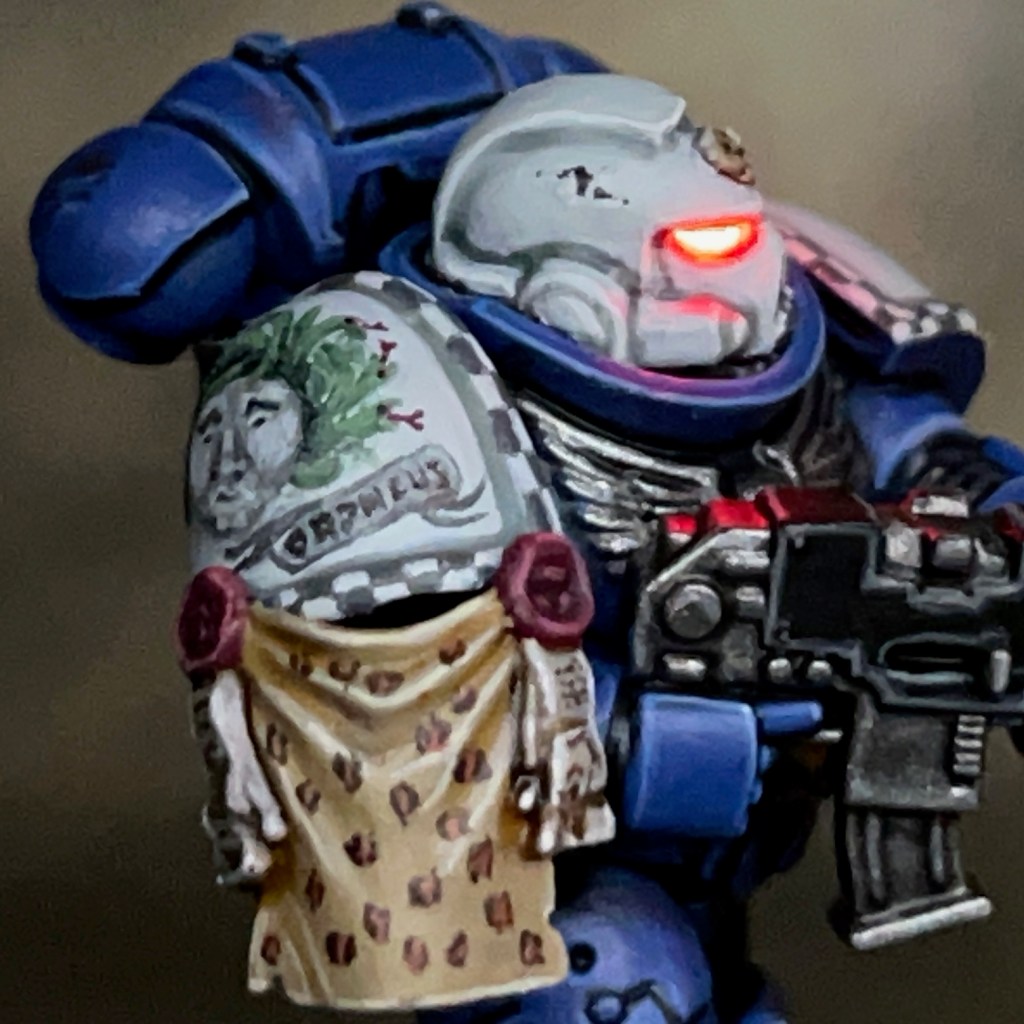
For the animal pelt on the pauldron, I used the same technique as used on Brother Nikko of the Flesh Eaters.

  • Animal Pelt
  • Zandri Dust base coat
  • Seraphim Sepia shade
  • Karak Stone highlight
  • Screaming skull fine highlight
  • Tuskgor Fur small dots
  • 50:50 Abaddon Black:Rhinox Hide irregular circles around the dots

When painting freehand I use the ‘iterative’ method. I start by ‘sketching’ in the shape in a dull colour, and then slowly build up in layers to the brighter final colours, correcting mistakes as I go. If you’d like to read more about this technique, and how it can be applied to freehand checker patterns, then check out this post.

That’s all for today, I hope you’ve enjoyed reading about my #MarchForMacragge 2024 project. I’ll be back again soon with more on my regular projects. Thanks very much for reading, and please remember you can also find me sharing my work on InstagramThreadsTwitter/XBluesky and Mastodon.
Brother Pitman, Flesh Eaters Assault Intercessor

So you like bolters do you, traitors? Well GOOD NEWS!

Brother Pitman, Assault Specialist

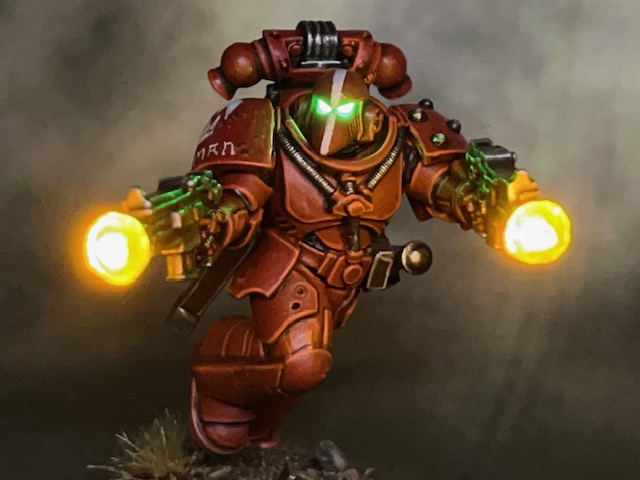
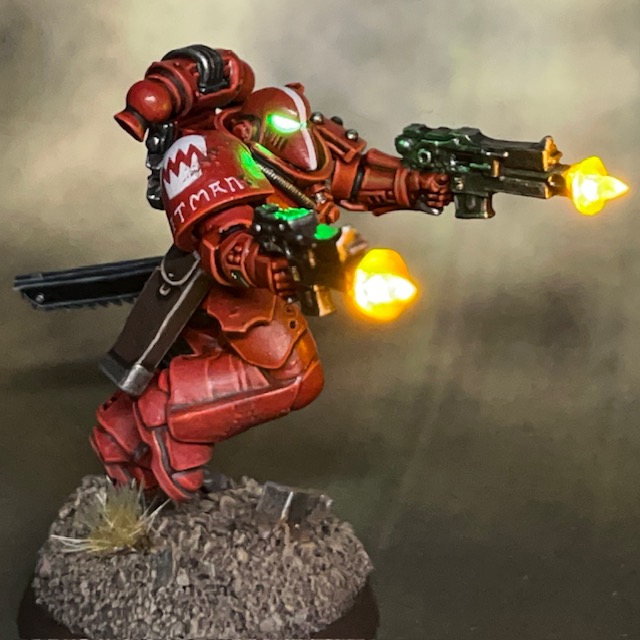
It’s back to the Flesh Eaters project this week with Brother Pitman, an Assault Intercessor equipped with duel heavy bolt pistols and a chainsword. Brother Pitman will be joining my second Assault Intercessor squad as the third member of the unit.

Modelling & Painting

This miniature is a redux of Crimson Fists Sergeant Bast. I was always pleased with his guns akimbo pose, and wanted to bring it into my Flesh Eaters project. There are a couple of other effects I want to port over from my Crimson Fists army, but those are projects for another day.

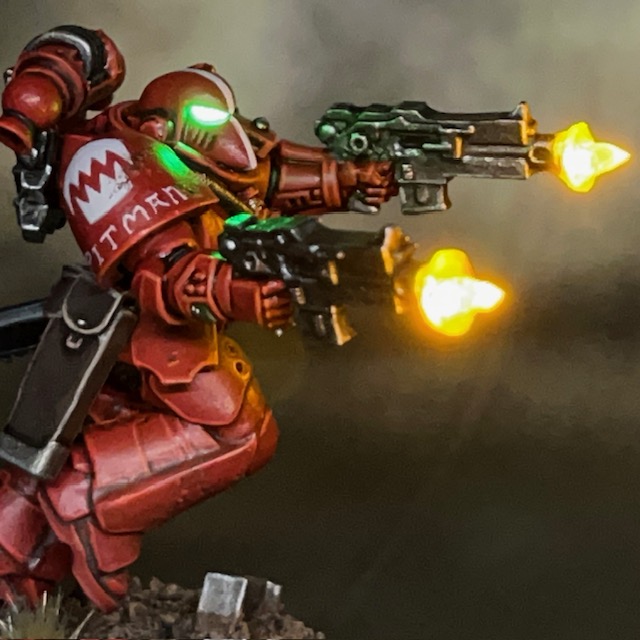
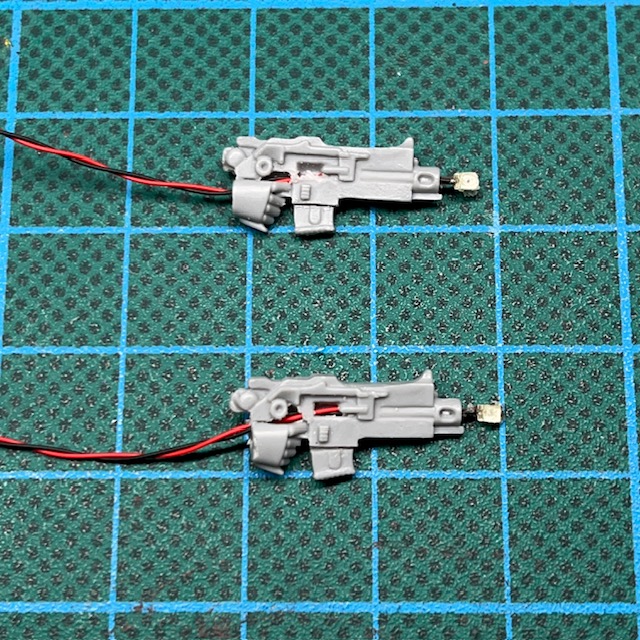
The LED effects on Brother Pitman were assembled using the techniques described in my LED Muzzle Flare Tutorial, with the slight change that there are two LED muzzle flares instead of one. To achieve this, I simply repeated Steps 2 – 7 of the tutorial. The second yellow chip LED was connected in parallel with the first yellow chip LED and the green helmet LED.

A tip I remember picking up from a fellow miniature painter – possibly Apologist – is that if you have a model with duel weapons, it can enchance the pose if the miniature’s head is looking in the same direction as one of the guns it is firing. This is a principle I’ve tried to follow here. If you have the two guns firing in opposite directions and the miniature’s head facing halfway between the two, then it can make the model seem ‘disengaged’ from the act of firing the weapons.

The conclave known as the ‘Diet of Fools’ ensured the Flesh Eaters and the other chapters of the Pentarchy of Blood were incredibly well equipped for the task ahead. This glut of equipment, supplied by order of the High Lords of Terra, wasn’t just reserved for officers but also filtered down to the line units. In these holo-picts we can see a very well provisioned Brother Pitman. His chainsword will carry the word of Terra – quite literally – to his Partisan foes!

EXTRACT FROM ‘A TREATISE ON THE WAR OF THE FALSE PRIMARCH’ BY SCRIBE HOWTOPHER BUXCRAFT

As I’ve described previously for other Flesh Eaters miniatures, the base model is a Primaris Assault Intercessor (from the Indomitus box) that I have modified to wear MkVI armour, in keeping with the War of the False Primarch theme for my Flesh Eaters army. The heavy bolt pistols are made from Umbra pattern bolt guns with the magazine cut down to give them a smaller profile.

For those that are interested, my painting recipe for the red Flesh Eaters armour can be found in this earlier post. I’ve added a little more battle damage to this Intercessor squad than the previous one. The ‘paint chips’ on their armour were applied using the sponge method and Rhinox Hide, which I then highlighted along the lower edge with Evil Sunz Scarlet and Wild Rider Red to give a sense of depth. Below you can see a picture of Squad Byrne so far – three down, two to go!

That’s all for today, I hope you’ve enjoyed this addition to the Flesh Eaters project. I’ll be back with more LED miniatures soon. Thanks very much for reading, and please remember you can also find me sharing my work on InstagramThreadsTwitter/XBluesky and Mastodon.

Tyranid Neurolictor

They get in your mind. They make you see things. They make you do things!

Astra Militarum after-action report on Hive Fleet Cerberus (suppressed)

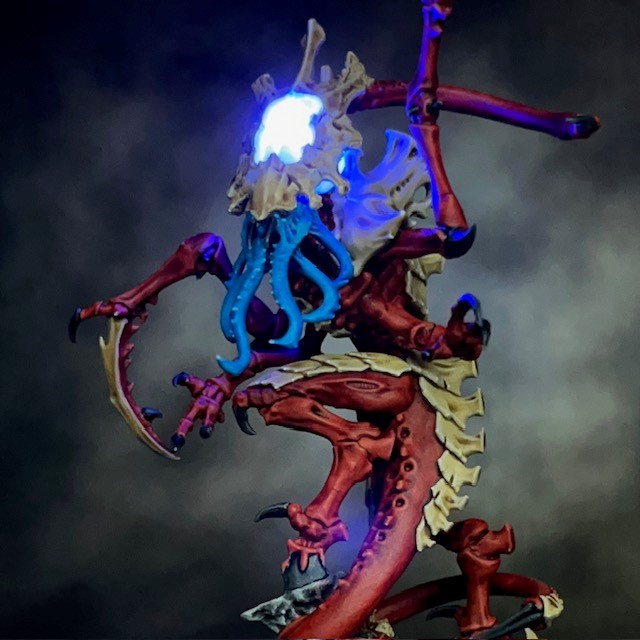
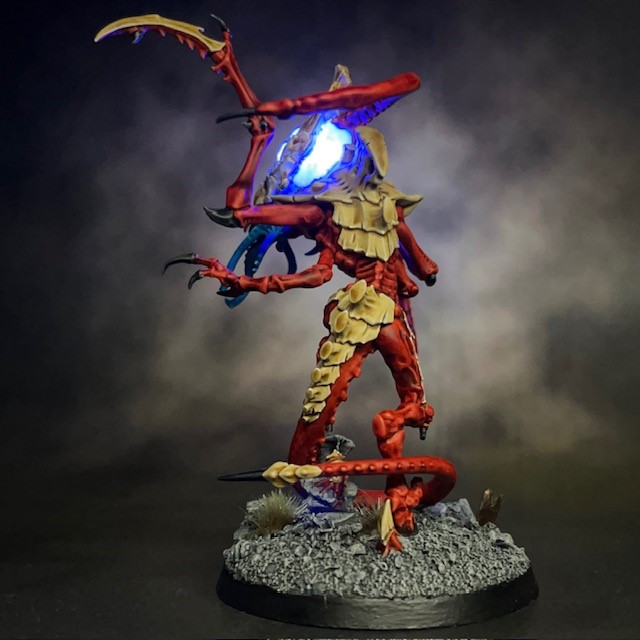
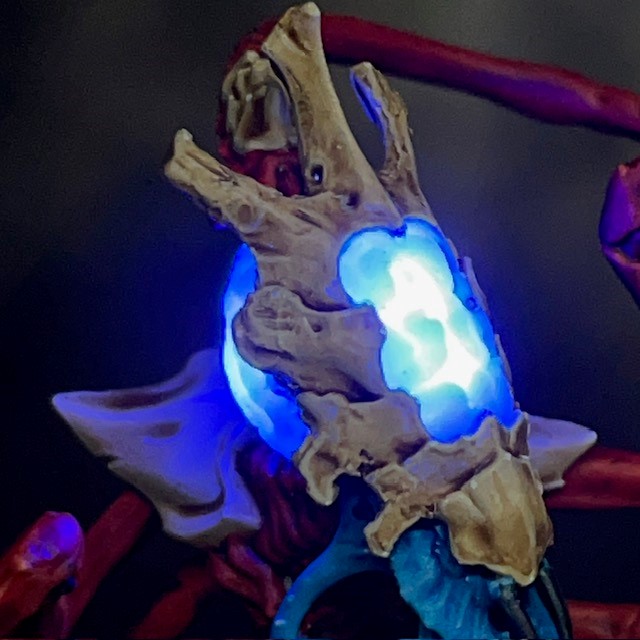
Work continues on Tyranid Hive Fleet Cerberus this week with the Neurolictor. The Neurolictor is a psychic infiltrator, able to project a neural disruption field that causes terror in its prey. I knew as soon as I saw this model that I was going to have to give it a glowing LED brain!

Modelling

I bought this model on the day it was released in September last year. I planned to start working on it immediately, but the more I thought about how I would illuminate the model, the more complex I realised that task was, which put me off making a start. In the end I didn’t begin work until January. This project has taken around four weeks of hobby time, compared to about two weeks for a standard space marine.

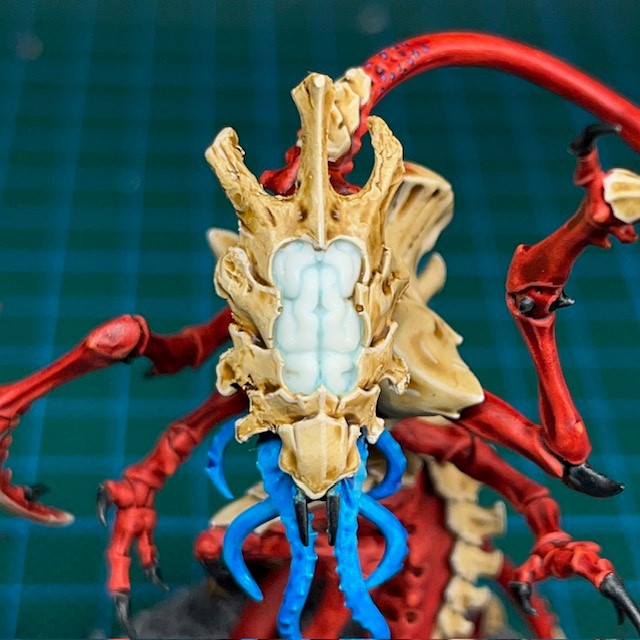
If you’d like to replicate this model yourself, then the techniques set out in my LED Psyker tutorial are probably the best starting point. I began by recasting the two parts of the head that I wanted to illuminate – the front and the rear of the brain – in polyurethane resin, as per my Resin Casting tutorial. You can see the initial test casts in the left-hand picture below.

This miniature uses four 3V Blue 0805 SMD chip LEDs, each in series with their supplied resistor. Two of the LEDs were evenly spaced under the forehead to illuminate the top and bottom of the front brain. The other two were then used to illuminate each half of the rear brain.

This miniature is powered by two CR2032 coin cell batteries in the base. Two of the LEDs are connected in parallel with each battery. In theory I could have run all four LEDs from a single battery, but as there was room in the base I decided to use two batteries. This will give the miniature more longevity on the battlefield between battery changes.

Painting

When painting the Neurolictor I used the Hive Fleet Cerberus recipe described in this post. For this colour scheme, simple weapons like claws are black, but more advanced bioweapons are blue. In the case of the Neurolictor, I decided the ‘advanced’ description applied to the feeder tendrils. This also helps them stand out against the rest of the miniature.

When it came to painting the resin brain, I wanted to give it a little texture and depth without dulling the light that was passing through. You can see the bare resin in the left-hand picture above. I played around with a few techniques, but in the end I gave the resin two very diluted glazes of Soulstone Blue, the end result of which you can see in the middle picture. Next I painted the brain with two very diluted glazes of Lothern Blue. You can see the final result in the right-hand picture above. This gives the brain area of the miniature some depth and interest even when the LED is switched off.

That’s all for today, I hope you’ve enjoyed seeing how this Neurolictor was built. I’ll be back with more LED miniatures soon. Thanks very much for reading, and please remember you can also find me sharing my work on InstagramThreadsTwitter/XBluesky and Mastodon.

Hive Fleet Cerberus & New Year, New Army

Hive Fleet Cerberus

We’re in ‘New Year, New Army’ season, so now is the perfect time to introduce my next big project – the Tyranids of Hive Fleet Cerberus! I already have a Tyranid army that has been plaguing the galaxy for decades. In fact, they’re the only army I own that has – in some form or another – consistently seen the tabletop in every single edition of Warhammer 40,000. They took part in the global Ichar IV campaign back in the 1990s, so it has always been my ‘headcanon’ that Hive Fleet Cerberus was a splinter of Hive Fleet Kraken, skulking off to terrorise the Eastern Fringe in the aftermath of that epic conflict. The name Cerberus is intended to allude to the “multi headed” threat of the splinter fleets.

This army has soldiered on with many of the original Tyranid models for many years now, as shown above. These were among the first xenos models I ever purchased, and they will always hold a special place in my nostalgic gamer’s heart. But the arrival of the Leviathan boxed set last summer convinced me that it was time for a long-overdue revamp of this force. I will be adding the Hive Fleet Cerberus tag to my blog, if you want to follow search for any posts relating to this project as it progresses.

If you’re a regular reader, you may also recall I made a ‘soft start’ to this project back in July 2023 with my Leviathan Screamer Killer.

Paint Palette

When it came to picking the colours for this revamp project I wanted to stick fairly close to my original Hive Fleet Cerberus scheme, which was also the “official” Games Workshop scheme back in the day. So this meant red for flesh and bone for carapace. After some thought on what colour bioweapons should be I eventually settled on blue. This forms a triadic colour harmony with the red and the yellowish tint of the bone. I find this free Colour Wheel website a useful reference for choosing complementary colours schemes for painting projects.

You can see some examples below of the classic Tyranid colour scheme from the 1990s. This is my main source of inspiration for the colours of Hive Fleet Cerberus.

When I list my painting recipes on this blog, I’m not only recording them for those of you who are interested in using them, but also as a reminder for myself. Below are the paint recipes for Hive Fleet Cerberus, and I’m sure I’ll be referring to this post frequently throughout the project. All paints listed are from the Citadel range and are applied over an undercoat of Citadel Wraithbone spray.

  • Red Flesh
  • Contrast Blood Angels Red
  • Wild Rider Red highlight
  • Troll Slayer orange dot highlight on sharp points
  • Bone Carapace
  • Contrast Skeleton Horde
  • Screaming Skull highlight
  • Skull White dot highlight on sharp points
  • Blue Bioweapons
  • Contrast Talassar Blue
  • Lothern Blue highlight
  • Blue Horror dot highlight on sharp points
  • Black Claws
  • Contrast Black Templar
  • Eshin Grey highlight
  • Dawnstone dot highlight on sharp points
  • Head Mottling
  • Naggaroth Night irregular dot
  • Genestealer Purple layer inside dot
  • Yellow Eyes
  • Averland Sunset base coat
  • Agrax Earthshade shade
  • Yriel Yellow layer
  • Abaddon Black pupils
  • Urban Ruins Base
  • Mechanicus Standard Grey base coat on rocks
  • Warplock Bronze base coat on metal debris
  • Contrast Skeleton Horde on skulls
  • Nuln Oil shade over rocks and metal
  • Dawnstone drybrush on rocks
  • Administratum Grey drybrush on rocks
  • White Scar drybrush on rocks
  • Retributor Armour highlight on metal debris
  • Screaming Skull highlight on skulls
  • Skull White dot highlight on skulls
  • Citadel Middenland Tufts (used sparingly)
  • Abaddon Black rim

When I’m painting a display miniature or a small model count army, then I prefer the traditional painting methods of base coat, shade, multiple highlights and glazes. But if I was to try and apply that to the Tyranids I don’t think my sanity would hold out (although that would be fitting)! So I’ve decided that Contrast paints and one or two highlights are the best compromise between speed and acceptable quality. You can see the first test Termagant above, and I’m pleased with the results.

LED Palette

Since my Crimson Fists project I tend to specify a limited LED colour palette for new armies. This is to ensure they don’t look like multi-coloured Christmas decorations when the force is fully assembled on the tabletop. Hive Fleet Cerberus will use the following limited LED colour palette:

  • Blue for bio plasma, psychic weapons and psychic abilities.
  • Yellow for bullet impacts and fire.

I expect to use less LEDs in this project than in my space marine armies. My first rule of LED miniature design philosophy is “follow the art”. What this means is that I won’t put effects like LED muzzle flares on bio weapons that launch their projectiles through muscle spasms rather than gunpowder, as that wouldn’t make sense. Pyrovores on the other hand…

My painting desk is swarming with Tyranids!

Army List

Below is the initial 1000 point army list that I’m aiming for. I hope to have this done by the summer so I can start playing some small games with this force. This list uses the ‘Invasion Fleet’ detachment.

  • Hive Tyrant
    • Heavy venom cannon
    • Monstrous bonesword and lash whip
    • Warlord
    • Enchancement: Perfectly adapted
  • Termagants x 10
  • Termagants x 10
  • Termagants x 10
  • Barbgaunts x 5
  • Neurolictor
  • Screamer Killer
  • Tyranid Warriors x 3
    • Melee bio-weapons
  • Von Ryan’s Leapers x 3
  • Zoanthropes x 3

Once the initial 1000 points are finished, what will be next? Tyrant Guard and a Biovore will be high priority, as I think they are awesome models. I’ll probably also need more fire power in the form of either Hive Guard, Exocrine or a Tyrannofex. A second Screamer Killer would be great too, as would some Lictors! My army list choice is always based on what I think looks cool, not what makes any tactical sense. I just can’t bring myself to paint miniature I’m not enthused about.

Like all my armies, I’m sure Hive Fleet Cerberus will be a slow-burn project. The Crimson Fists took about three years to complete, and the Flesh Eaters are also coming into their third year. So don’t expect to see a new unit of Tyranids every week! Having said that, here’s a preview of a another Tyranid miniature that is currently on my workbench…

What Else This Year?

It won’t just be Tyranids all the way down in 2024, I’ll also be continuing to expand my Flesh Eaters, painting a small Age of Sigmar force, plus working on a couple of one-off display projects.

That’s all for today, I hope you’ve enjoyed this introduction to my Tyranid project. Thanks very much for reading, and please remember you can also find me sharing my work on InstagramThreadsTwitter/XBluesky and Mastodon.