The Lamenters and Badab

Like all excellent ideas, this one started in the pub. I was out for drinks and dinner with a few of the members of my games club, when an intriguing question was proposed; if you could have one magical wish that would compel the other members of the club to collect themed armies and play in a campaign of your choice, what campaign would you wish for? My answer was easy. A Badab War Kill Team campaign.

Eyes around the table lit up. “You don’t need a magic wish for that!” they told me. So here we are!

Lamenter01

Some ask why we lament the execution of our duty. We do not. We lament that our duty is necessary at all. – Brother Heamis

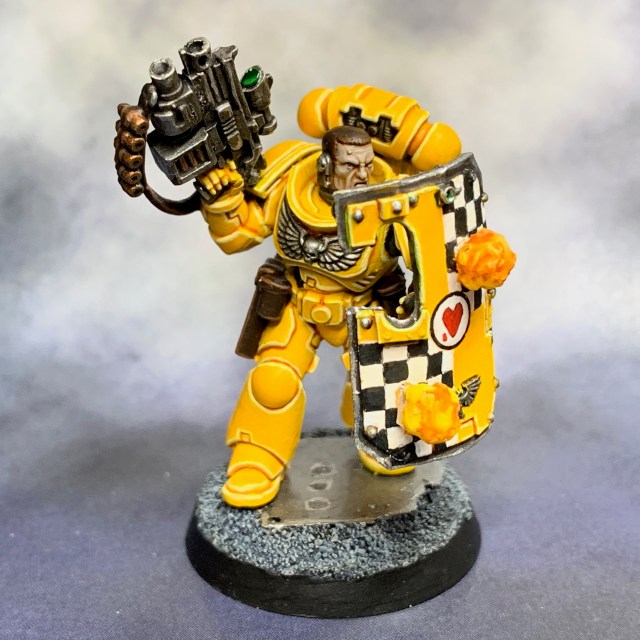
I’m pleased with how my first Marine has turned out, but slightly embarrassed to note that many of the others in the club have finished their entire kill teams in the time it took me to make a single model!

I wanted to start with a basic tactical marine just to make sure I could get everything ‘right’, before moving on to specialists and the leader. But even though he’s ‘just’ a tactical marine I still wanted to allude to the fact that he would be taking part in some brutal ship-to-ship fighting and also hint at that Blood Angel ancestry. This is why I eventually settled on the pose of being in the middle of drawing his knife.

True Scaling

I knew from the outset that I wanted my kill team to be both ‘true scale’ and to have a retro vibe. Not only is the Badab War set in 40K’s “past”, but the original campaign narrative was first conceived in the early 1990s. Thankfully true scaling is a lot easier these days thanks to plastic Primaris Marines. No mucking around with Terminator legs any more if you don’t want to!

As you can see from the WIP picture below, the model is based around a plastic Primaris Marine. I was careful to remove and resculpt any details that were obviously ‘Primaris’, such as the rims around the knee pads and the stabilisers on the ankles.

I used Reiver arms as these are less bulky than Primaris arms, since they lack the forearm ‘bracers’ that the Primaris have, and therefore look more old school. It also gave me access to ready-made arms in the process of drawing the knife.

Painting

To paint the yellow, I tried something a little different from the technique I used on my Imperial Fists. It basically went like this:

  • Corax white undercoat
  • Averland sunset base
  • Cassandora yellow shade in recessed
  • Yriel yellow (two thin coats)
  • Flash Gitz yellow edge highlight
  • Dorn yellow final edge highlight

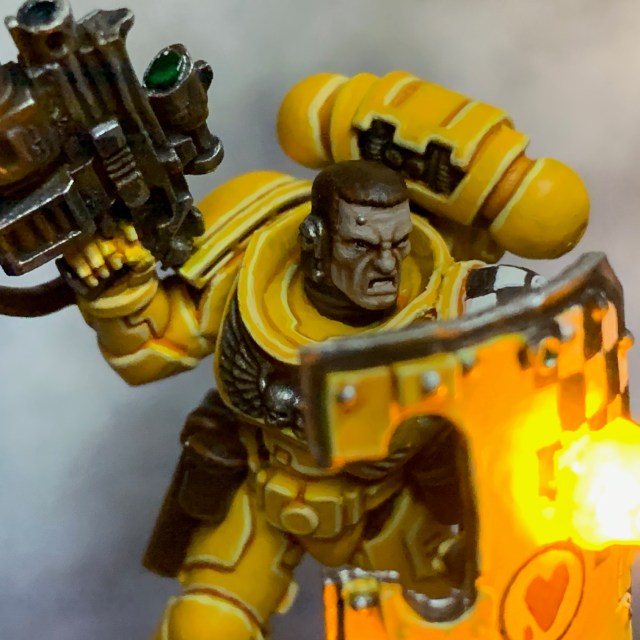
The chapter icon was an interesting challenge. I used an old Space Marine campaign badge transfer – a black skull in a black circle – applied over a white shoulder pad to get the central circle right. Then I painted over the skull in white and painted the heart in freehand (Khorne red then Evil Suns red).

Next I filled in the chequered pattern. I did this by ‘sketching’ in roughly where the black squares should be, then going back and painting the black more solidly, followed by any touch ups of the white where I’d made a mistake. I know some people like to draw in a grid for cheques and then fill in alternate squares, but I find that can leave the black squares larger than the white due to the thickness of the grid lines.

Lamenter05

LED Eye Lenses

Of course I had to add my customary LED helmet eye lenses. My tutorial is here if you’re interested and haven’t seen it already.

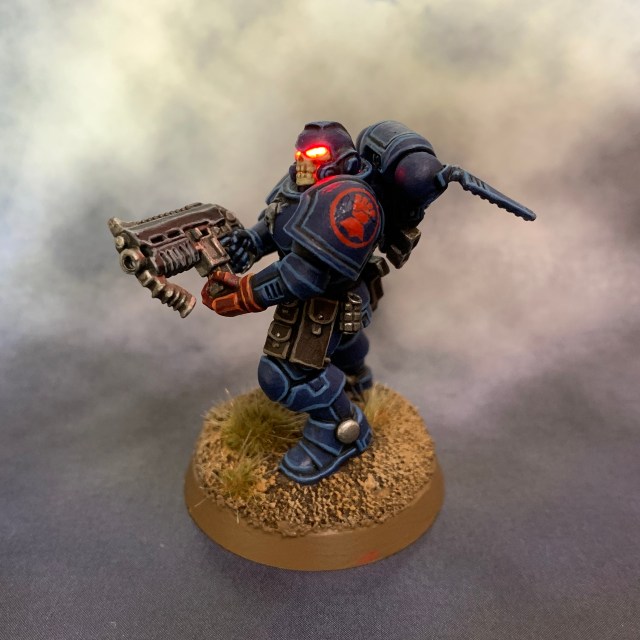
As an experiment I applied a thin coat of Spiritstone red technical paint to the eye lenses. This doesn’t do anything to hinder the light when the LED is on, but makes the eye lenses look red when it is off, as seen in the image below.

Lamenter06

That’s it for Lamenters and Badab for the moment, but there are still six more models to come. It should be a fun campaign, in addition to my Lamenters the rest of the games club already have Astral Claws, Space Sharks, Sons of Medusa and Salamanders kill teams underway. If you’d like to see my good friend Apologist’s Astral Claws kill team then his blog is here. Stay tuned for more Badab action over the coming weeks and months!

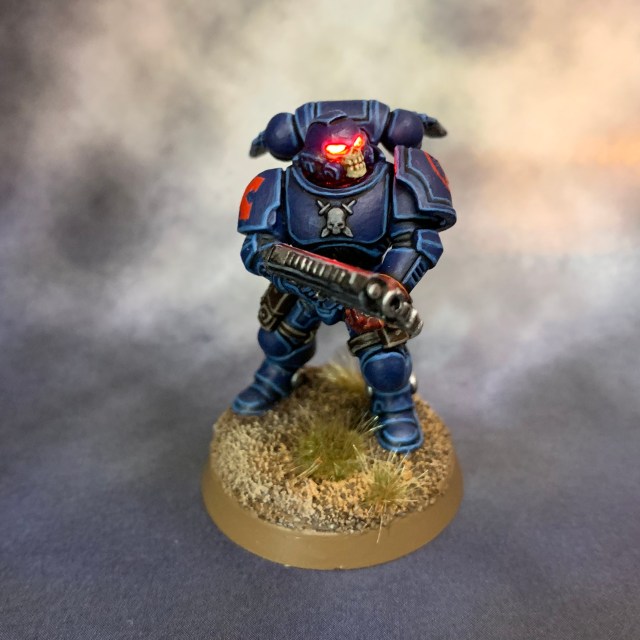
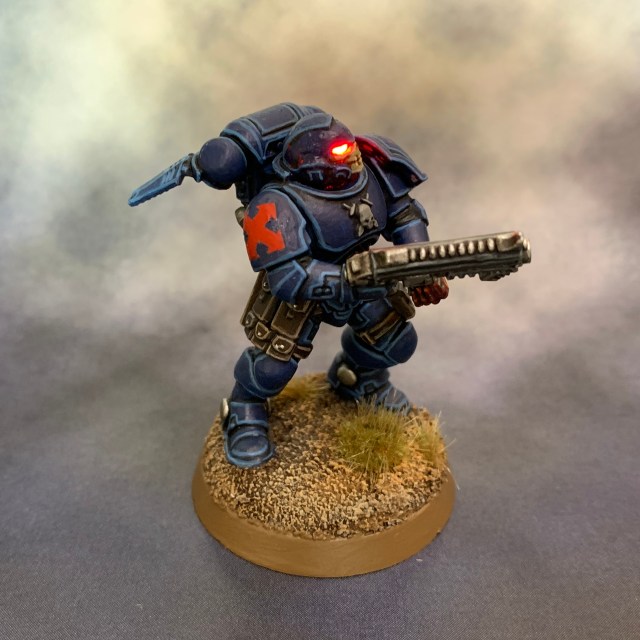
Another Primaris Reiver Finished

It is said Mankind has many enemies. But we also have many bolter rounds. – Reiver Joha

Another Reiver finished! Not a lot to say about this one as I’ve taken a break from the complicated muzzle flare effects I used on the first two models in the squad. Sometimes it’s nice to have a “rest” and put together a comparatively simple miniature in a “stock” pose.

Even though the reloading pose is a little less dynamic than the other Reivers, I have an overall vision for the squad so that all five of them will be in complimentary poses. Hopefully this will allow for some nice group shots as the unit progresses.

Don’t forget, if you’d like to have a go at LED helmet eye lenses, my tutorial can be found here.

Everchosen – 3rd Place at Warhammer Nottingham

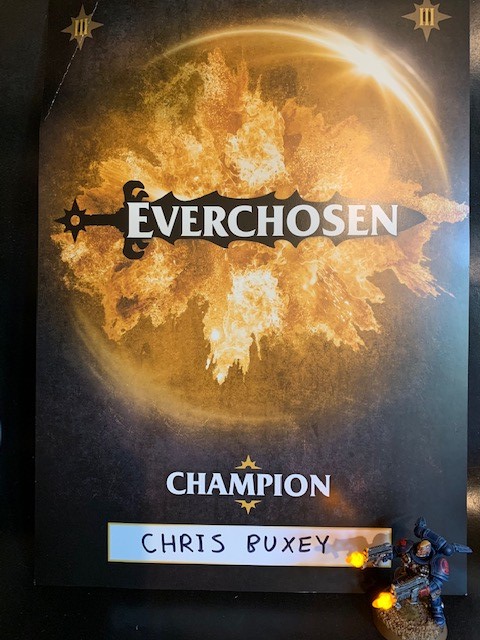
I’m pleased to say that my Reiver Sergeant picked up enough votes to come in third place in the Everchosen contest at the Warhammer Nottingham store this weekend!

Everchosen

Sadly not enough to progress to the next round, but to be honest the quality of entries at the Nottingham store was so high that I was honoured to place in the top three at all! Thank you very much to anyone who was there and voted for my miniature, if you happen to be reading this!

Nottingham isn’t actually my regular local store, but I was in the area visiting family, so it was the store I was closest to on that particular Saturday. I must say I enjoyed the Everchosen experience; it’s quite different to Golden Demon with the public vote and different rounds. The atmosphere in the store was very friendly – while I was there at least! I hope Everchosen goes on to becomes an annual event. In the meantime I’m looking forward to casting my online vote in the next round!

Conductive Paint – New Product Coming Soon From Green Stuff World

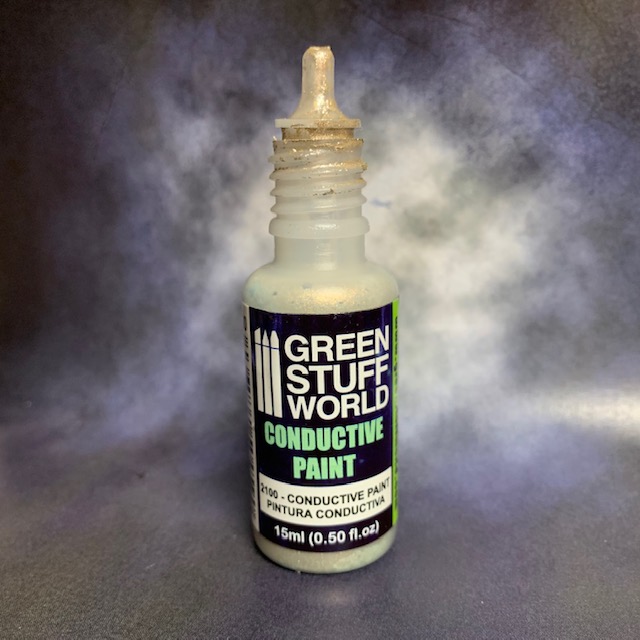
The guys at Green Stuff World, providers of many useful hobby supplies, will soon be selling a new Conductive Paint, and they got in touch to ask if I’d like to try it before it goes on general release at the end of August. Of course this is right up my alley, so I said yes please! Full disclosure, this article isn’t a paid add, but they were kind enough to supply the bottle for free.

ConductivePaint

So what is it?

As the name suggests, Conductive Paint is a paint that conducts electricity, which is useful for either creating electronic circuits from scratch or repairing gaps in existing circuits. So how does it work? Detailed ingredients aren’t listed – fair enough – but it is apparently water based and also contains silver particles, so I imagine it’s simply a high concentration of silver particles suspended in an acrylic paint medium. It seems quite similar to ElectroDAG or silverDAG, if you’ve ever used those, which are basically conductive adhesives.

Conductive Paint 02

The only GHS symbol is ‘Harmful to the Environment’, which stands to reason. Although it’s not listed as ‘Irritant’ or ‘Harmful’, I can’t imagine you’d want to get this in your eyes, so do be careful! During the course of testing I got a bit on my skin, but it easily washed off with soap and water.

One word of warning – this product is supplied in a dropper bottle. I gave it a good shake before removing the lid, and attempting to dispense some of the paint. Only a very small drop came out, so I assumed it was quite viscous and squeezed harder, at which point the spout of the dropper bottle flew off and the paint splashed everywhere! So please exercise caution when dispensing. As an aside, if it gets on your clothes, you can rub it off by hand scrubbing it in water when it has dried!

Conductive Paint 03

Testing properties

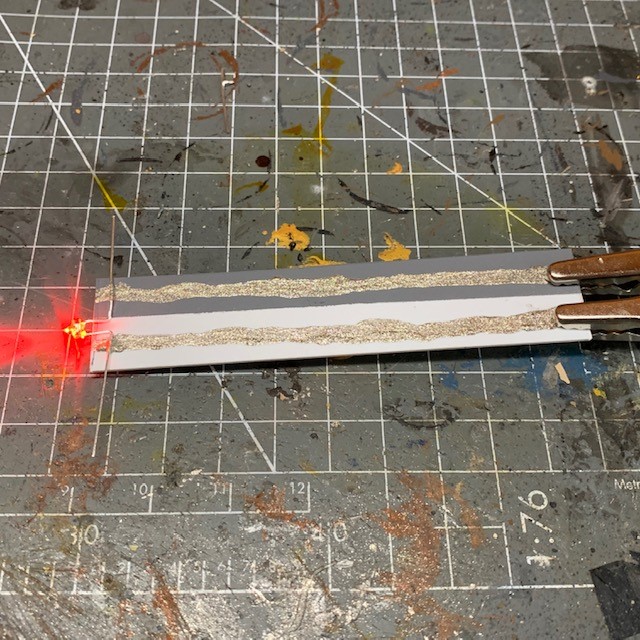
My background is in science, so the first thing I felt compelled to do was test the properties of the paint. I painted two lines on a 10cm strip of plastic card – one over bare plastic and one over an undercoat spray. This was intended to check whether the paint needed an undercoat to key to and if not having an undercoat effected its conductivity.

Conductive Paint 04

The lines are a bit wonky as I used an old brush. I wasn’t sure how easily this stuff would clean off and I didn’t want to ruin any of my good brushes. But as it turns out, it cleans off very easily under running water. Just be careful about cleaning it in a water pot, and then using that water again with normal paints, as you’re likely to contaminate your brush and the other paints with the silver particles.

Once the paint had dried I measured the resistance with a digital multi-meter. It averaged at about 5.5 Ω per cm of track. This will obviously vary with the thickness that the paint is applied.

What can we use it for?

Basic tests out of the way, what can we actually use this conductive paint it for?

Conductive Paint 05

It can definitely be used for completing circuits and connecting LEDs. The LED shown above is simply held in place by applying the conductive paint thickly over the legs and allowing it to dry. No solder used!

Conductive Paint 06

You can also use it in place of solder to connect wires to a battery holder, again applying a thick layer of the paint. The LED shown above is a blue Nano Chip LED from Small Scale Lights.

Conductive Paint 08

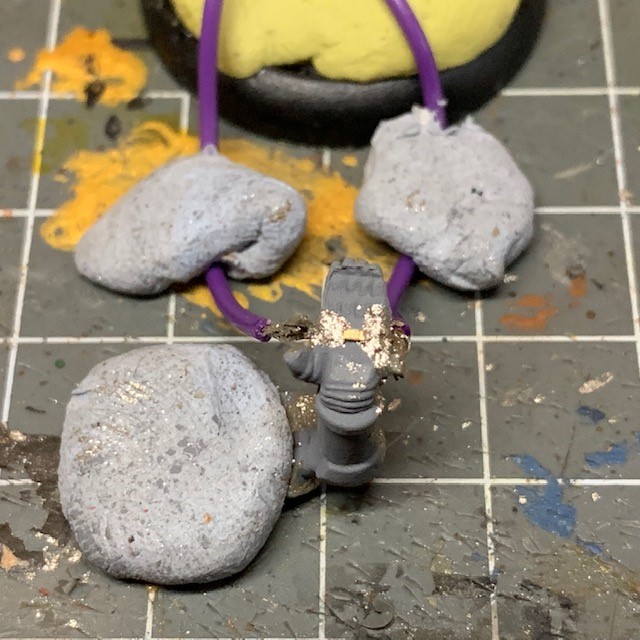
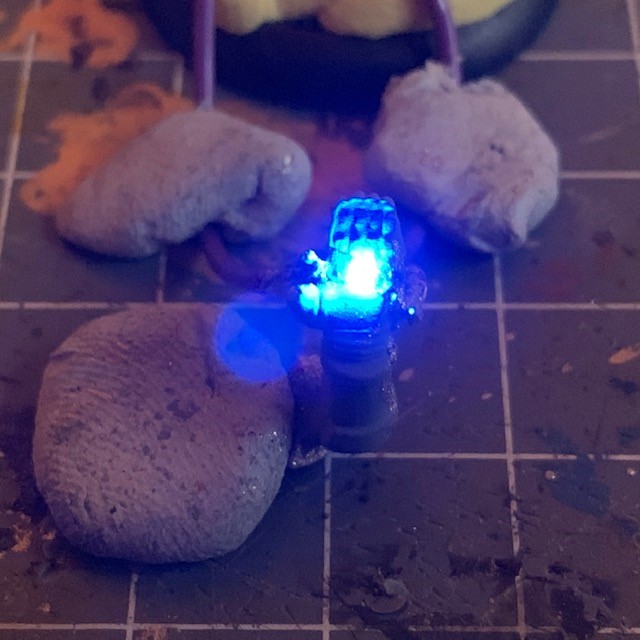
It can also be used for mounting tiny chip LEDs without any wires. The chip shown above is a Kingbright KPHHS-1005PBC-A Blue Low Profile LED mounted in a standard 0402 chip package from Rapid Electronics. These things are small, in case that’s not clear from the photo. Each chip is 1mm x 0.5mm x 0.5mm, so make sure you have some very fine tweezers handy if you’re going to be working with them. These chip LEDs have pads on the bottom at both of the narrow ends, so you just need to leave a break between the two sides of the circuit that is slightly narrower than the length of the LED, then press the chip into the conductive paint while it is still wet. When it drys, it will hold the chip in place and complete the circuit. In the image above I have added the chip to the palm of a plastic space marine arm and then attached two wires using the conductive paint, one on either side of the arm.

Conductive Paint 09

Combing these tiny chips and the conductive paint with a bit of resin casting, you could potentially use this to make cool effects like magical flames, psychic lightning or Iron Man style hand blasters, for example. On a complete model, the connections between the conductive paint tracks and the wires could be hidden inside the body. It could probably also be used as an alternative method of completing a LED muzzle flare circuit, rather than drilling out the barrel of the gun and passing wires through.

Conclusion

In conclusion, I really like this product! It’s certainly not a magical solution to all my circuit needs, but it definitely is a useful tool to have at my disposal. The ability to use it to mount chip LEDs and using it to make solderless connections is especially handy.

Where it doesn’t compare to solder is in long-term durability and strength of the connections, but in effect you’re trading that off for the speed and convenience of applying the paint.

The other potential downside is the resistance. The 5.5 Ω per cm may not sound like a lot, but when you compare it to the resistance of 0.1mm copper wire, which will be about 0.02 Ω per cm, it soon adds up. When I first started testing the conductive paint I envisaged using it to mount LEDs on a model – such as the chip LED mounted on the arm shown above – and then painting tracks all the way down the side of the model (hidden under the top paint coat) to connect it to the battery in the base. However on reflection that might be tricky, as if you layer on the conductive paint too thick then it will be hard to hide under the regular paint, but if you make it too thin then the resistance could be too great. It would effectively be like adding a 50 or 100 Ω resistor into the circuit, which would be a problem.

Having said that, it definitely seems to work as intended for short connections, and I’ll certainly buy more when my free sample runs out! Conductive Paint will be available from Green Stuff World at the end of August.

Sergeant Bast, Reiver Squad Leader with LED Muzzle Flares

SgtBast02

I only have two answers for the question of heresy, and both of them are fully loaded! – Reiver-Sergeant Bast, on the eve of the Jotun Offensive.

Reiver-Sergeant Bast is the second member to be completed for my Reiver squad, and also my entry for the Everchosen nationwide painting competition that Games Workshop are running tomorrow.

The role of the Reiver has two aspects, just like our skull helms and the human faces underneath. One is the stealthy infiltration of our targets. The other is the application of instant and overwhelming force. – Reiver-Sergeant Bast, squad initiation.

When I was first planning how to assemble this unit, I decided I wanted to go for very dynamic and aggressive poses. I was imaging them deploying via their grav-chutes, opening fire on their targets before they were even on the ground.

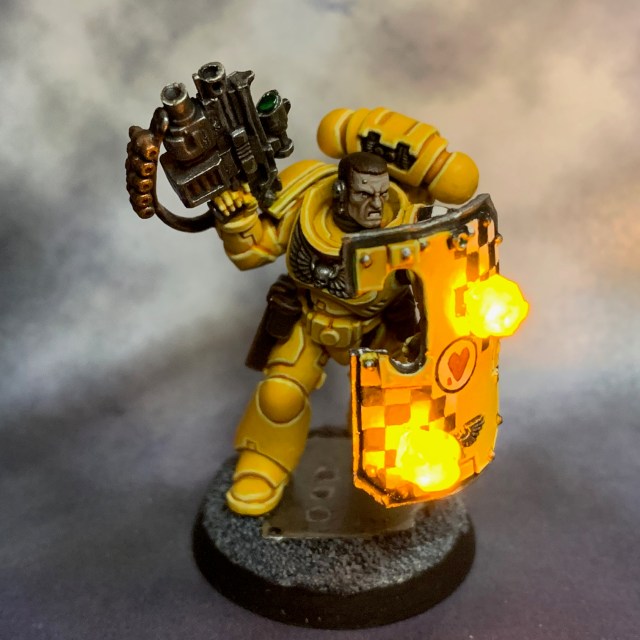
This conversion may look a little complex, but it was actually fairly simple. There is no left-handed bolt carbine on the Reiver sprue, but I simply cut the hand from the right-hand from bolt carbine that doesn’t have a hand on the forward grip, and then glued it onto a left combat knife arm. The LED muzzle flare effects were achieved as described in my tutorial here. Both LEDs are connected to the same battery in parallel. As they are identical LEDs there is no need for any additional resistors (the current draw is obviously the same for both). There’s no actual in-game effect for having two bolt carbines on the model, it’s just for show!

SgtBast06

The image above shows the model with the LEDs switched off. Normally I leave the resin unpainted, but that of course means the muzzle flares are resin white when the LEDs are not on. As an experiment for this model, I painted some Fuegan Orange shade into the recesses, and then painted the whole muzzle flare with Lamenters Yellow glaze. As you can see above it makes the muzzle flare resin look better when the LEDs are off, but doesn’t seem to effect the brightness at all, since the shade and the glaze are both semi-transparent. I’m so pleased with this look that I think I’ll go back and apply this to all previous muzzle flares.

More Reivers to come soon, and I’ll post an update over the weekend about how Sergeant Bast does in the Everchosen competition!