‘The Summons’

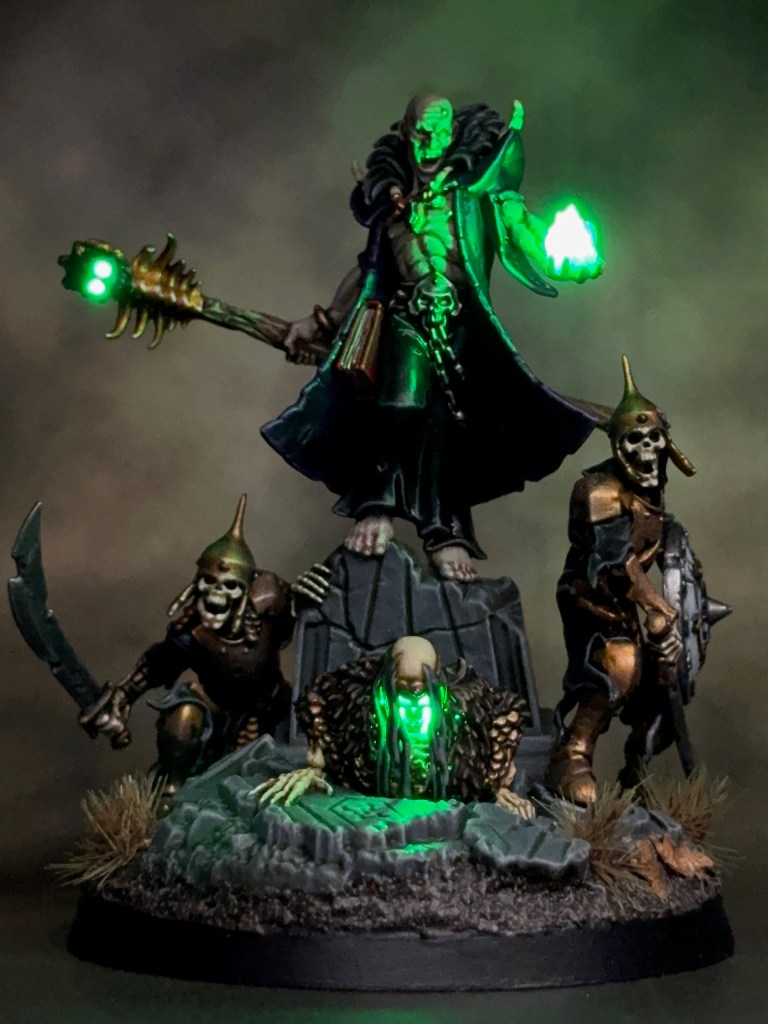
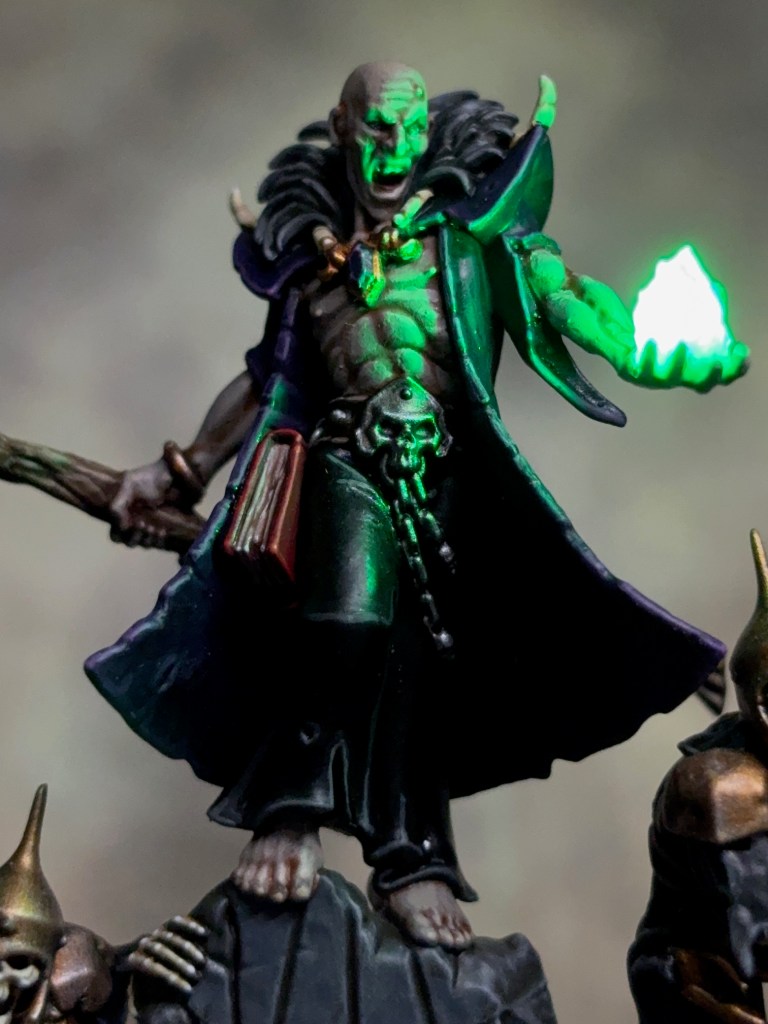
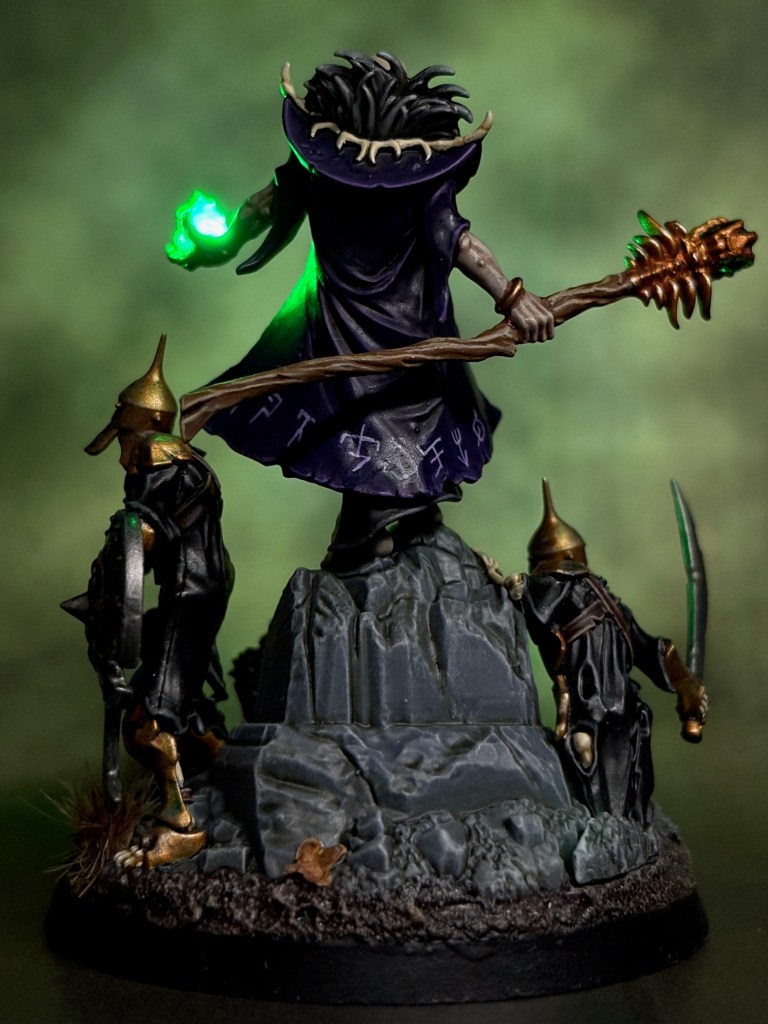
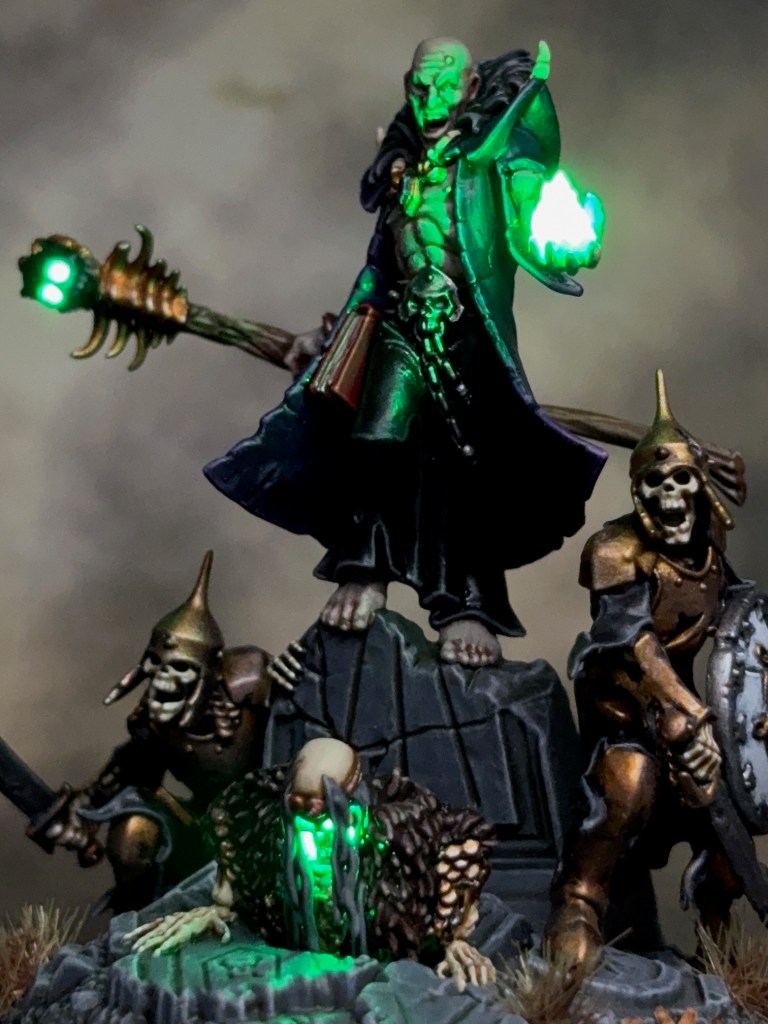
This week I’m sharing my take on the Warhammer+ Soulblight Gravelords ‘The Summons’, with some extra LED magic of course! I had hoped to finish this spooky miniature in time for Halloween, but it took a longer to paint than I’d estimated.

Modelling

I’ve been flirting with the idea of building some variety of Warhammer Undead army for many years now. So when the Warhammer+ miniatures were announced for this year, the Necromancer really leapt out at me as the clear choice. The stock miniature doesn’t feature any obvious light sources, so I had some creative freedom on which parts I chose to illuminate. I considered a number of ideas; candles, lanterns, glowing necklace gems, burning green eyes on the Necromancer, and even an unholy glow projected upwards from the open grave.

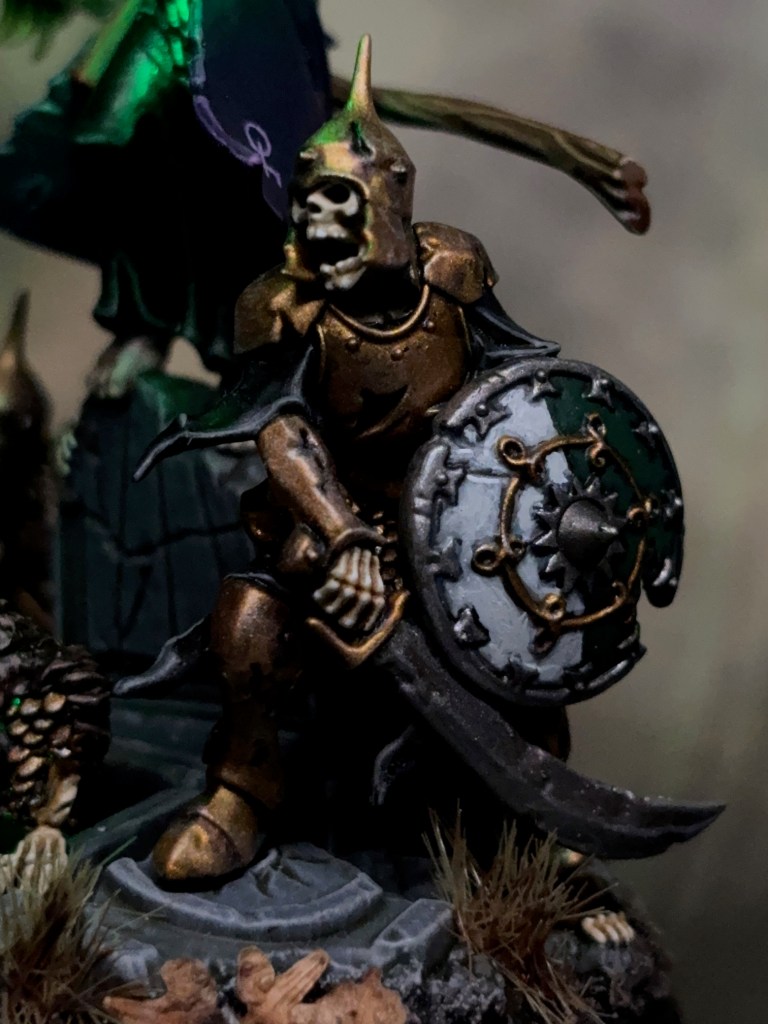
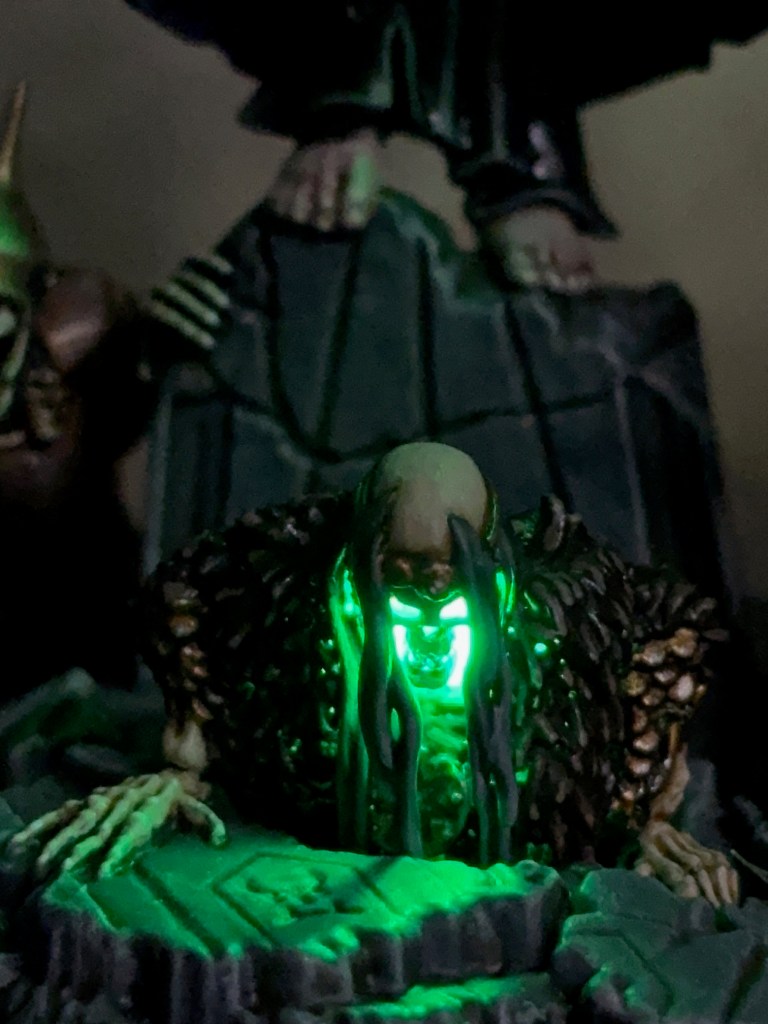
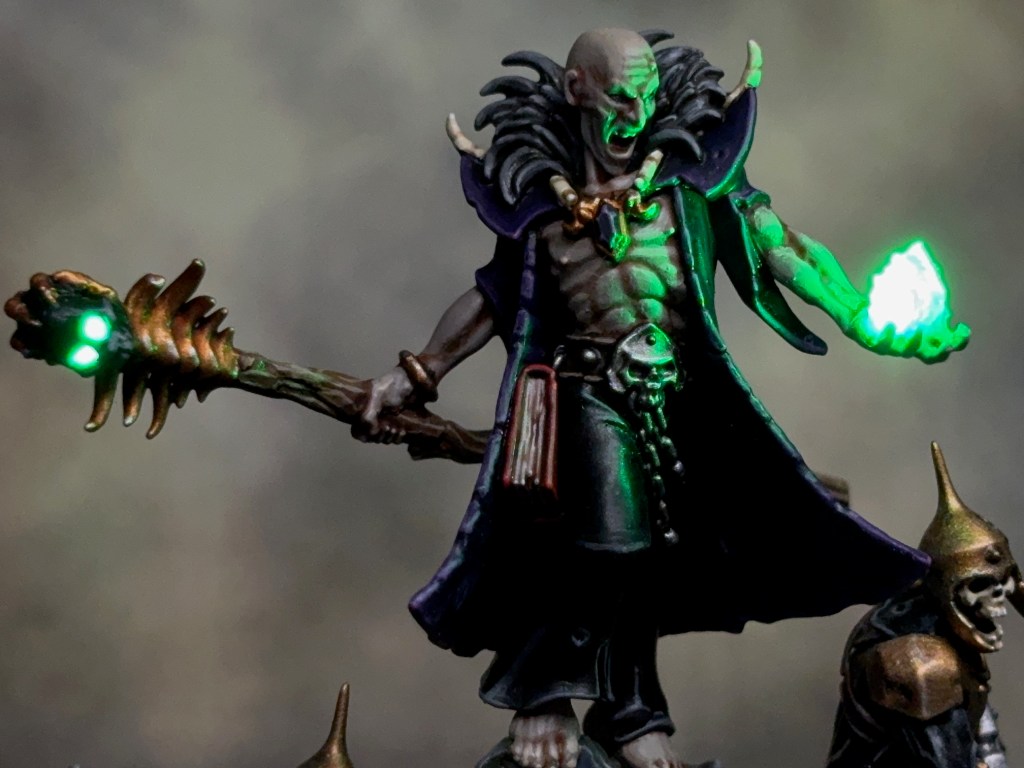
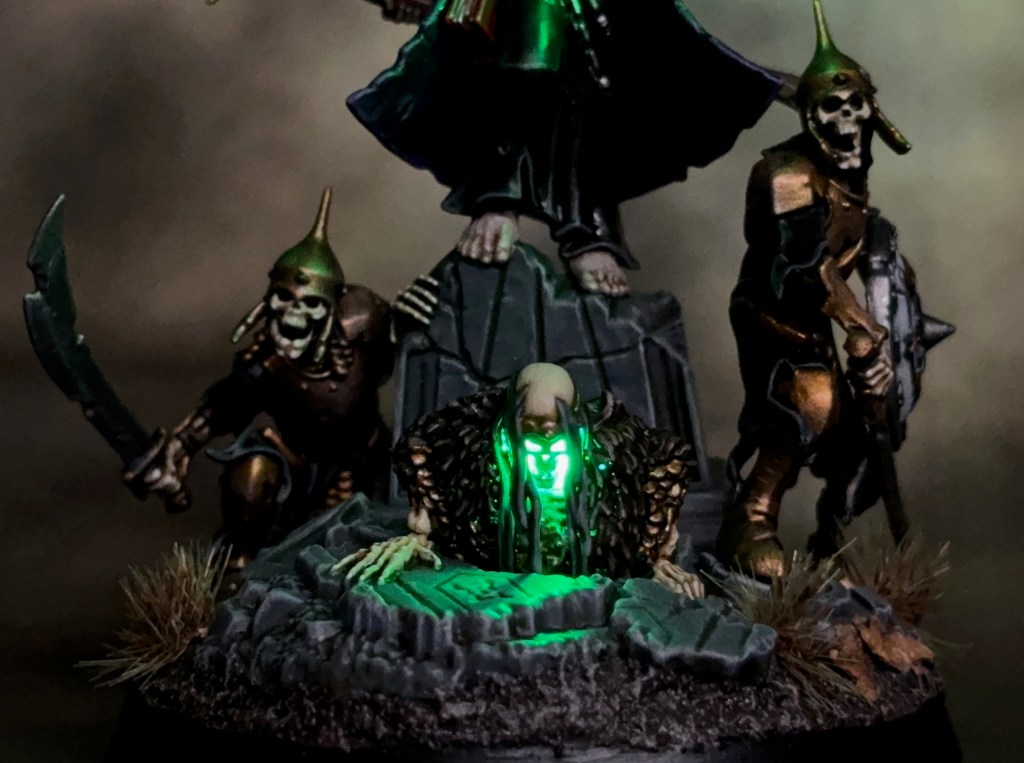
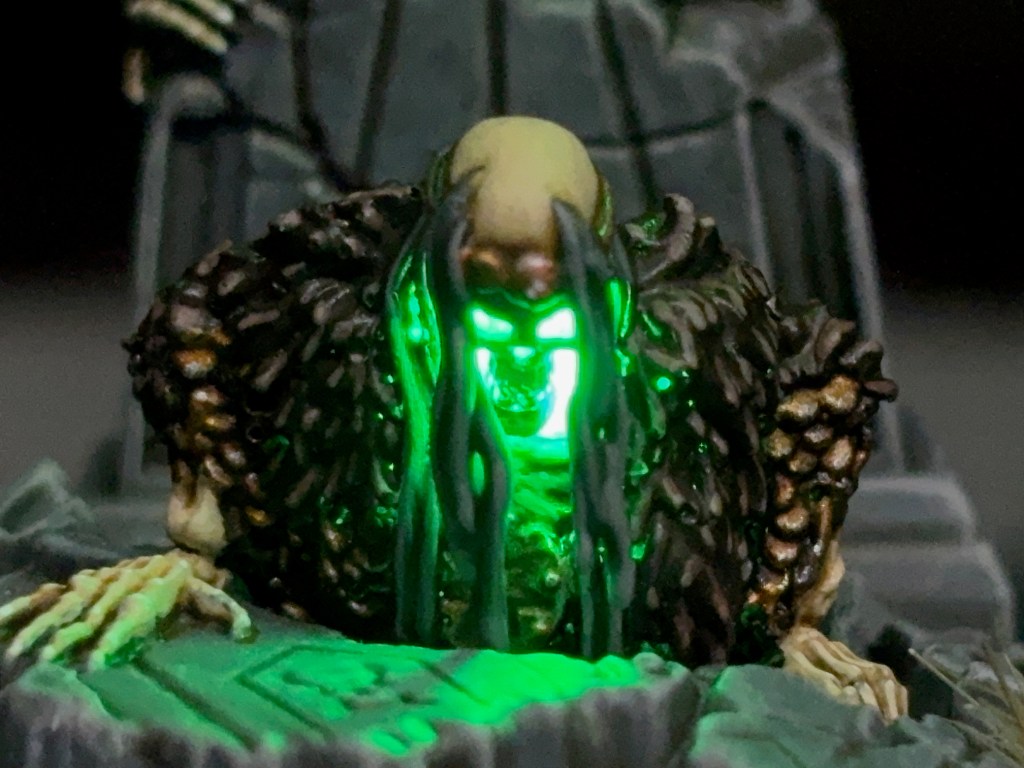
I settled on illuminating the eyes of the Skull Staff, a soulfire flame in the conveniently outstretched hand, and the skull of the skeleton who is mid-reanimation. These areas created a visually pleasing triangle of light when viewed from the front.

The Skull Staff and reanimating skeleton were illuminated followed the techniques described in my LED Eye Lens tutorial, only with skulls rather than space marine helmets. The soulfire flame was created using acrylic gel from Green Stuff World and followed the techniques described in my Simple LED Muzzle Flare tutorial.

All three of the LEDs are 3V Green 0805 SMD Chip LEDs with 10 ohm resistors. The three LEDs are connected in parallel with a single CR2032 coin cell battery and switch in the base.

Painting

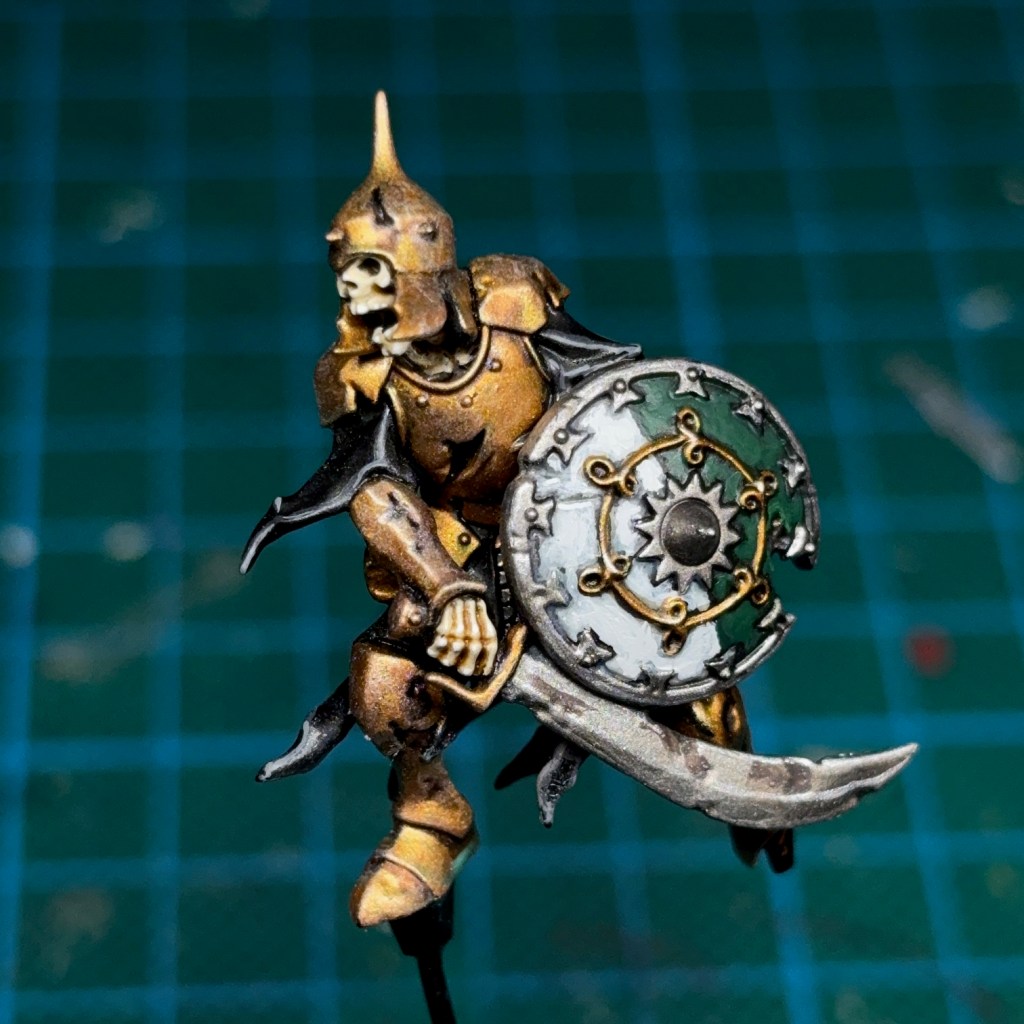
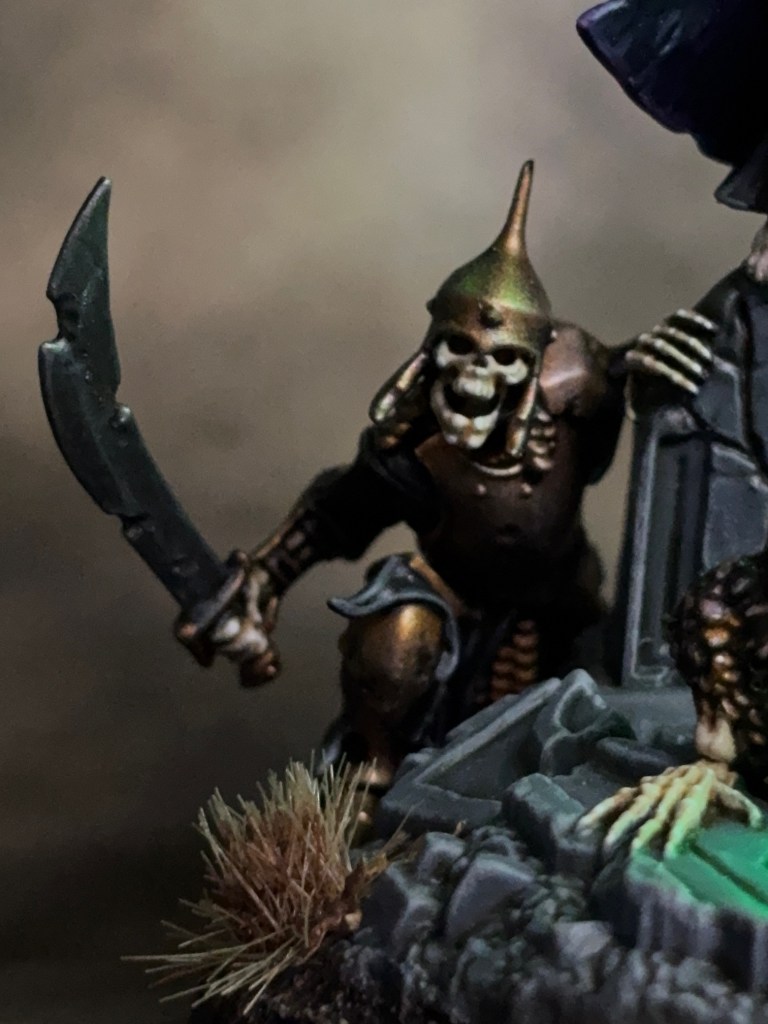
When deciding on the paint scheme, I decided to stay reasonably close to the box art as I didn’t have an existing army colour palette to match. The purple and black robes were also very evocative of the classic Warhammer Fantasy Necromancer. But I did add a few small twists of my own. In my head canon this is Wilhelm Lichtenfels, a Necromancer I created for a short lived narrative campaign ‘Shadow Over Steepacre’, that I played with with my gaming group back when Age of Sigmar was first released. The Steepacre town heraldry was white and green, which is reproduced in the skeleton’s shield. I’ve made previous versions of Wilhelm, and each version becomes a little more corrupted (and a little more buff).

R.I.P? More like ripped! Am I right, ladies?!

Helga Stormglad, Steepacre resident (burned as witch)

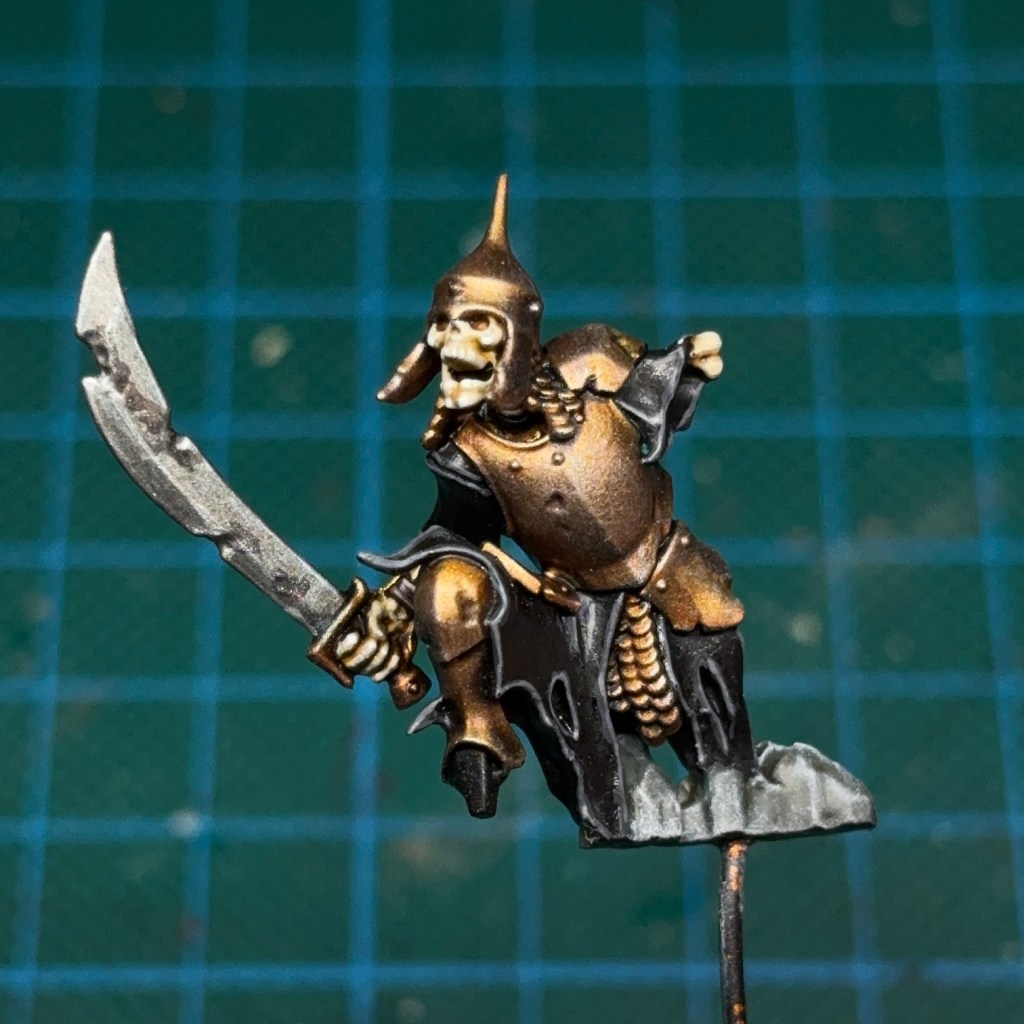
The miniature was undercoated with Citadel ‘Chaos Black’ spray. All other paints are Citadel unless specified otherwise. It’s worth noting that for ease of access to details I painted the skeletons as separate sub-assemblies.

  • Bones
  • Wraithbone basecoat
  • Skeleton Horde Contrast shade
  • Ushabti Bone highlight
  • Screaming Skull fine highlight
  • White Scar spot highlight
  • Pallid Skin
  • Rakarth Flesh basecoat
  • Reikland Fleshshade shade
  • Rakarth Flesh layer
  • Skin Tones (Pale) tutorial steps 5-11 (replacing Bugman’s Glow with Rakarth Flesh)
  • 50:50 Rakarth Flesh:Flayed One Flesh highlight
  • 33:66 Rakarth Flesh:Flayed One Flesh fine highlight
  • Flayed One Flesh spot highlight
  • Dark Purple Cape
  • Naggaroth Night basecoat
  • Druchii Violet shade
  • Xereus Purple highlight
  • Genestealer Purple fine highlight
  • Cape Runes
  • Xereus Purple layer
  • 90:10 Corax White:Xereus Purple highlight
  • Naggaroth Night thin glaze
  • Black Cloth
  • Abaddon Black basecoat
  • Agrax Earthshade shade
  • Eshin Grey highlight
  • Dawnstone fine highlight
  • Grey Fur
  • Mechanicus Standard Grey basecoat
  • Agrax Earthshade shade
  • Dawnstone layer
  • Administratum Grey layer
  • Brown Fur
  • Rhinox Hide basecoat
  • Seraphim Sepia shade
  • Gorthor Brown layer
  • Baneblade Brown layer
  • Bronze Armour
  • Retributor Gold basecoat
  • Kabalite Green thin glaze
  • Agrax Earthshade shade
  • Runefang Steel drybrush
  • Iron Weapons & Trim
  • Leadbelcher basecoat
  • Nuln Oil shade
  • Runefang Steel highlight
  • Obsidian Skull Staff
  • Abaddon Black basecoat
  • 50:50 Abaddon Black:Daemonette Hide highlight
  • Daemonette Hide fine highlight
  • Dawnstone Grey spot highlight
  • Gold Staff, Jewellery & Coins
  • Retributor Gold basecoat
  • Reikland Fleshshade shade
  • Runefang Steel highlight
  • Wooden Staff
  • Steel Legion Drab basecoat
  • Reikland Fleshshade shade
  • Tallarn Sand highlight
  • Karak Stone fine highlight
  • Red Leather Book Cover
  • Khorne Red basecoat
  • Carronburg Crimson shade
  • Wazzdakka Red highlight
  • Evil Sunz Scarlet fine highlight
  • Wild Rider Red spot highlight
  • Book Pages
  • Rakarth Flesh basecoat
  • Reikland Fleshshade shade
  • Pallid Wych Flesh highlight
  • White Scar spot highlight
  • Shield Green Heraldry
  • Caliban Green basecoat
  • Athonian Camoshade shade
  • 50:50 Caliban Green:Warpstone Glow layer
  • Warpstone Glow highlight
  • Shield White Heraldry
  • Corax White basecoat
  • Apothecary White Contrast shade
  • Corax White layer
  • White Scar highlight
  • Grave Stone (base)
  • Mechanicus Standard Grey basecoat
  • Athonian Camoshade shade
  • Dawnstone drybrush
  • Administratum Grey drybrush
  • Corax White light drybrush
  • Dark Earth (base)
  • Dryad Bark basecoat
  • Agrax Earthshade shade
  • Gorthor Brown drybrush
  • Karak Stone drybrush
  • Ushabti Bone light drybrush

The only other thing worth mentioning is that the magical flame was painted with a thin glaze of Hexwraith Flame.

That’s all for today, I hope you’ve enjoyed this (sort of) seasonal miniature! I’ll be back again soon, most likely with more space marines. As ever, thanks very much for reading, and please remember you can also find me sharing my work on InstagramThreadsBluesky and Mastodon. Or if you prefer you can subscribe to my website by entering your email in the box below to receive updates whenever I post a new blog article or tutorial.
Imperial Fists Saturnine Terminator Heavy Disintergrator

Mercy? That was the mercy setting!

Veteran-Brother Alruba, 36th Company, Imperial Fists Legion

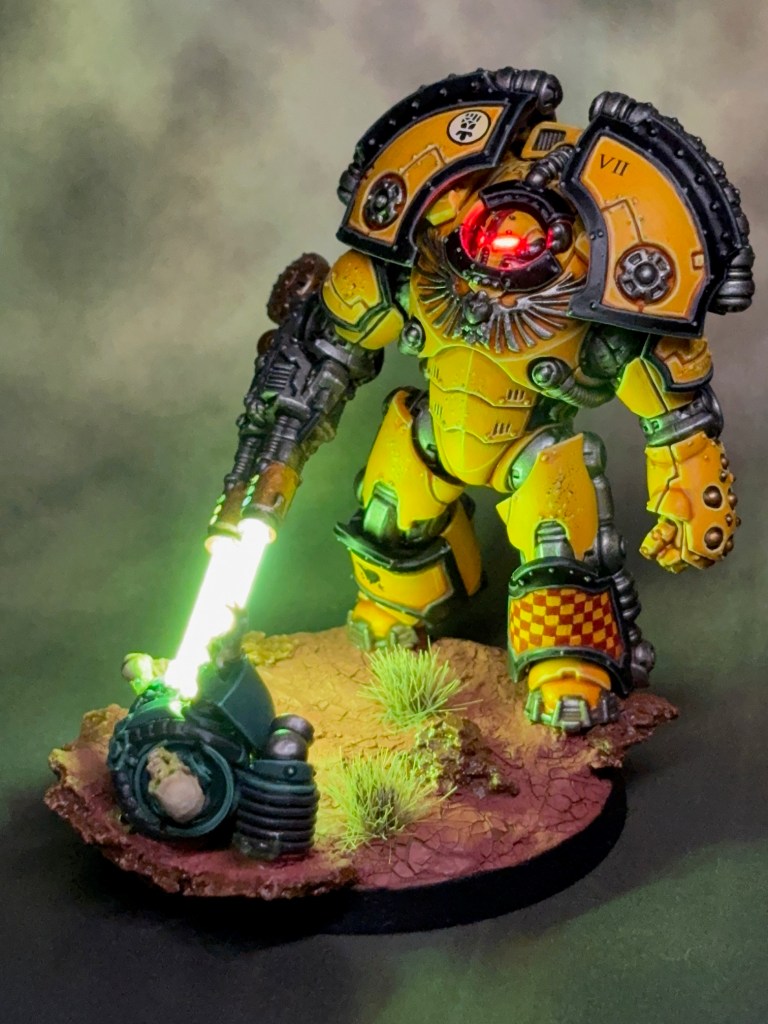
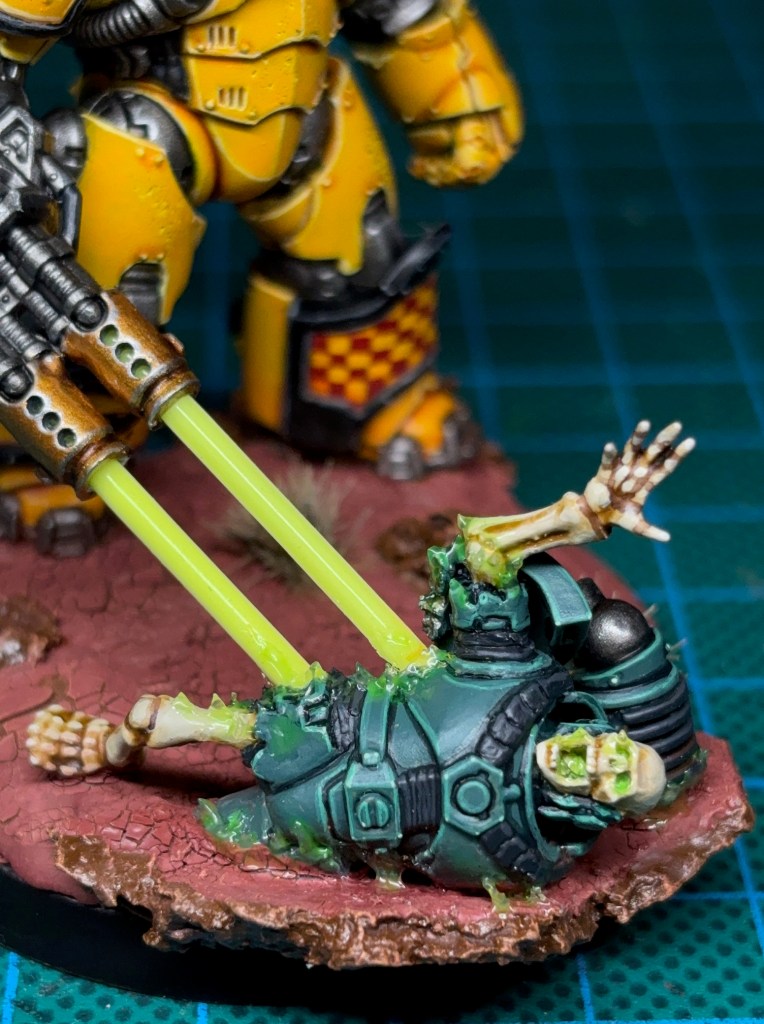
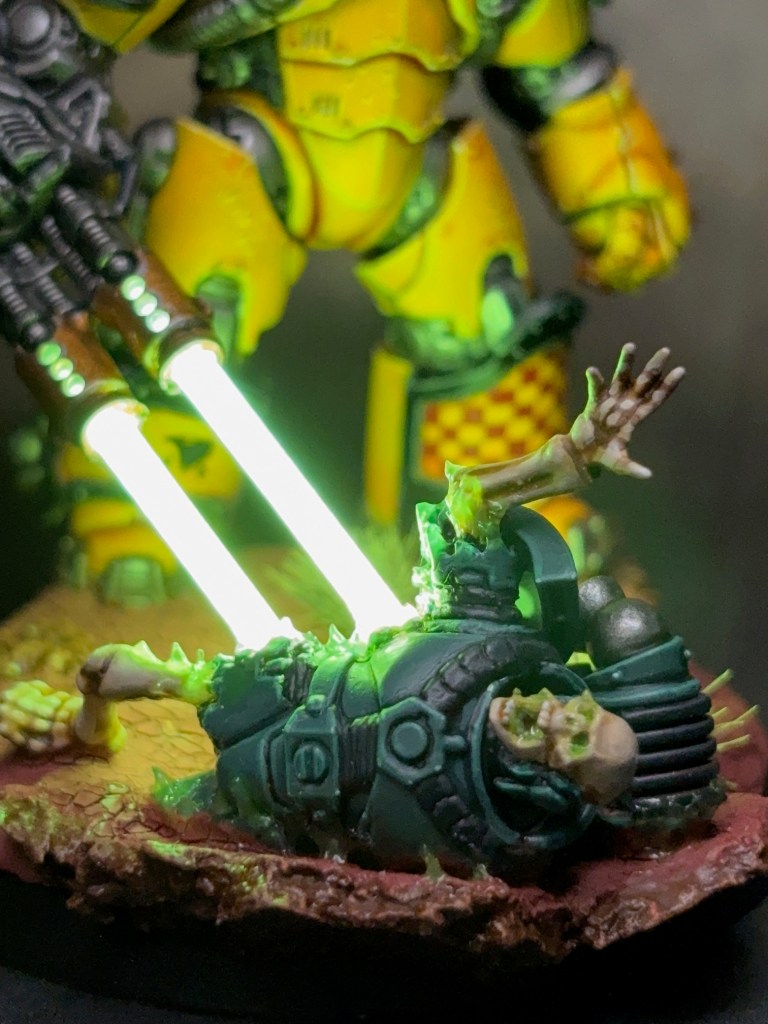
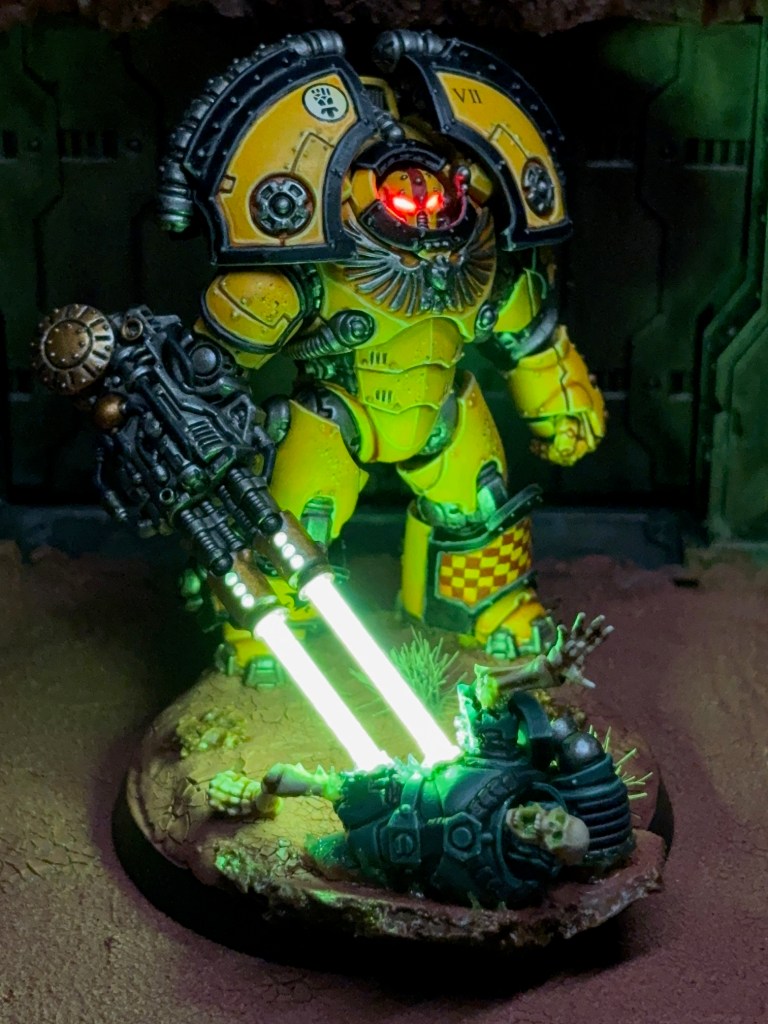
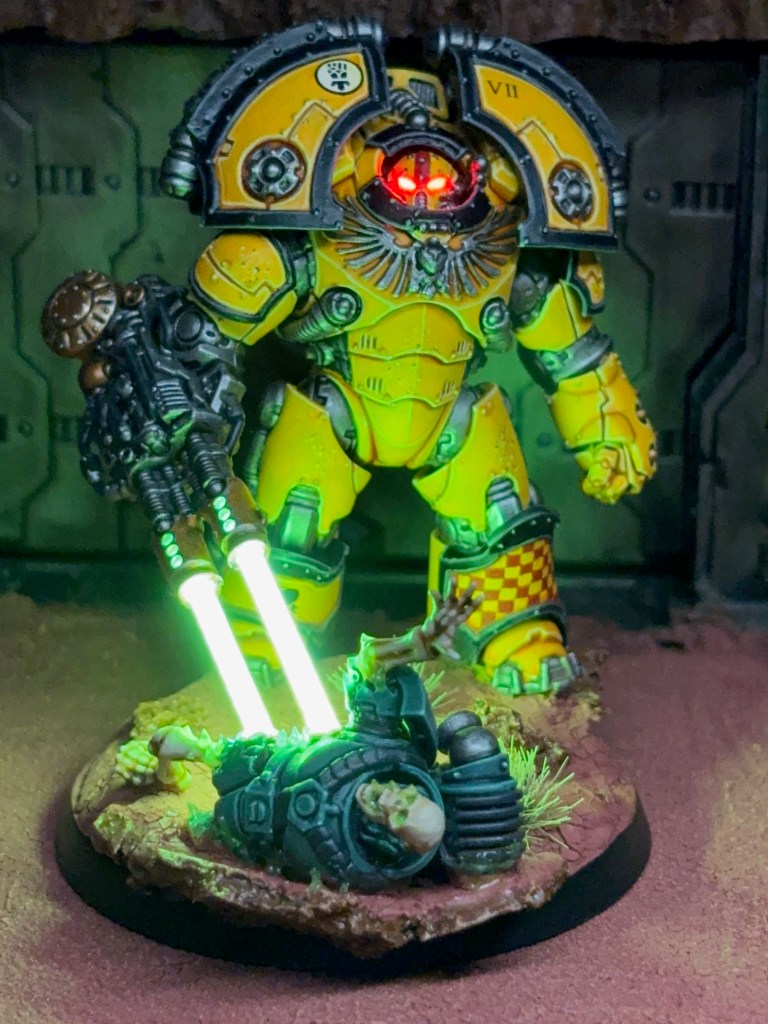
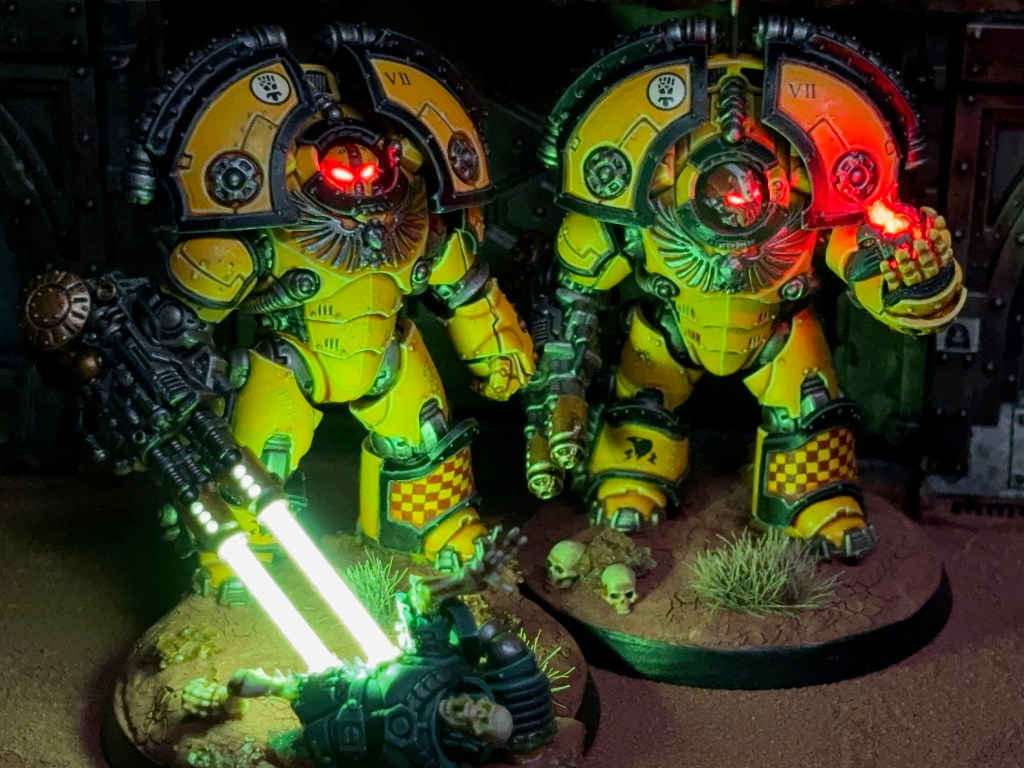
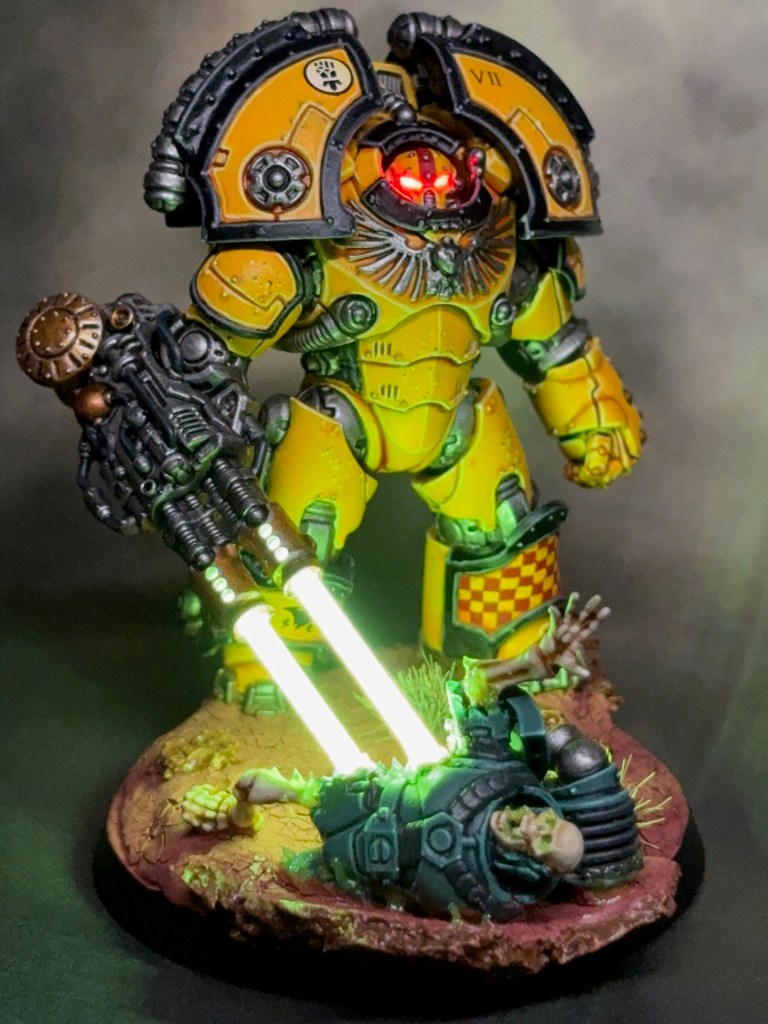
I’ve made more progress on my Imperial Fists in the Age of Darkness project this week as another marine joins my Saturnine Terminators – and this time they’re bringing the full power of their heavy disintegrator!

Modelling

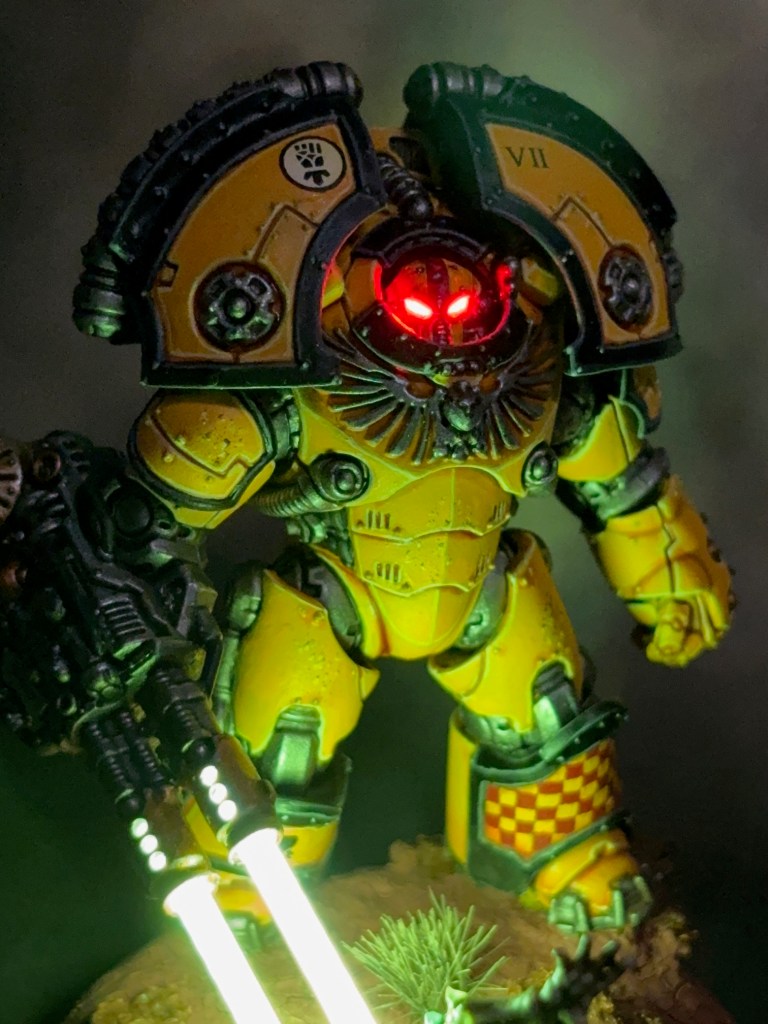
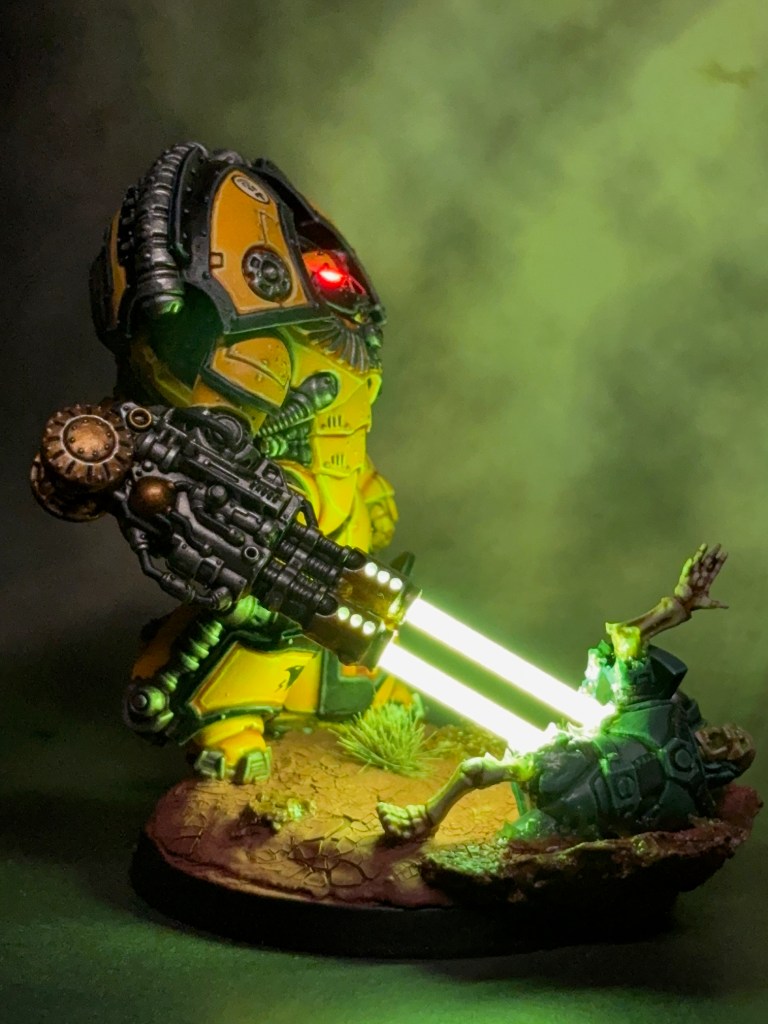
My goal for this unit of Saturnine Terminators was to make them look brutal and intimidating, and the focus of this miniature is very much the energy beams coming from the twin heavy disintegrators and their unfortunate victim. Long-time readers of this website may recognise this as a riff on the themes and techniques used in my “Burn Traitor” Golden Demon diorama, although this time I wanted to execute the effect on a usable gaming miniature rather than a display piece.

The disintergration beams are made from two yellow-green filament LEDs (shown switched off and switched on in the two images above). Although the disintergration beams shown in the Horus Heresy cinematic trailer are blue, I decided I preferred the look of green beams. The filaments are 38mm 3V LEDs (available in the UK from eBay), and each connected in series with a 10 ohm resistor. The two filament-resistor pairs were then connected in parallel to each other and in series with a single CR2032 coin cell battery and switch in the base. The filament LEDs have their connections at opposite ends, so one part of the connecting circuit passes up through the gun and arm, down the torso and legs and into the base. The other part of the circuit passes through the dead marines and directly into the base. If you plan to work with this type of filament LEDs yourself it is worth noting they are very brittle and will not bend at all without snapping. This whole miniature was constructed and painted very carefully!

The helmet LED is on a separate circuit with it’s own battery and is built around a TruOpto OSHR7331A-KL 1.8mm Red LED and the techniques described in my LED Eye Lens tutorial.

The dead Sons of Horus marine is made from parts of the Legion MKVI Tactical Squad kit and various fantasy undead components. I was trying to give the impression that the disintergration beams had already destroyed all the organic components of the marine and had now begun to eat away at the tougher bones and armour. The ‘flames’ were created from Water Splash Effect Gel, available from Green Stuff World.

Painting

I’ve been working on painting this miniature for several weeks, mainly because it is essentially two miniatures. The paint scheme I used follows my Imperial Fists recipes described in this earlier post and the Saturnine heraldry described in this post. My Sons of Horus paint scheme can be found in this post.  The flames on the Sons of Horus marine were painted with a thin glaze of Hexwraith Flame.

As mentioned above, I had to be very careful with the filaments during painting, as an accidental knock from my brush could have damaged it. To keep the filaments safe during undercoating I gently wrapped them in a layer of tinfoil using tweezers (and a steady hand)!

That’s all for today, but I’ll be back soon with more Imperial Fists plus some seasonal diversions! As ever, thanks very much for reading, and please remember you can also find me sharing my work on InstagramThreadsBluesky and Mastodon. Or if you prefer you can subscribe to my website by entering your email in the box below to receive updates whenever I post a new blog article or tutorial.
Imperial Fists Saturnine Terminator Sergeant

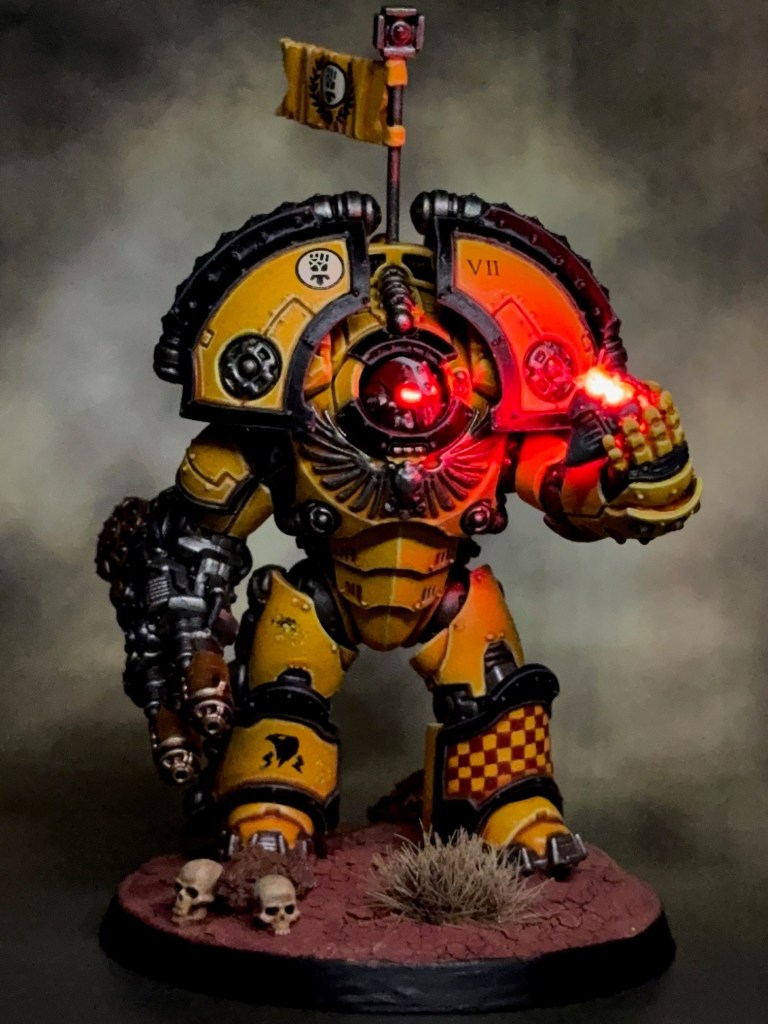
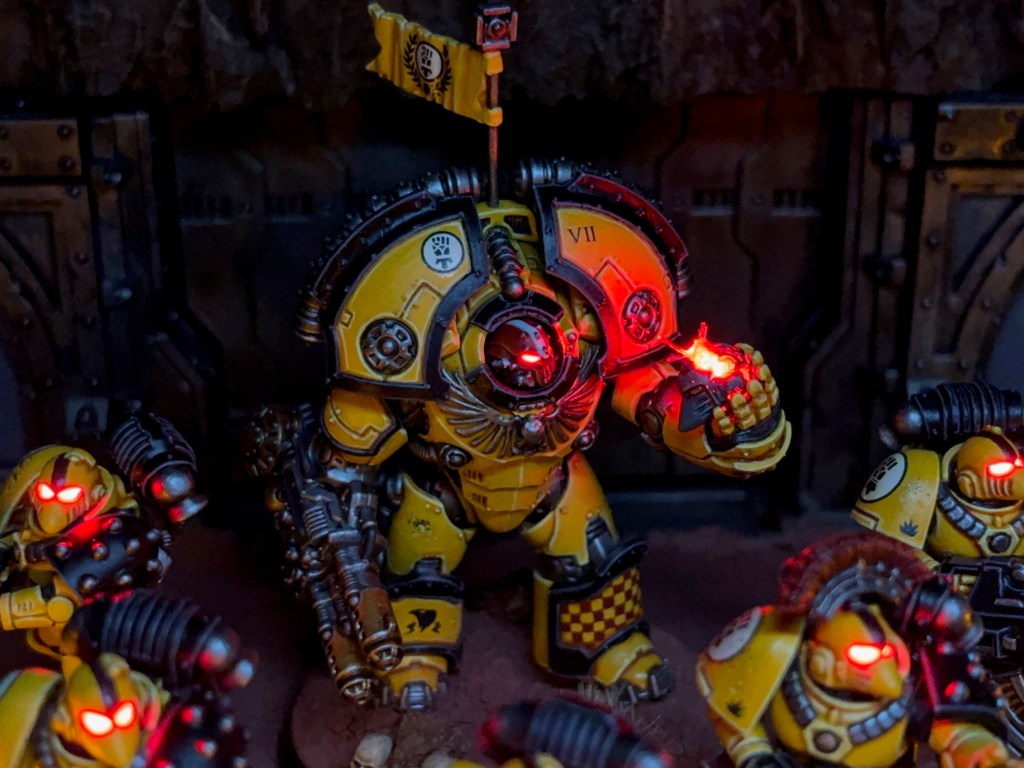
My Imperial Fists in the Age of Darkness project continues this week with the start of a new unit – the Saturnine Terminators! First to step out of the arming chambers is the Saturnine Terminator Sergeant.

Modelling

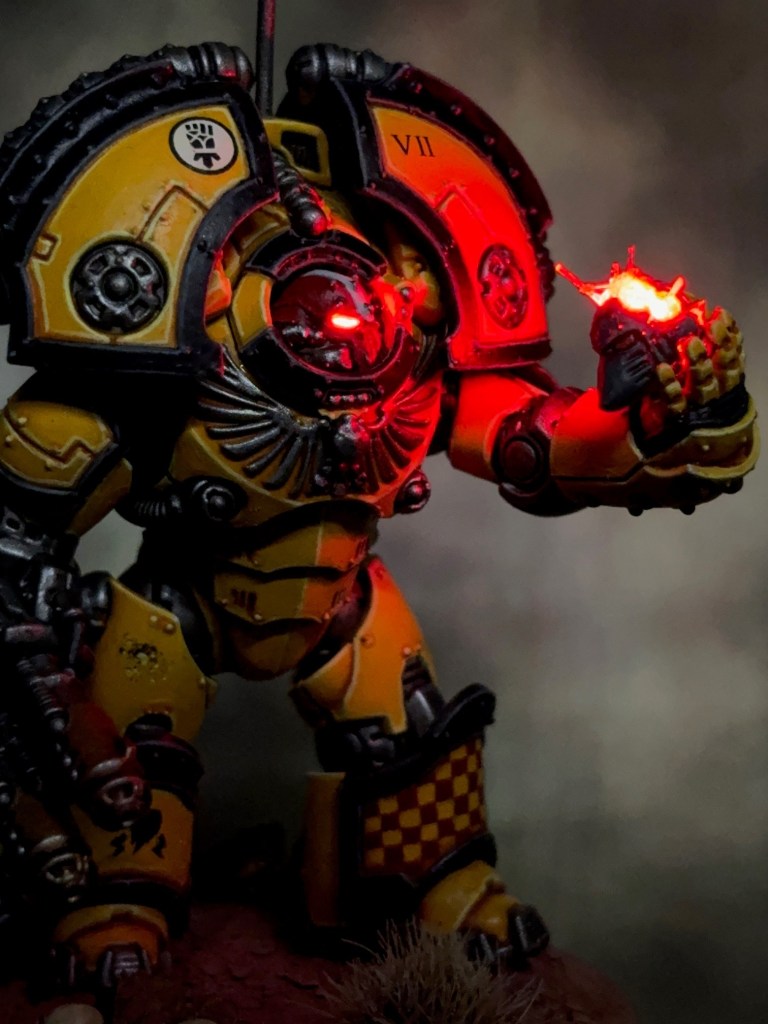
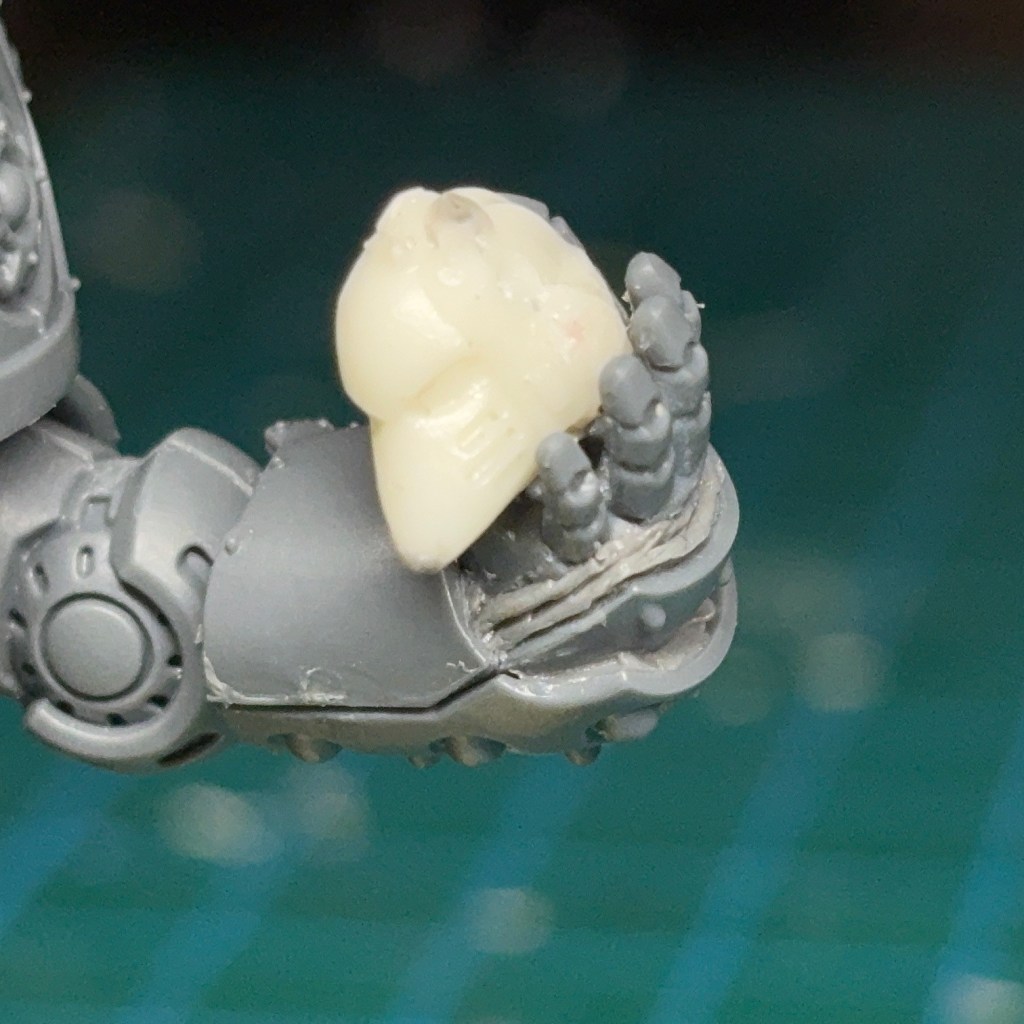
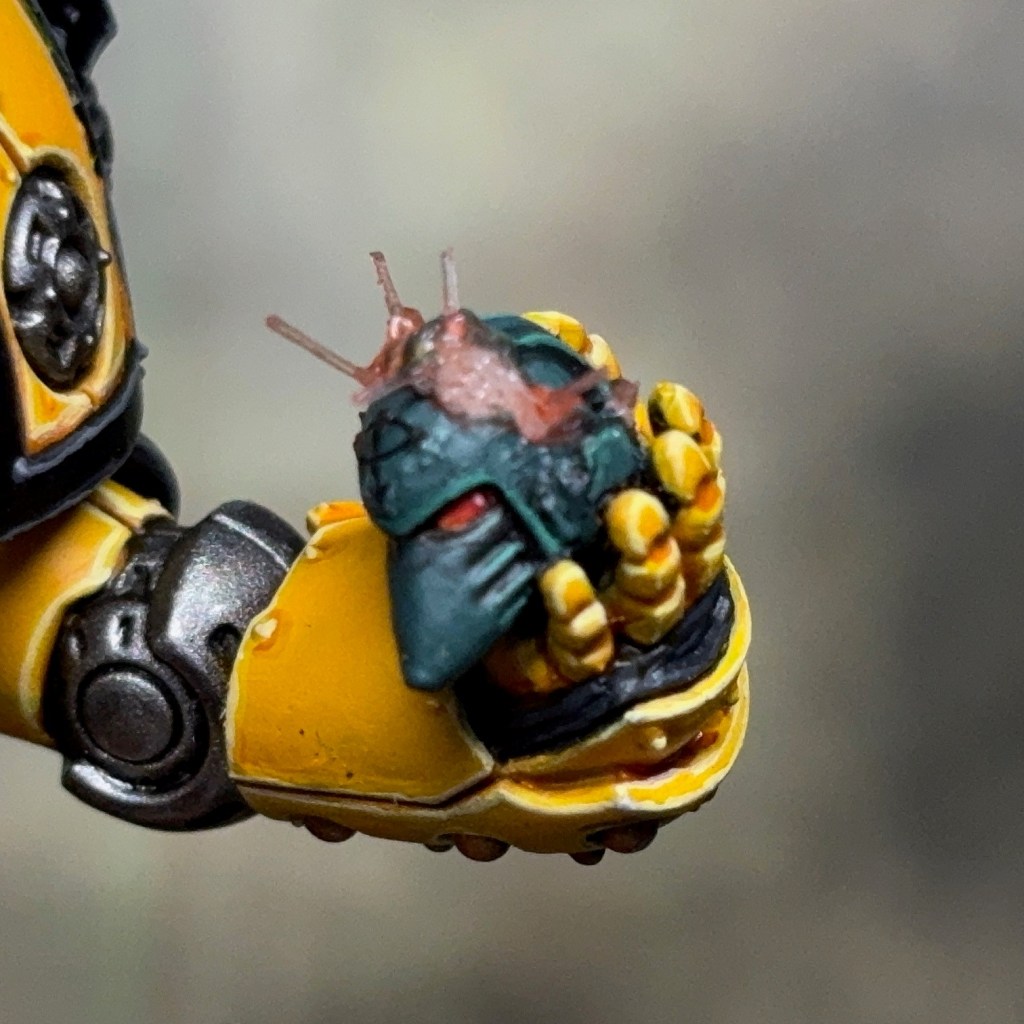
I want my Saturnine Terminators to look brutal and intimidating, so I have modelled the sergeant casually crushing a MkVI Sons of Horus helmet in his disruption fist. I also selected the Saturnine helmets with the spiked studs and vox grill for this squad. They might be a more common choice for the traitor legions, but I just love the look!

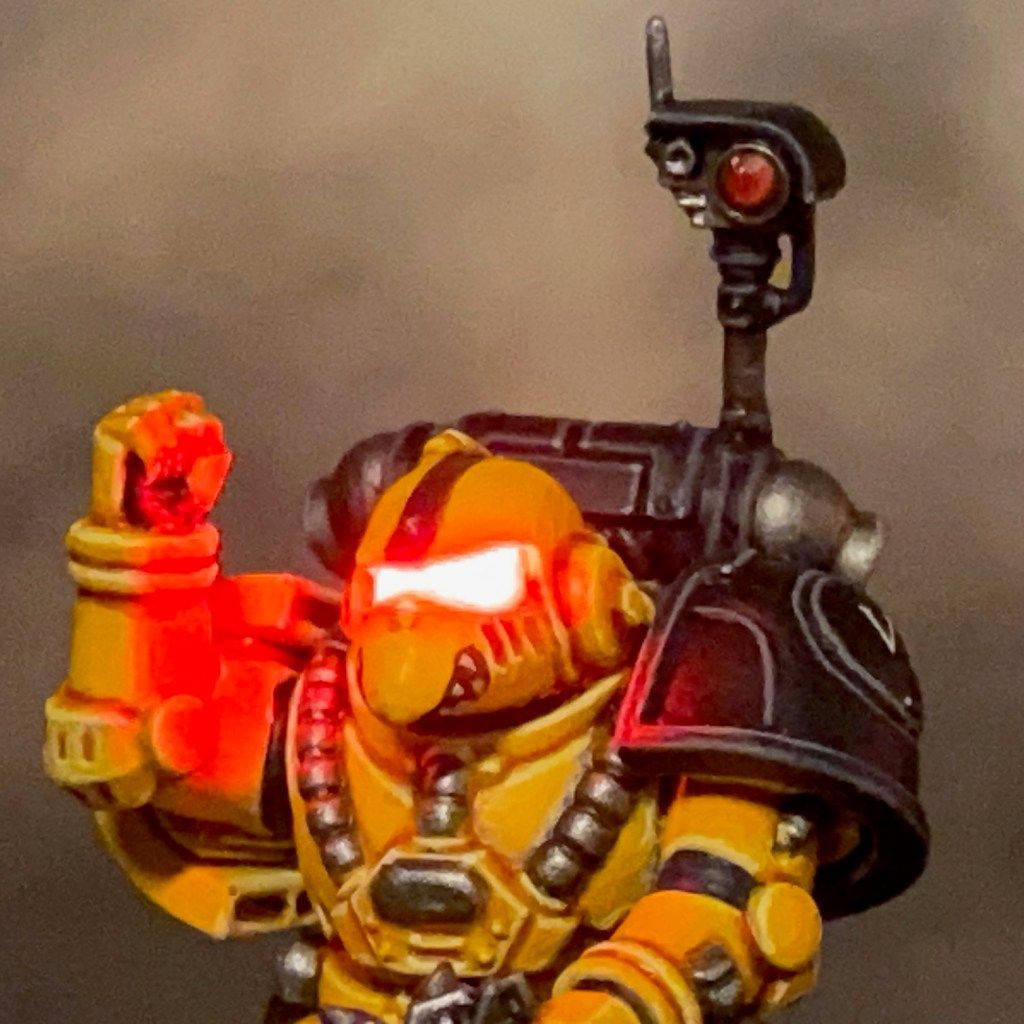
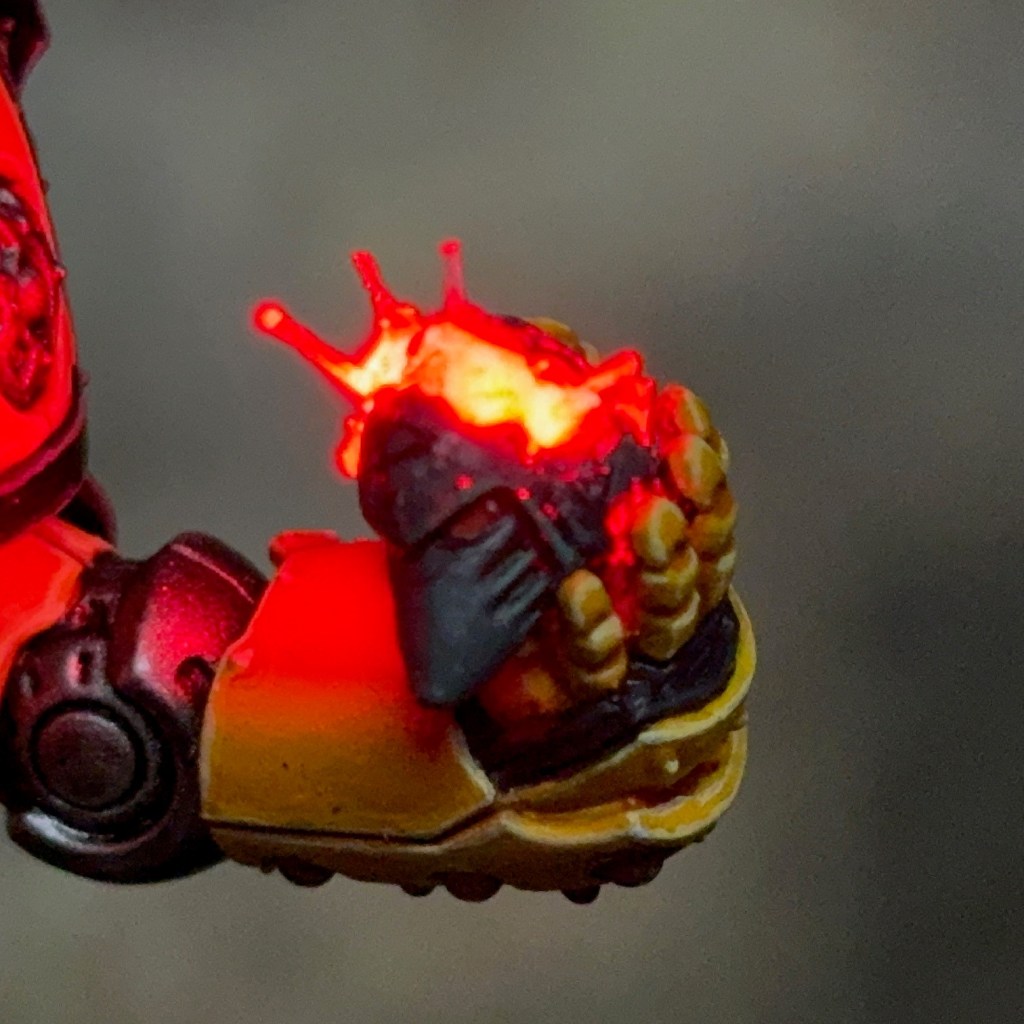
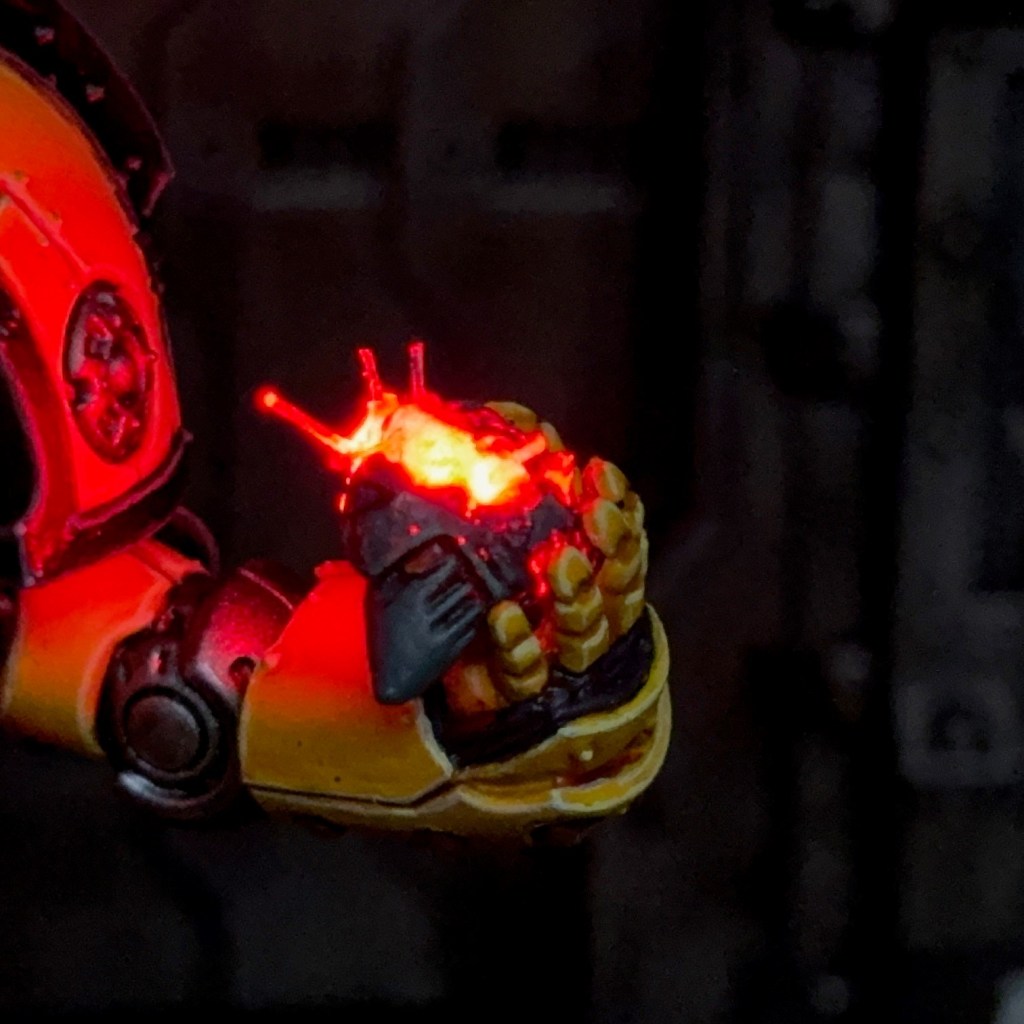
The LED effects on this miniature – both the Saturnine helmet and the exploding MkVI helmet – were created using the techniques described in my LED Eye Lens tutorial. The LED circuits for each helmet were connected in parallel to a single 3V coin cell battery and switch in the base.

I added Water Splash Effect Gel – available from Green Stuff World – in small patches over the MkVI helmet to create the crackling energy effect. This gel is best applied in thin layers, allowing each layer to dry before applying the next. To give the impression of sparks flying as the helmet cracked, I also added some very small lengths of fibre optic cable to the gel before it hardened. These were small sections of fibre cut from a child’s toy using a sharp hobby knife. You can see this process at various stages below.

Once the gel is completely dry, the final step is to apply a single thin glaze of red paint over all the gel. As long as this glaze is suitably thin it will enhance the look of the miniature while the LED is off without inhibiting the light when the LED is on.

My original plan for this army was to stick with tried-and-tested LED miniature techniques (as described in my tutorials) and not get caught up doing anything new or complicated. But this design goal seems to have slipped my mind with the Saturnine Terminators!

Painting

This was a very time consuming miniature to paint, both due to its size compared to other space marine infantry and also the level of detail. It felt a little like painting a miniature titan! The paint scheme I used follows the recipes described in this earlier post

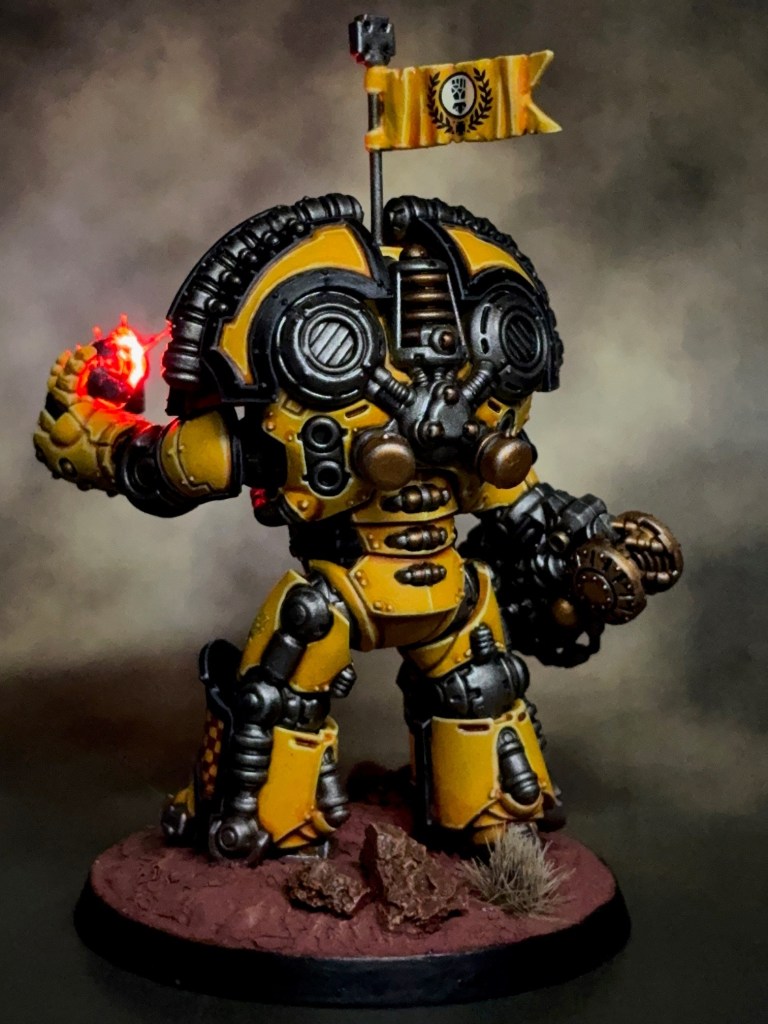
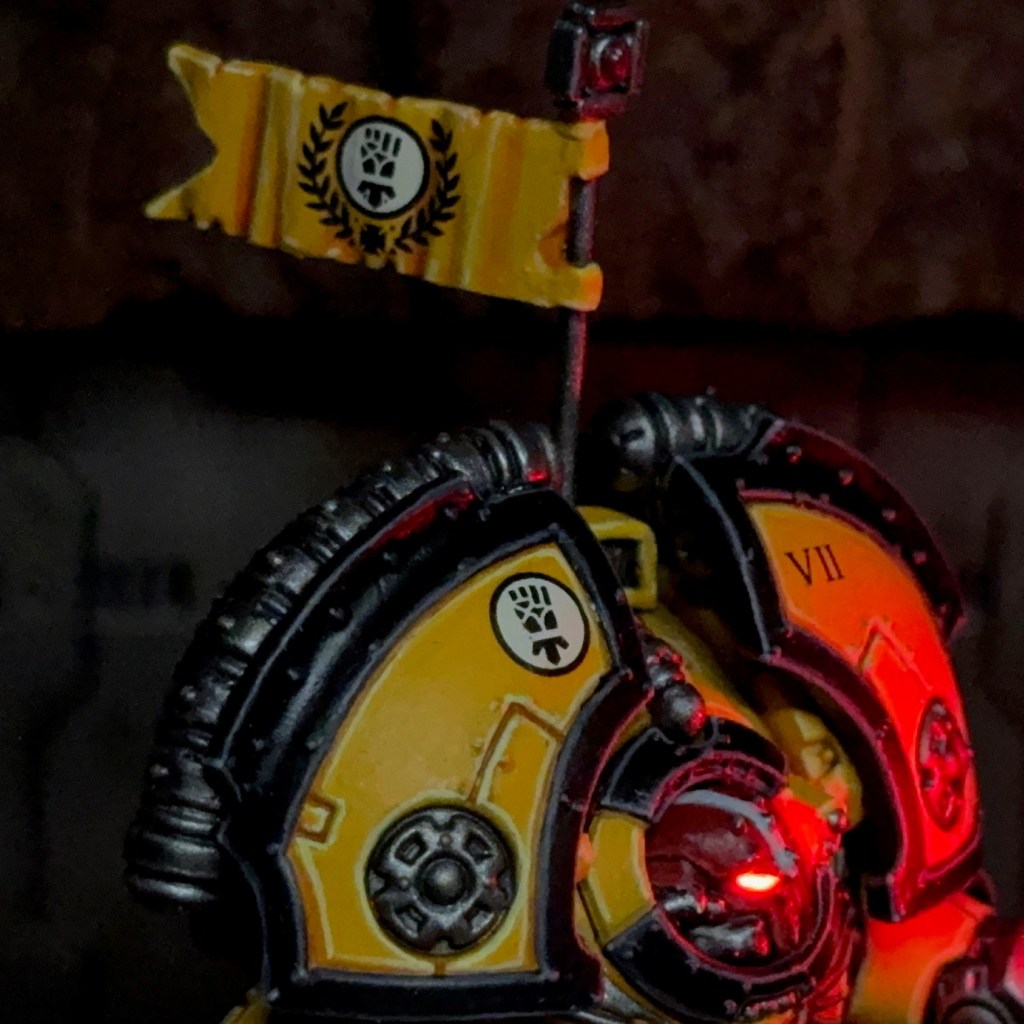
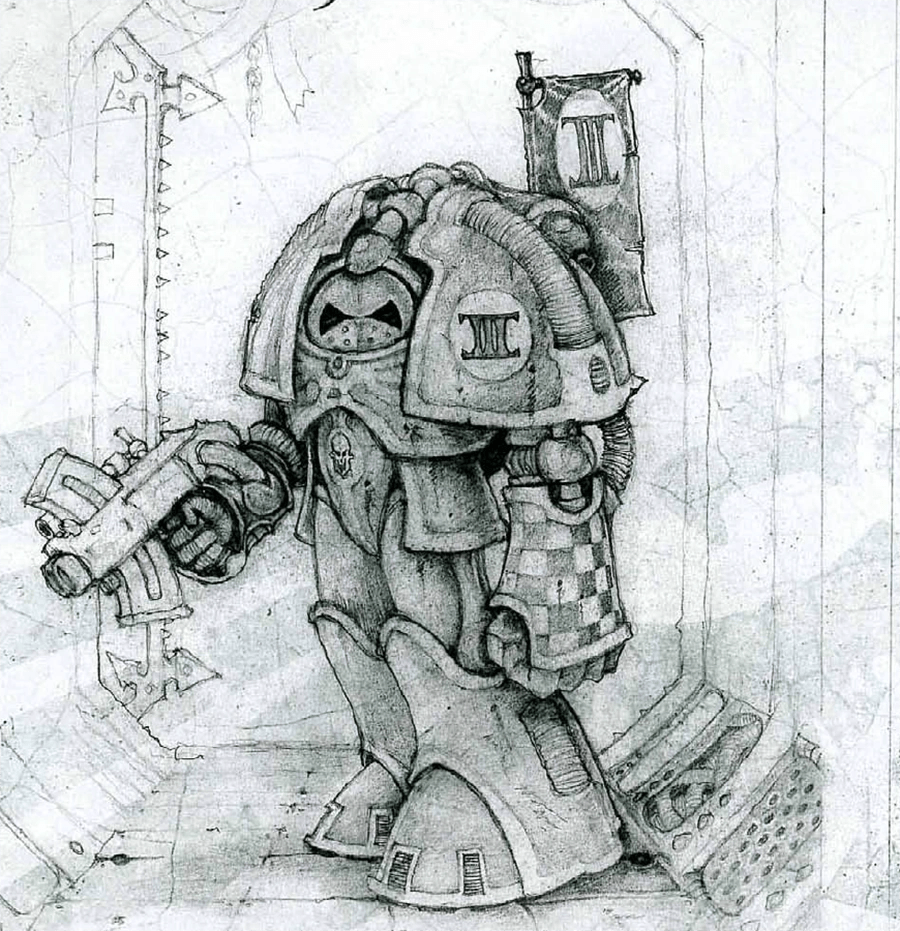
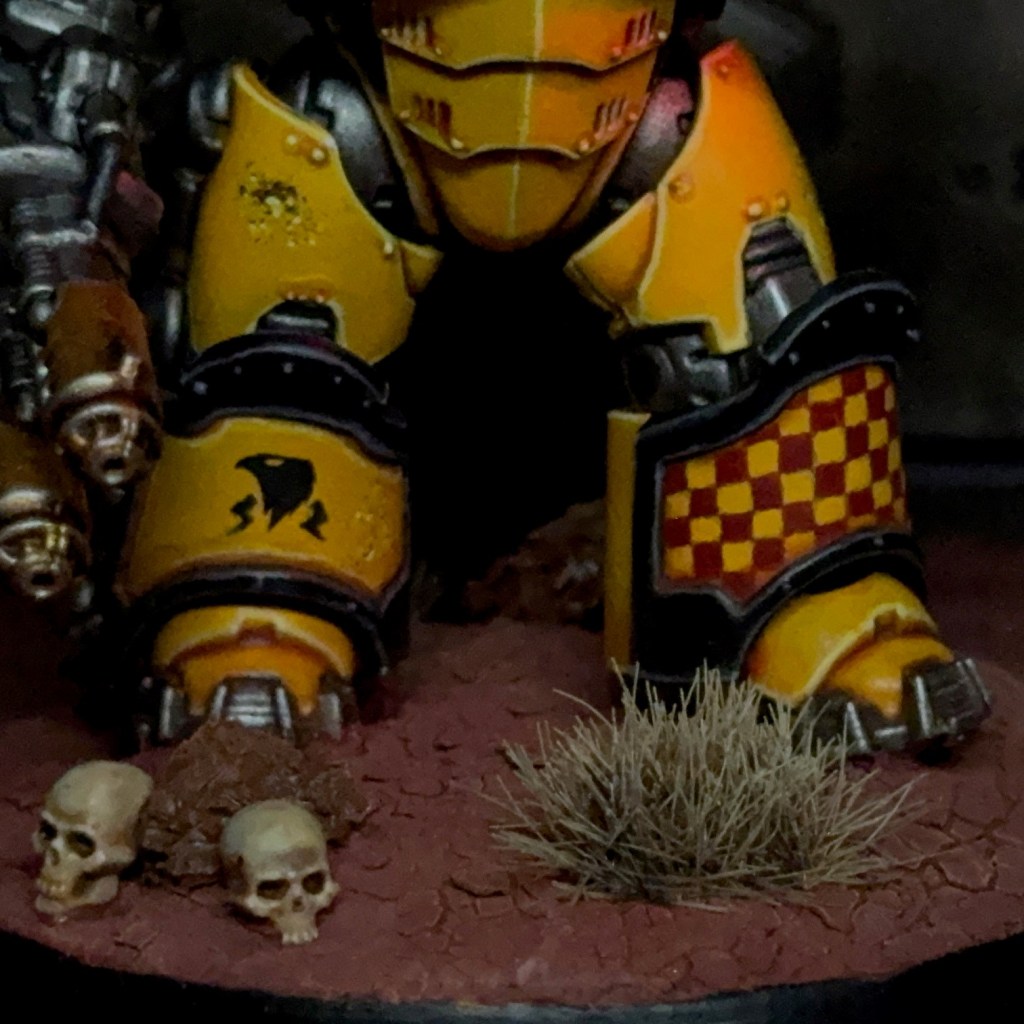
This miniature was heavily influenced by Jes Goodwin’s early Terminator concept art (above), specifically the checked heraldry, large numeral on the left shoulder and the use of a back banner. The laurel wreath on the banner indicates the squad is a honour guard for a Saturnine Praetor. The Raptor Imperialis on the greaves indicates the squad are veterans of the Terran Unification wars. The red checks are heraldry for the squad, showing they are warriors of great strength and courage. The checks were painted using my ‘iterative’ freehand technique described in this post.

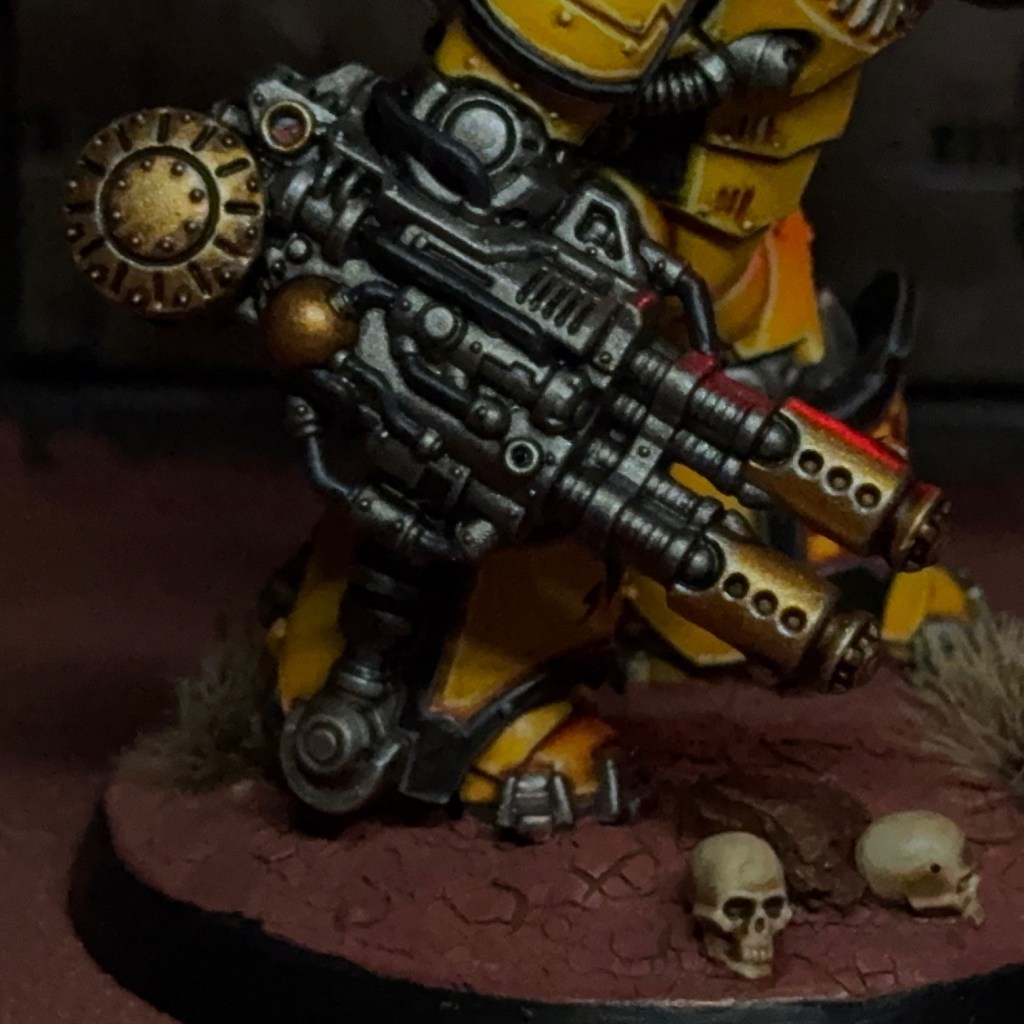
When painting the disintegrator I took influence from the disintegrator on my Ultramarines Veteran. I wanted it to look more like a bespoke, handcrafted instrument than a mass-produced weapon. The body of the gun is painted in Citadel Leadbelcher, with Retributor Armour washed with Agrax Earthshade to create an antique brass effect on the cyclotron and muzzles, and Corvus Black for the rubberised cables.

That’s all for today. I haven’t decided if I’ll now move on to the next Saturnine Terminator, or take a break from this squad and paint another part of the army. Either way, I’ll be back again soon. As always, thanks very much for reading, and please remember you can also find me sharing my work on InstagramThreadsBluesky and Mastodon. Or if you prefer you can subscribe to my website by entering your email in the box below to receive updates whenever I post a new blog article or tutorial.
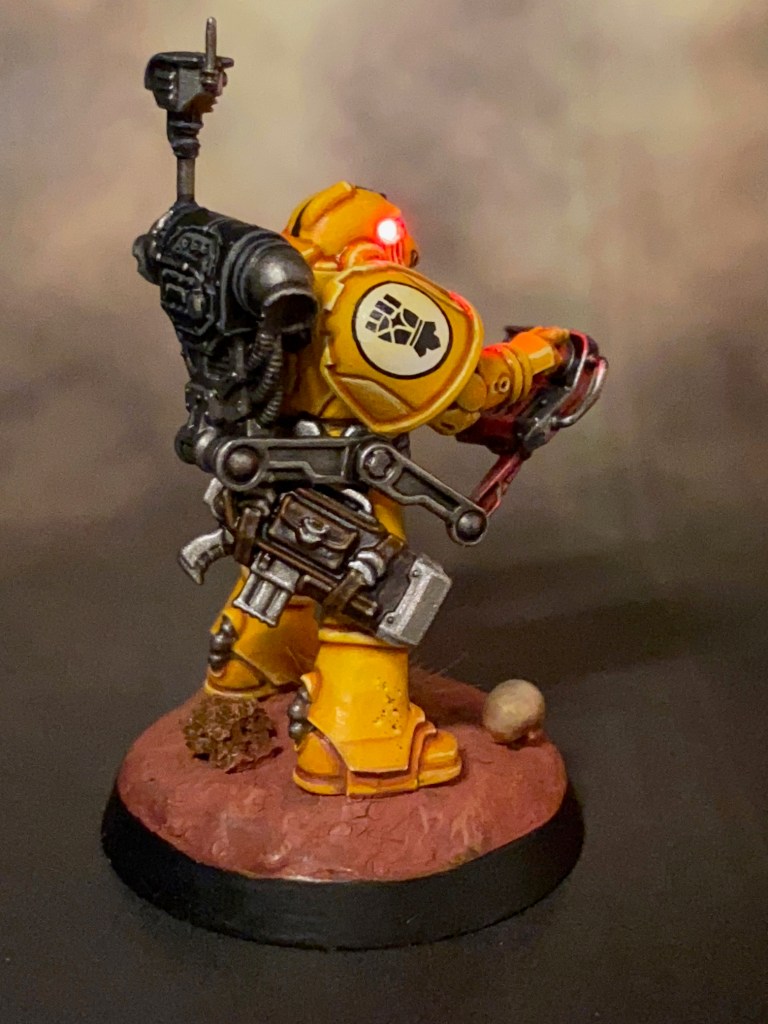
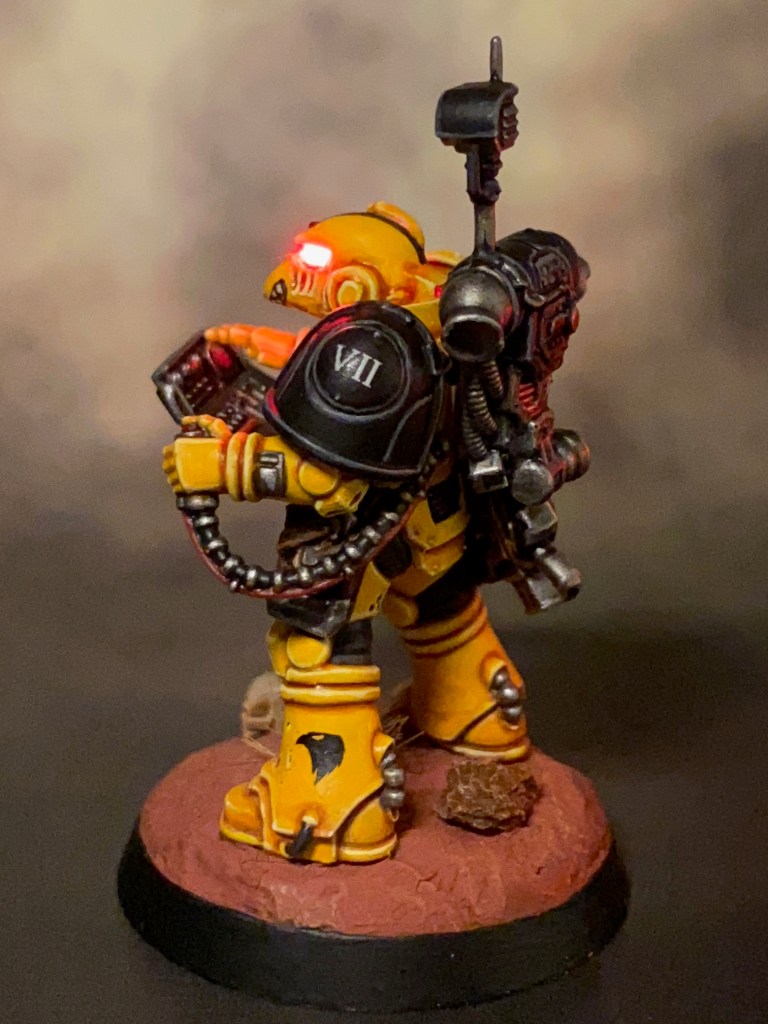
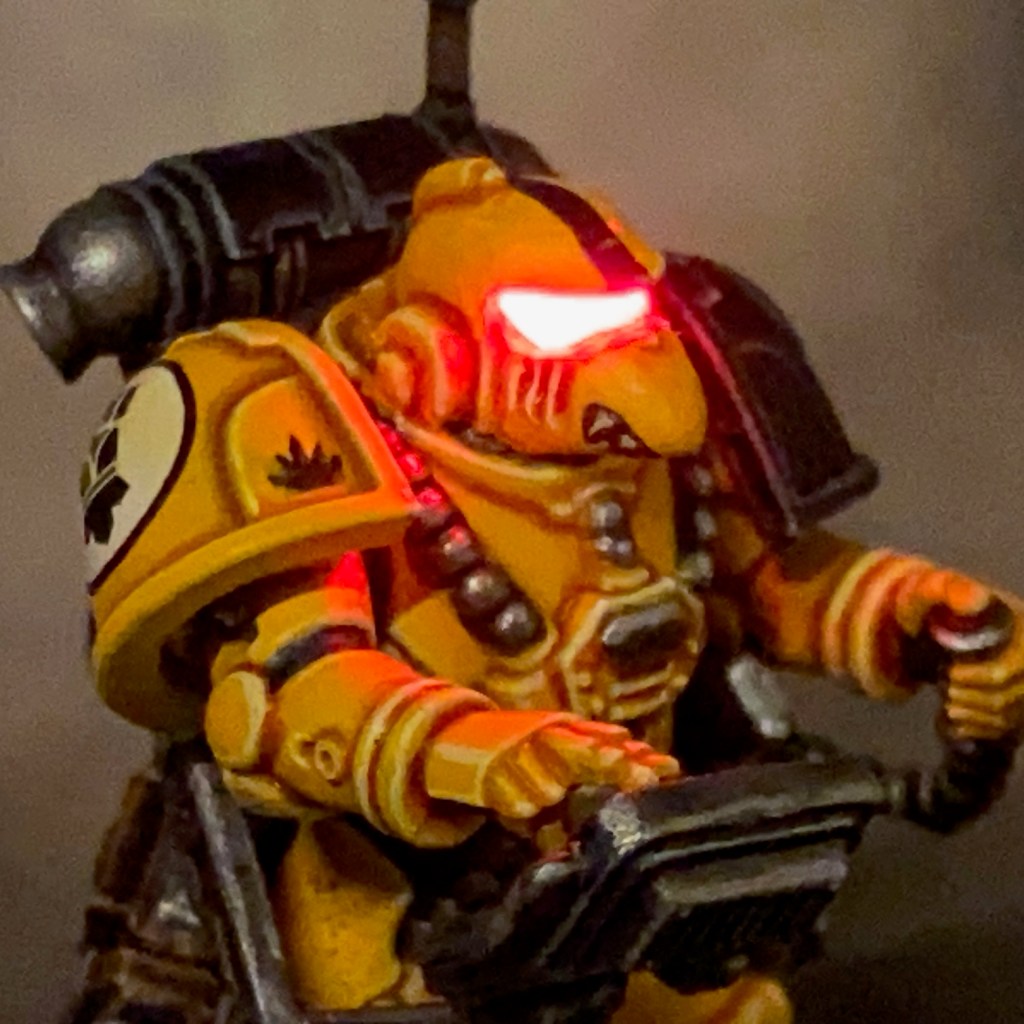
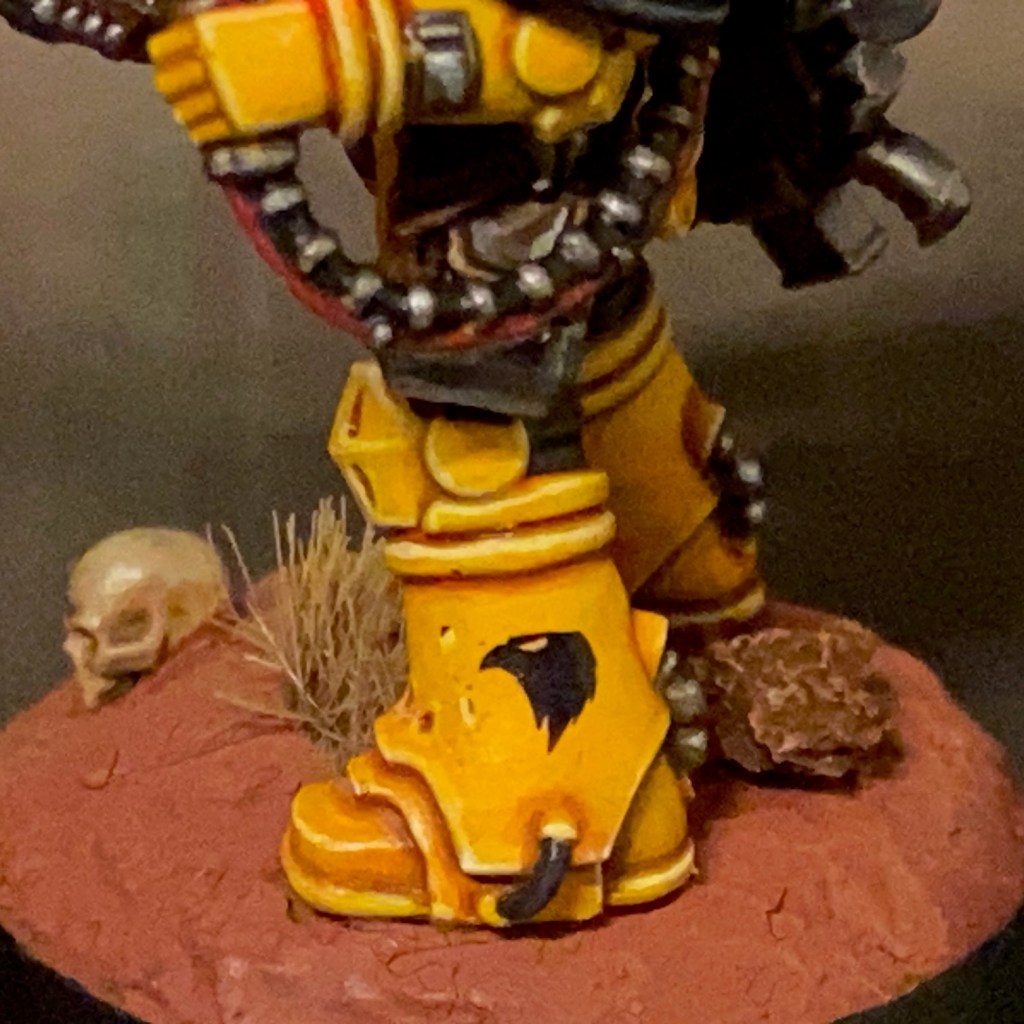
Imperial Fists Heavy Support Autocannon Squad Complete

This week I’ve finished the fifth and final member of the Heavy Support autocannon squad for my Imperial Fists in the Age of Darkness project.

Painting & Modelling

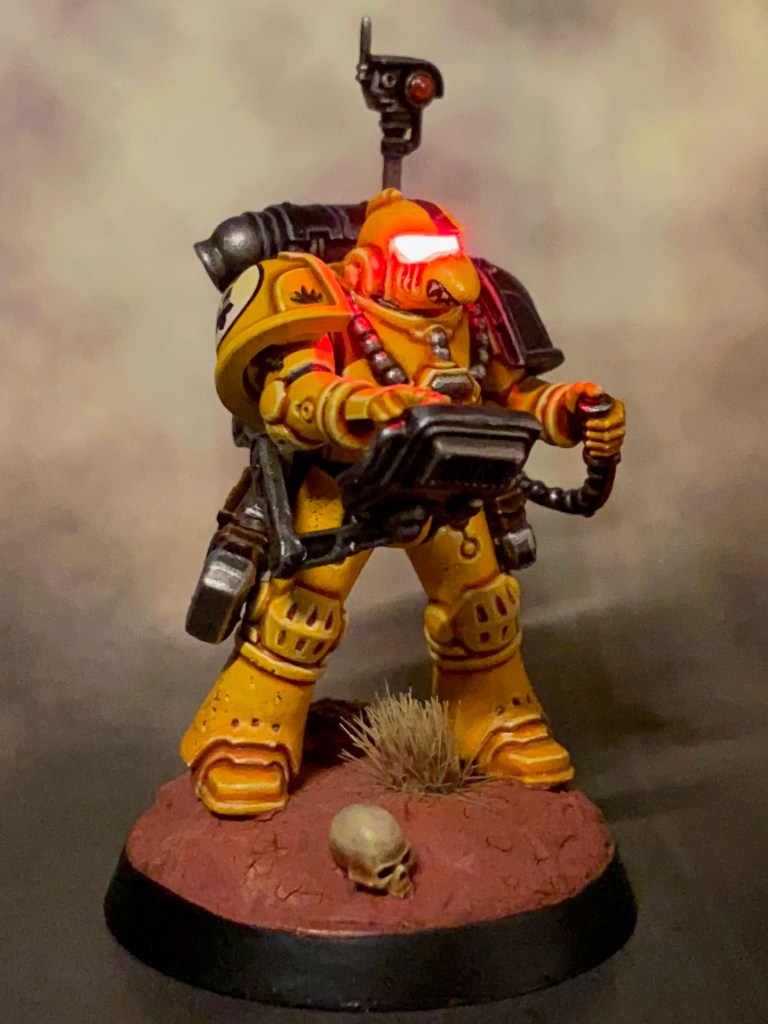
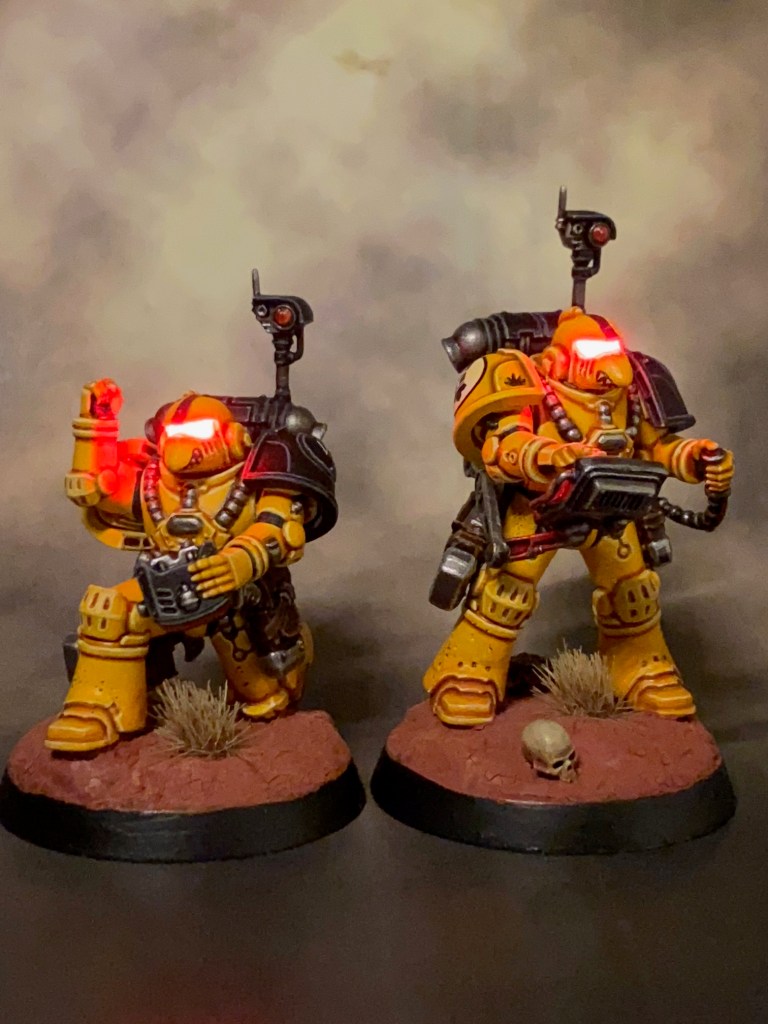
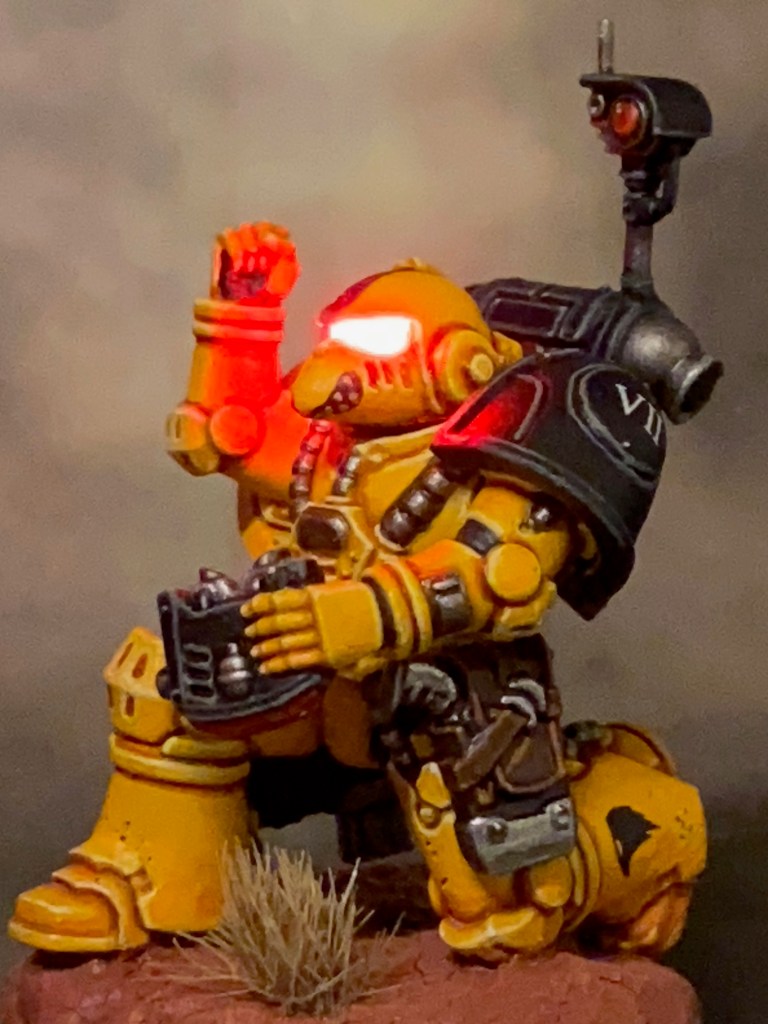
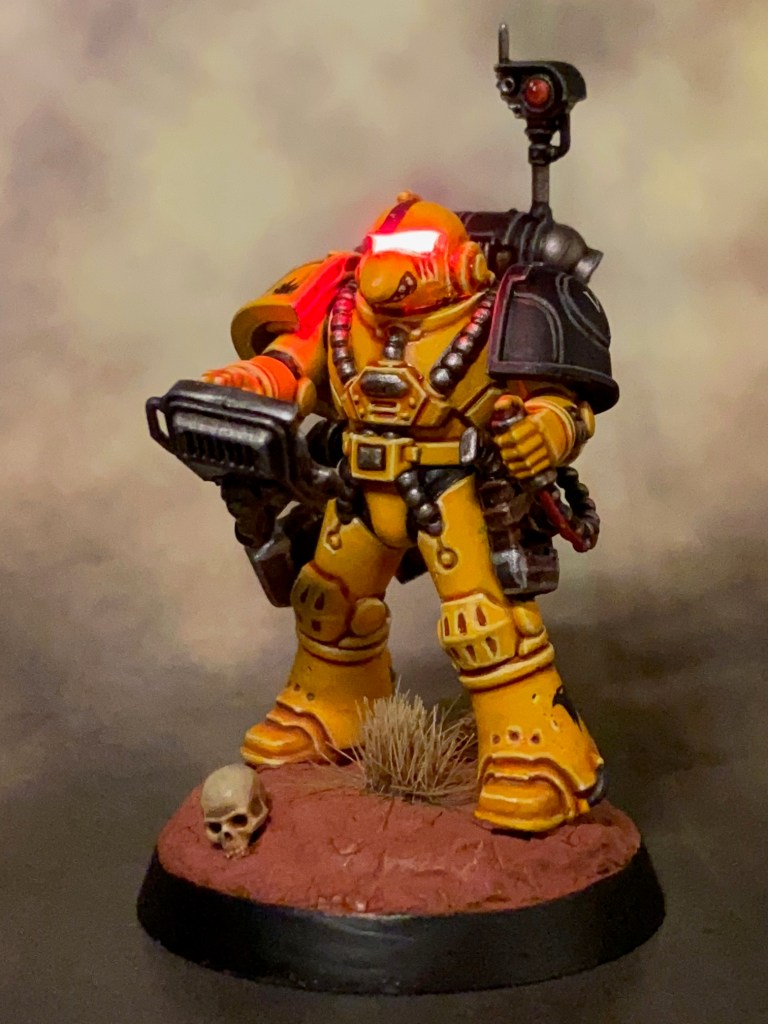
I’ve been working on this project for a few weeks now and if you’d like to look back at how this squad progressed you can see previous posts on it here, here and here (or just scroll down). I’ve included a few close-up pictures of the final member of the squad below.

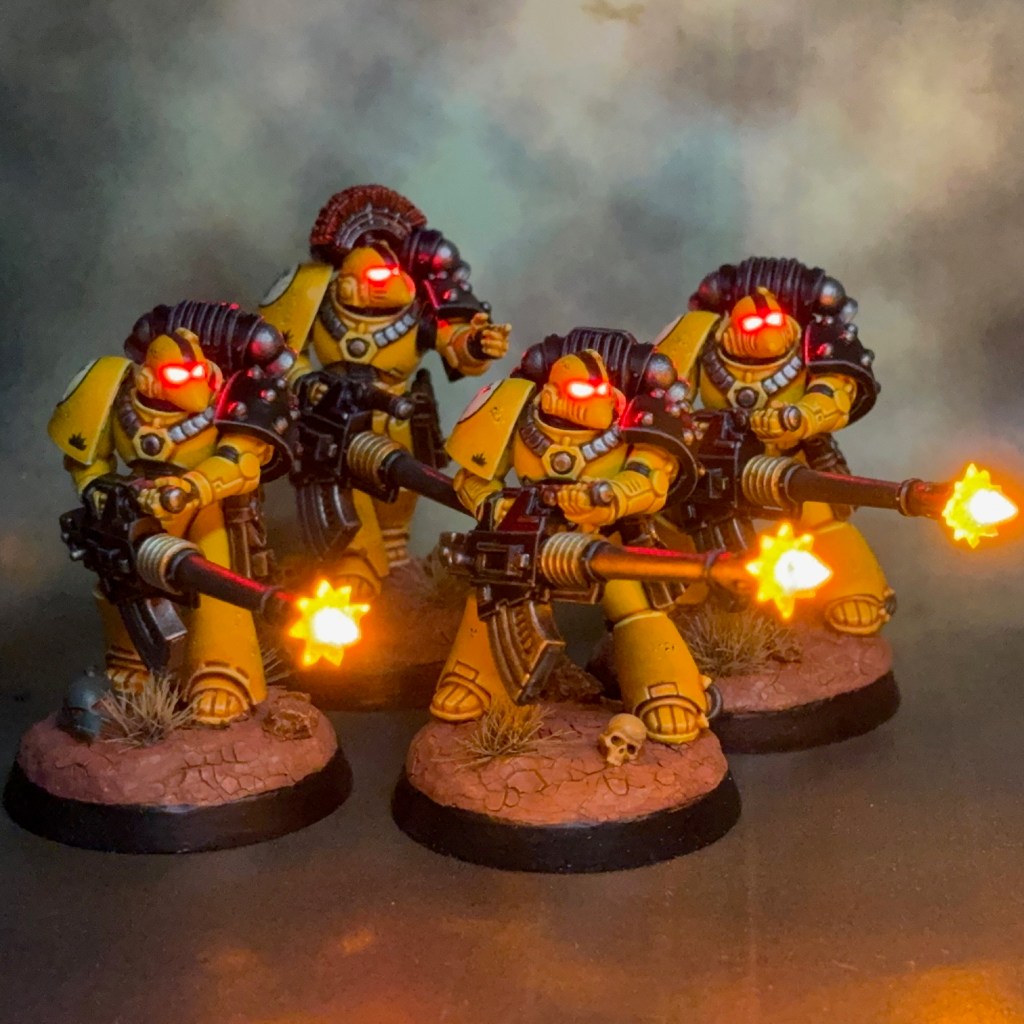
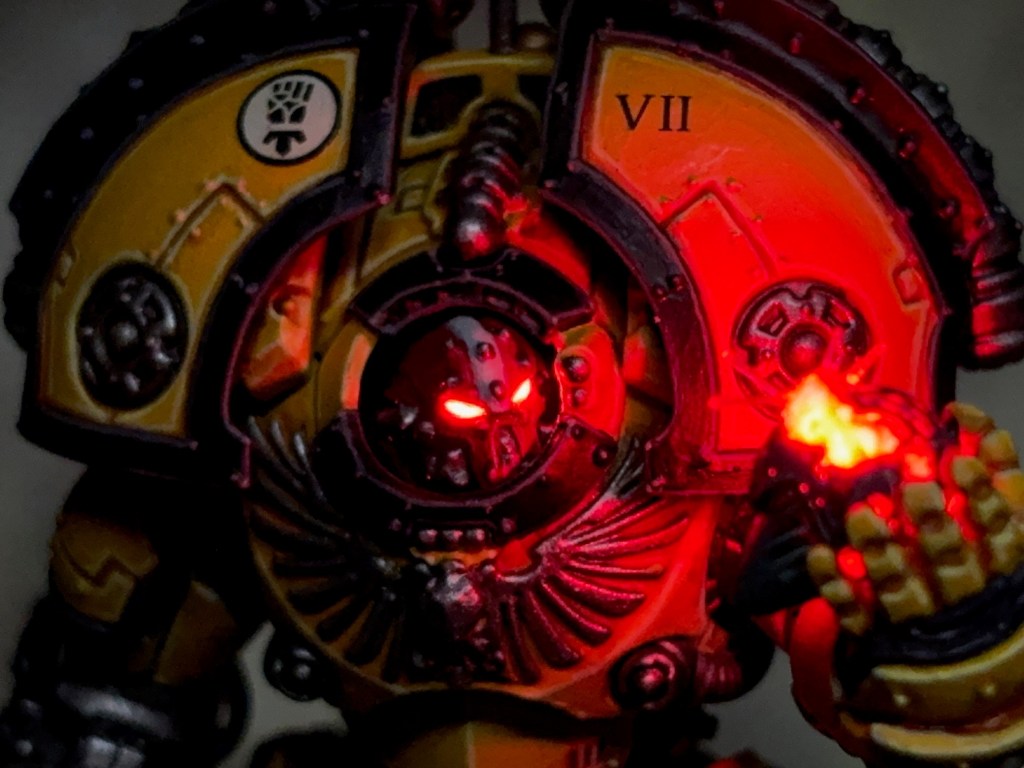
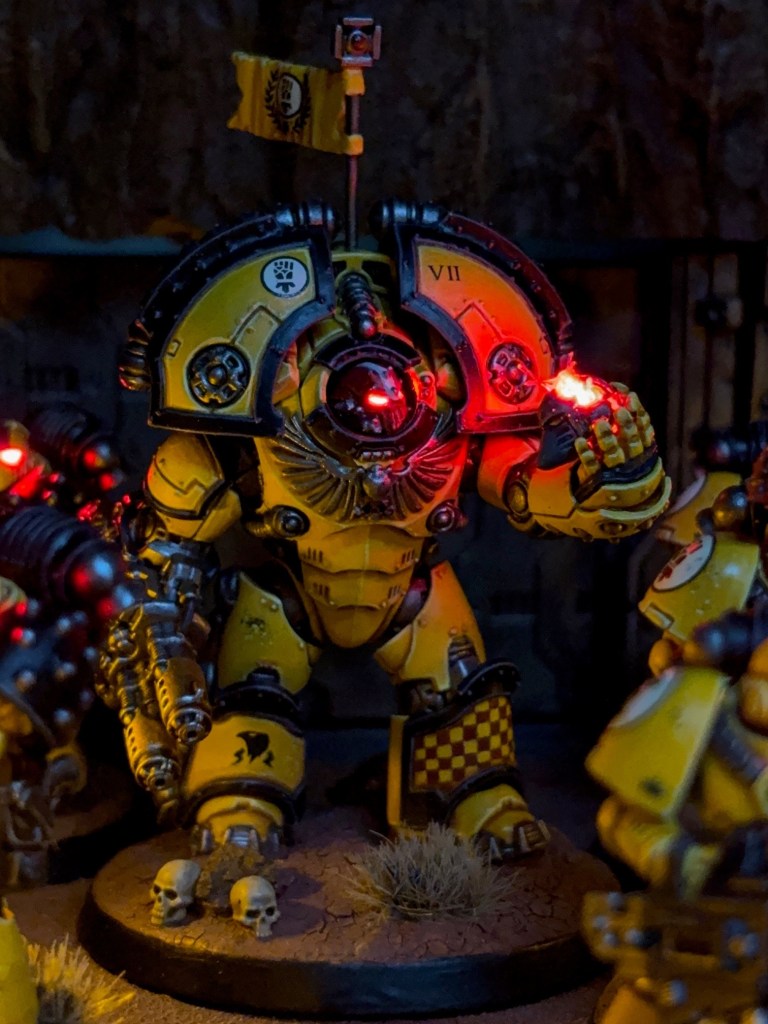
The LED effects used for this miniature were again identical to those I described for the previous members of the squad. The helmet and the autocannon muzzle effects used the techniques outlined in my LED Muzzle Flare tutorial. Again, I made one slight alteration; instead of the yellow 0805 SMD used for the muzzle flare in the tutorial, I used a larger TruOpto OSHR7331A-KL 1.8mm Yellow LED and a 20 ohm resistor. I chose this LED to make the autocannon muzzle flare larger and more impressive than a bolter muzzle flare, which is what the tutorial is focused on. Otherwise, all the methods used are the same.

The paint scheme on this miniature follows the recipes described in this earlier post. As I’ve said before, I chose to start with the Heavy Support squad as they were likely to be at the back of the army and therefore less noticeable. A perfect place to practice the army paint scheme! As it happens I’m pleased with the scheme and how this unit has turned out, so I’ll likely be continuing with it unaltered for the rest of the project.

That’s all for today, but I’ll be back again soon with more Imperial Fists! I have several different units on the work bench at the moment, so we’ll see which one I manage to finish first. As always, thanks very much for reading, and please remember you can also find me sharing my work on InstagramThreadsBluesky and Mastodon. Or if you prefer you can subscribe to my website by entering your email in the box below to receive updates whenever I post a new blog article or tutorial.
Imperial Fists Heavy Support Autocannon Squad Continued (Again)

My Imperial Fists in the Age of Darkness project continues this week with the fourth member of my Heavy Support autocannon squad.

Painting & Modelling

The LED effects used for this miniature were again identical to those I described for the previous members of the squad. The helmet and the autocannon muzzle effects used the techniques outlined in my LED Muzzle Flare tutorial. Again, I made one slight alteration; instead of the yellow 0805 SMD used for the muzzle flare in the tutorial, I used a larger TruOpto OSHR7331A-KL 1.8mm Yellow LED and a 20 ohm resistor. I chose this LED to make the autocannon muzzle flare larger and more impressive than a bolter muzzle flare, which is what the tutorial is focused on. Otherwise, all the methods used are the same.
It’s occurred to me that this is quite an unusual project by my standards, because each successive miniature is very similar to the last. Normally there’s a lot of variety between my LED projects that I post each week – even in armies like the Flesh Eaters space marines there was a lot of variation between individual squad members. Individual variety doesn’t fit so well for Age of Darkness Imperial Fists though, especially where each member of the squad is carrying a the same giant weapon. But as I’ve said before, I hope to start introducing a little more individual personality when I get to the Tacticals and other units.

The paint scheme on this miniature follows the recipes described in this earlier post.

That’s all for today, but I’ll be back again soon with the fifth and final member of this unit! As always, thanks very much for reading, and please remember you can also find me sharing my work on InstagramThreadsBluesky and Mastodon. Or if you prefer you can subscribe to my website by entering your email in the box below to receive updates whenever I post a new blog article or tutorial.