Leviathan Screamer Killer

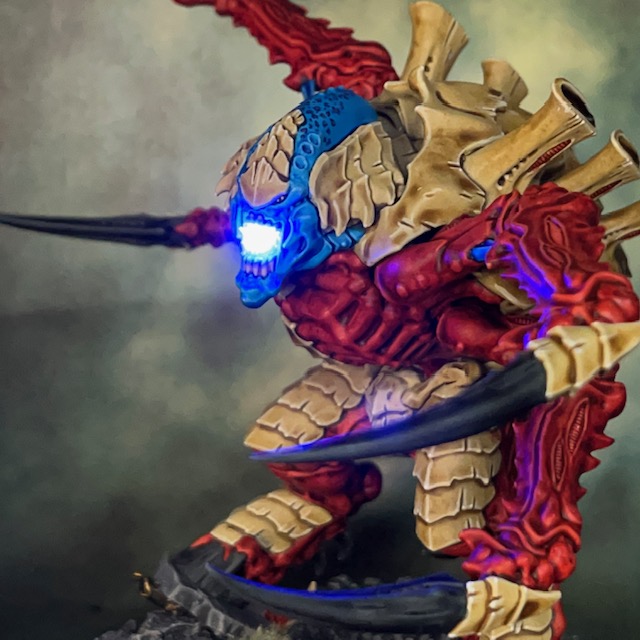
Today we’re looking at the first model that I’ve assembled and painted from the 10th Edition Warhammer 40,000 ‘Leviathan’ box – the Screamer Killer!

Hive Fleet Cerberus

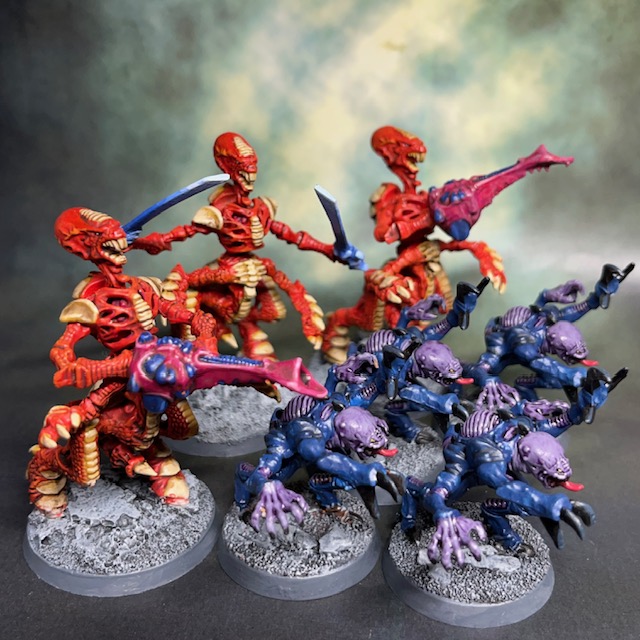
My personal Tyranid swarm, Hive Fleet Cerberus, has been plaguing the galaxy for decades. In fact, they’re the only army I own that has – in some form or another – consistently seen the tabletop in every single edition of Warhammer 40,000. They took part in the global Ichar IV campaign back in the 1990s, so it has always been my ‘headcanon’ that Hive Fleet Cerberus was a splinter of Hive Fleet Kraken, skulking off to terrorise the Eastern Fringe in the aftermath of that epic conflict.

This army has soldiered on with some of the original Tyranid models for many years now (as shown below). These were among the first xenos models I ever purchased, and they will always hold a special place in my nostalgic gamer’s heart. For the last couple of new Warhammer 40,00 edition release boxes, I’ve sold the non-Marine models, but the arrival of Leviathan convinced me to not only keep them, but begin the long-overdue revamp of my Tyranid army. As the classic Screamer Killer was always one of my favourites, I decided this is where I should start the project.
Modelling

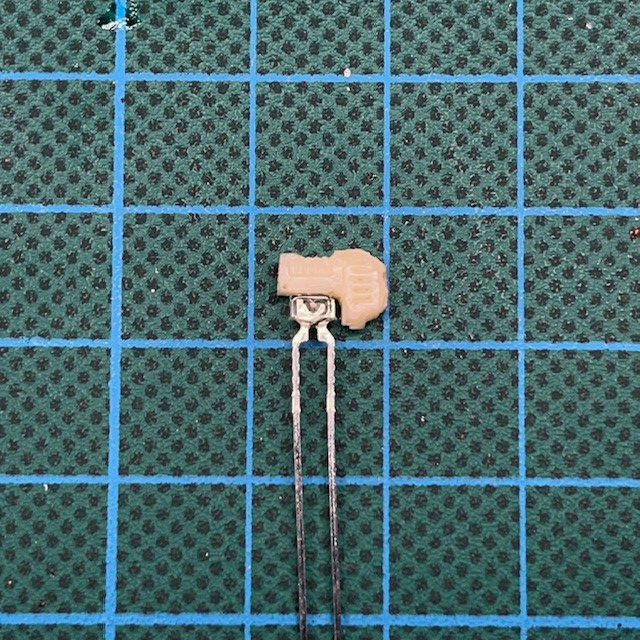
The most prominent feature of my Leviathan Screamer Killer is the LED bioplasma effect. This was achieved using the techniques described in my Simple LED Muzzle Flare tutorial, only with a blue 0805 chip LED instead of the yellow one listed in the tutorial. Additionally, the acrylic gel was given a blue glaze instead of the yellow.

These days I like to pick a limited colour palette of LEDs for army projects, just so the finished force does not look like a bunch of Christmas decorations with a huge mish-mash of different colours and lights. For Hive Fleet Cerberus I’ve settled on blue for energy weapons and psychic powers. I’m not sure what other colours I’ll use yet, but I’ll decide that as the need arises.

Painting

It’s often said that it’s best to start a new army paint scheme with the rank and file models, and not the leaders or large centrepieces, but as mentioned above I just couldn’t resist starting with the Screamer Killer. When it came to picking the colours for this revamp project I wanted to stick fairly close to the original scheme, so that meant red for flesh and bone for carapace. After some thought on what colour bioweapons should be, and considering both green and a beige ‘flesh’ colour, I eventually settled on blue. This forms a triadic colour harmony with the red and the yellowish tint of the bone. As an aside, I find this free Colour Wheel website a useful reference for choosing complementary colours schemes for painting projects.

You can see some examples below of classic Tyranids from Games Workshop publications painted in a red, yellow, and blue scheme. This colour combination definitely has a pedigree!
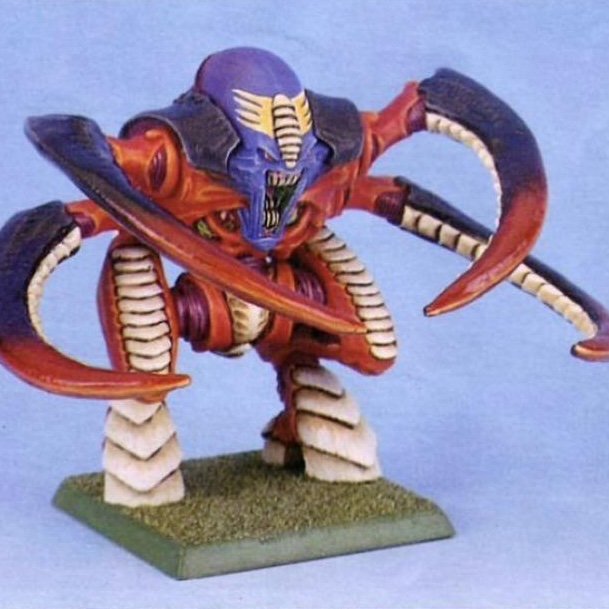
I decided to paint the Screamer Killer’s face blue for a number of reasons. Firstly, it was traditionally painted a different colour to the rest of the flesh and carapace on the classic model, so I felt that should be the case here as well. Secondly, as mentioned above, I’d settled on blue for bioweapons, and for this Tyranid, their face is the weapon! I added the purple mottling to the top of its head to provide some visual interest for what is otherwise a large, flat area.

I also made the sinews on the arms blue, as you may have noticed. This was because they felt distinct from the surrounding flesh, and in need of picking out in another colour. Again, as the claws are weapons, the blue seemed appropriate. Also, it adds some visual interest to what is otherwise a very large area of solid red when the model is viewed directly from the front.

When I list my painting recipes on this blog, I’m not only recording them for those of you who are interested in using them, but also as a reminder for myself! Below are the paint recipes for Hive Fleet Cerberus, and I’m sure I’ll be referring to this post frequently as the project progresses. All paints listed are from the Citadel range and are applied over an undercoat of Citadel Wraithbone spray.

  • Red Flesh
  • Contrast Blood Angels Red
  • Wild Rider Red highlight
  • Troll Slayer orange dot highlight on sharp points
  • Bone Armour
  • Contrast Skeleton Horde
  • Screaming Skull highlight
  • Skull White dot highlight on sharp points
  • Blue Bioweapons
  • Contrast Talassar Blue
  • Lothern Blue highlight
  • Blue Horror dot highlight on sharp points
  • Black Claws
  • Contrast Black Templar
  • Eshin Grey highlight
  • Dawnstone dot highlight on sharp points
  • Purple Mottling
  • Naggaroth Night irregular dot
  • Genestealer Purple layer inside dot
  • Yellow Eyes
  • Averland Sunset base coat
  • Agrax Earthshade shade
  • Yriel Yellow layer
  • Abaddon Black pupils
  • Urban Base
  • Mechanicus Standard Grey base coat on rocks
  • Warplock Bronze base coat on metal debris
  • Contrast Skeleton Horde on skulls
  • Nuln Oil shade all over
  • Dawnstone drybrush on rocks
  • Administratum Grey drybrush on rocks
  • White Scar drybrush on rocks
  • Retributor Armour highlight on metal debris
  • Screaming Skull highlight on skulls
  • Skull White dot highlight on skulls
  • Citadel Middenland Tufts

If you’re after tabletop ready models quickly, then I don’t think you can beat Contrast and one or two highlights as the best compromise between speed and acceptable quality. For projects with fewer models, like my Flesh Eaters space marines, then I do prefer traditional painting methods. But when you have to get a load of models done, especially highly textured models like Tyranids, then I just don’t have the hobby time these days to paint them in the traditional way.

That’s it for today, I hope you all found that interesting. Please check back soon for more miniatures from the Leviathan boxed set. As always, thanks very much for reading, and please don’t forget you can also follow my work on social media at TwitterMastodon and Instagram.
Brother Byrne, Flesh Eaters Sergeant

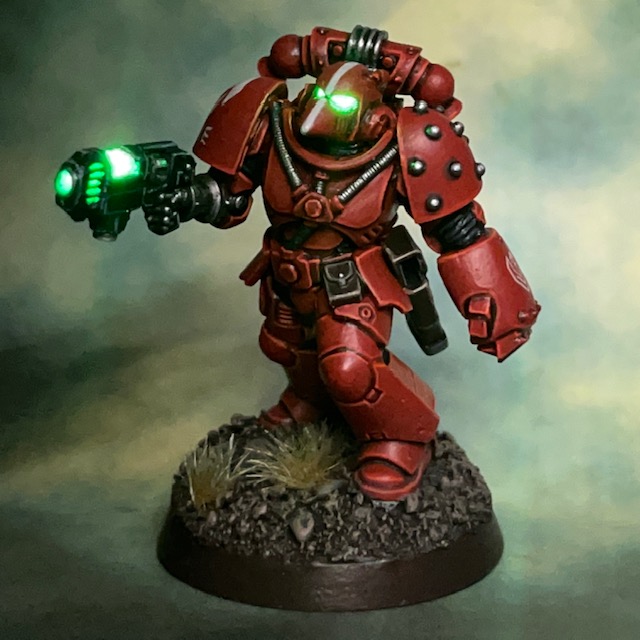
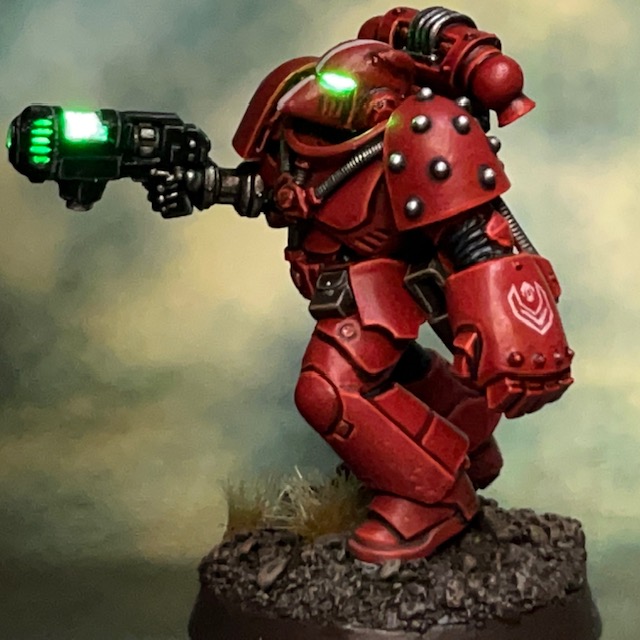
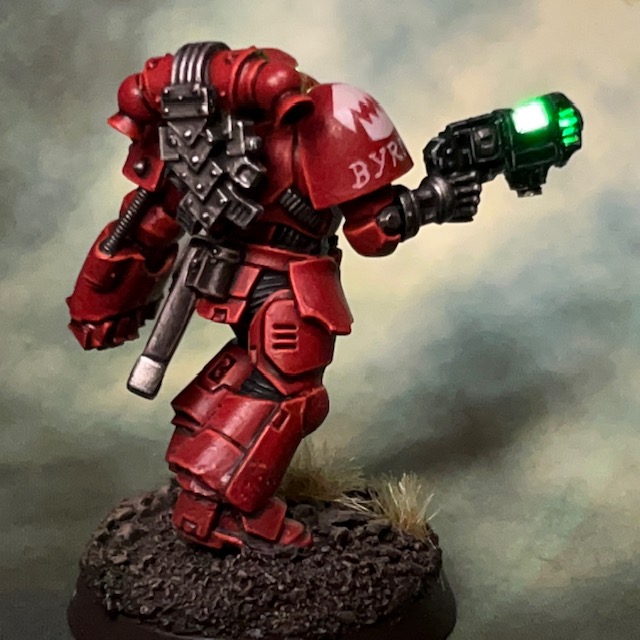
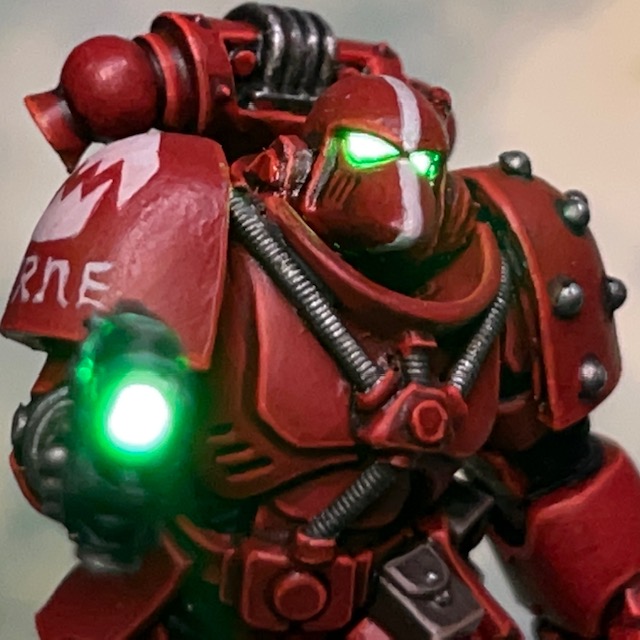
It’s back to the Flesh Eaters project this week with Brother Byrne, a plasma pistol and power fist equipped Assault Intercessor Sergeant. Brother Byrne will be leading my second Assault Intercessor squad – henceforth known as Squad Byrne!

Modelling & Painting

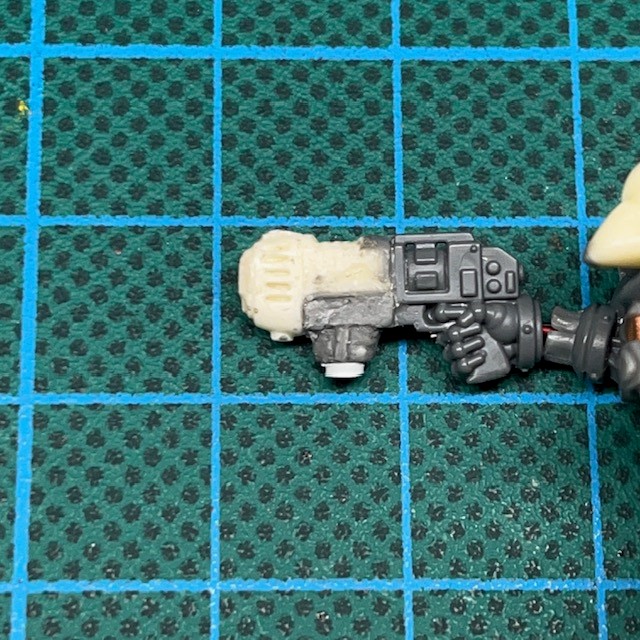
This model has had the LED helmet eye lens and plasma weapon treatment, as detailed in my LED Plasma Weapon tutorial. As this model was fairly straightforward to make, I took the opportunity to document the process and refresh my LED Plasma Weapon tutorial. It is essentially the same, with a few minor improvements and clarifications, as well as new, clearer photos.

I know from my website stats that LED plasma weapons this is one of my most popular tutorials. It’s a few years old now so I thought it was worth bringing up-to-date. I haven’t deleted the original August 2018 version though, that is now archived here in case anyone still wanted to reference it.

As I’ve described previously for other Flesh Eaters miniatures, the base model is a Primaris Assault Intercessor that I have modified to wear MkVI armour, in keeping with the War of the False Primarch theme for my Flesh Eaters army.

Brother Byrne takes his name from a classic Rogue Trader miniature with plasma gun. Unlike Brother Levers, who was directly inspired by his 1980s namesake, I’ve just borrowed the name from Brother Byrne and not tried to recreate the original miniature.

For those that are interested, my painting recipe for the red Flesh Eaters armour can be found in this previous post. One aspect of this model that I painted differently was the minor battle damage around the lower leg area. The damage was applied using the sponge method and Rhinox Hide, which I then highlighted along the lower edge with Evil Sunz Scarlet and Wild Rider Red to give a sense of depth.

I haven’t added much battle damage or weathering to the Flesh Eaters in this project so far, but Sergeant Bryne’s squad mate Brother Oram has some, so I thought I might introduce a bit more battle damage for this unit. I may even go back and add it to some other completed units!

That’s it for today, but if you’d like to read more about my Flesh Eaters then you can view all posts tagged with Flesh Eaters. As always, thanks very much for reading, and please don’t forget you can also follow my work on social media at TwitterMastodon and Instagram.
Flesh Eaters 500 Point Patrol

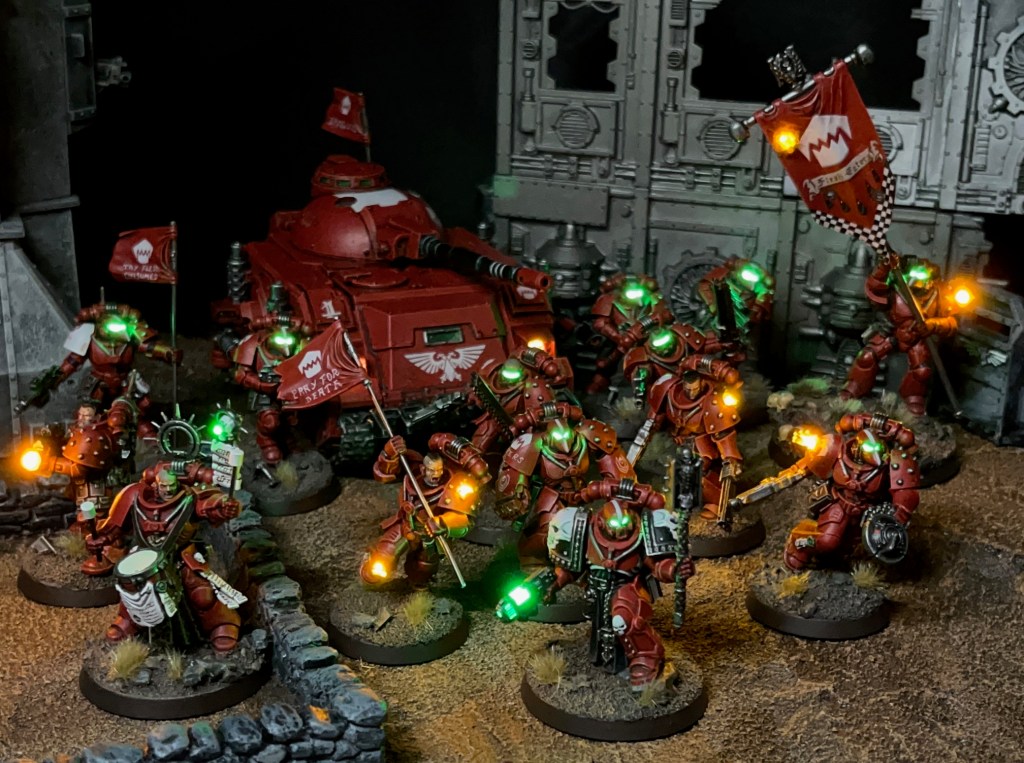
It’s finally happened, I’ve officially reached the 500 point milestone with the Flesh Eaters, and it’s only taken me a year and a half to get this far! I thought this would be the perfect opportunity to share some group photos.

So what’s in this 500 point ‘Patrol’ list?

Also pictured in the image above is Ancient Harlon. There weren’t quite enough points spare to fit him into the Patrol, but he will be included in future larger games.

There is of course the small matter of all the points values changing in a few weeks as 10th edition Warhammer 40,000 is released, so this force may not be quite 500 points by then. But I’m sure it won’t be drastically different…

Long time readers will know that this army is themed around Apologist’s ‘War of the False Primarch’ community project. This little-known piece of Imperial history takes place in the 34th Millennium, and is described in very few official sources.

The War of the False Primarch was a dark and bloody episode of the Imperium’s history, now largely lost to myth and purged from all records, that plunged the Segmentum Pacificus into anarchy from 780.M33 to 860.M33. The conflict was finally ended when the High Lords of Terra convened the Pentarchy of Blood and tasked five loyal Chapters to destroy eleven others that had been declared Traitoris Perdita for their actions during the war.

IMPERIAL ARMOUR VOLUME TWO – SECOND EDITION PG. 17

The Flesh Eaters are members of the so-called ‘Pentarchy of Blood’, those chapters who enacted the will of the High Lords of Terra on the wayward Partisan chapters. The patronage of the High Lords means that they are equipped with a mixture of the latest technology the 34th millenium has to offer, plus the best of what’s left in the vaults from the Heresy. I’ve tried to give this force a retro ‘Rogue Trader’ and ‘2nd edition’ Warhammer 40,000 vibe, and I hope that comes across in the model design and paint schemes.

The army in its current form represents Task Force Grimm as it appeared during the during the so-called “Sorrowful Years”, the period during the War of the False Primarch that saw mainly retrenchment and small scale skirmishes between Orthodox and Partisan forces. Uriah Grimm spent this time leading his forces in small-scale raids into Partisan border worlds, looking for any clues to the whereabouts of the False Primarch.

So where do the Flesh Eaters go from here? Well we have the Space Marine half of the Leviathan box just over the horizon, plus plans for some more, larger vehicles. So plenty more to come back for!

That’s all for today, I hope you’ve enjoyed this summary of the project so far. If you’d like to read more about my Flesh Eaters then you can read all posts tagged with Flesh Eaters. As ever, thanks very much for reading, and please don’t forget you can also follow my work on social media at TwitterMastodon and Instagram.

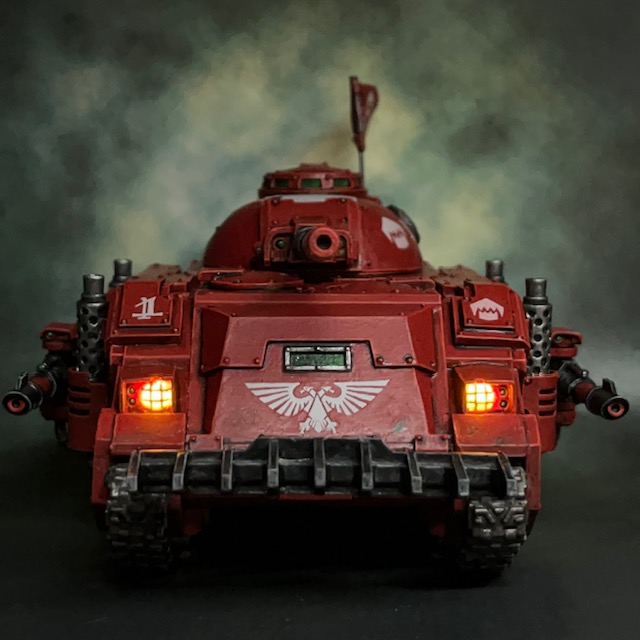
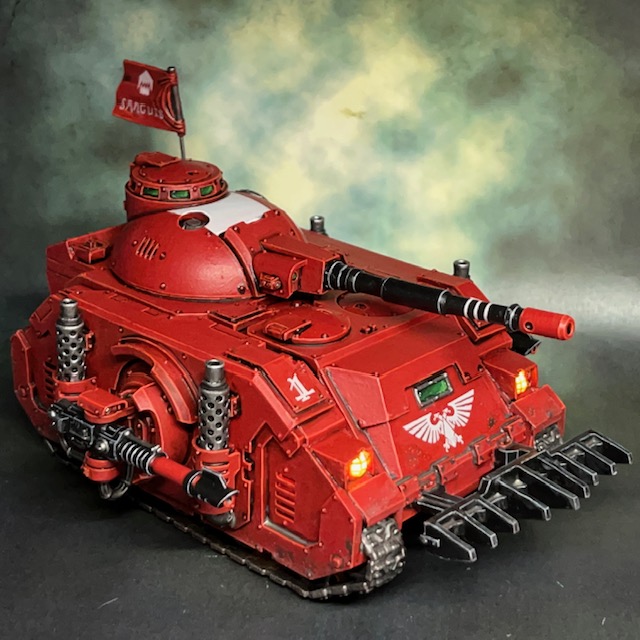
Flesh Eaters Deimos Predator

It’s an older pattern, but it checks out.

Brother-Techmarine Enlit

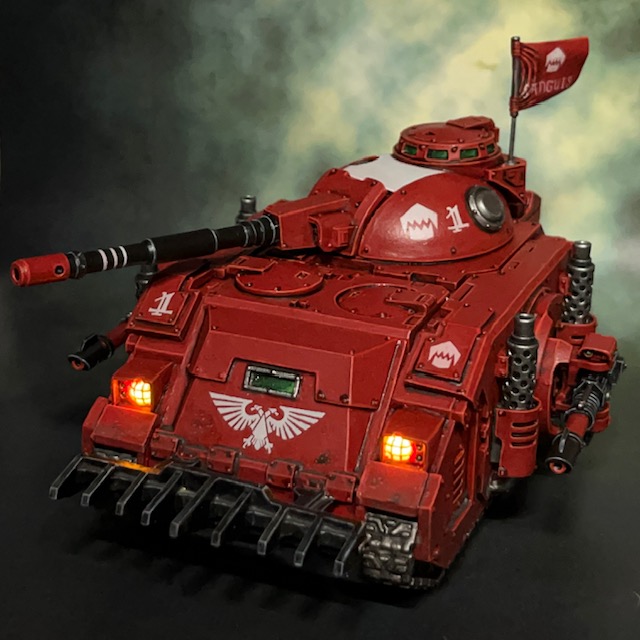
Reinforcements for the Flesh Eaters rumble off the production line this week, in the form of a Forge World resin Deimos Predator.

Painting & Modelling

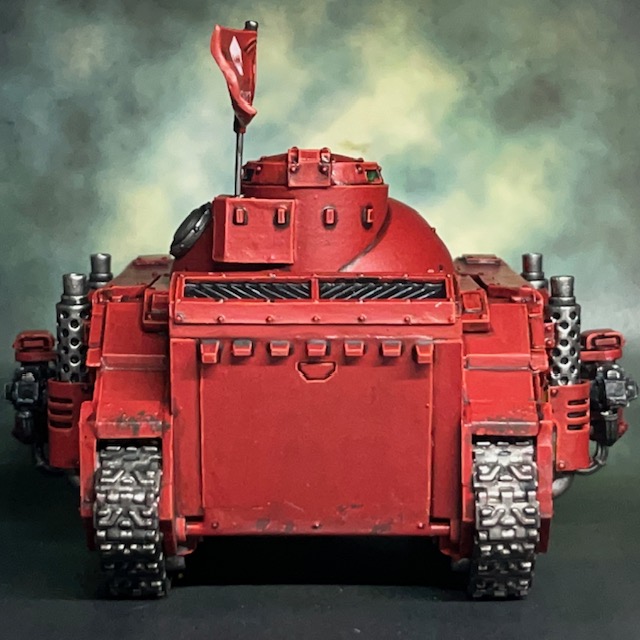
This is a slightly unusual one as it’s a rescue job – from myself! This Predator has been languishing base coated on my ‘Shelf of Shame’, waiting to join the Imperial Fists since around 2014. Anticipating an upcoming game of my Flesh Eaters against Apologist‘s Silver Stars, I decide to quickly revamp this model to add a bit of firepower to my boys in red.

The LED work on this miniature is incredibly basic by my current standards, as you can see in the picture below. The headlights are cast resin, each with a white LED inside, and these are the only part of the model that illuminates. The battery and switch are accessible via the magnetised front panel. I did consider completely re-doing the LEDs, but decided it wasn’t worth the effort as they were still serviceable. All I did in the end was swap in a fresh CR2032 battery.

Image © Games Workshop

I took a lot of influence for the paint scheme from the classic Blood Angels Predator above. I wasn’t aiming to replicate it exactly, but I certainly wanted to capture the Rogue Trader/2nd Edition vibe. My Flesh Eaters are themed around the War of the False Primarch in M33, so the whole army intentionally has a retro feel.

In terms of colour selection, I stuck with my normal Flesh Eaters palette of colours (as detailed in this post). I’ve chosen to limit myself to only green and yellow LEDs in this army. The LEDs originally installed were white, but a quick yellow glaze over the headlights helped to give them a yellow hue that fits in with the rest of the army.

The Imperial Eagle and numerals are transfers that I then painted over in Administratum Grey and Corax White so that they matched the rest of the army’s heraldry. The Flesh Eaters chapter symbol is freehand, as usual. I added the white stripe to the turret to emulate the white stripe on the Flesh Eaters helmets, and also to give a bit of visual interest to what was otherwise a very large area of flat red.

I also applied some damage and corrosion around the bottom of the tank, mainly near the treads. The battle damage was Rhinox Hide applied in spots with a sponge and then highlighted at the bottom to give the appearance of depth. I also applied a little Typhus Corrosion technical paint in areas where I thought dirt and mud might naturally collect.

That’s all for today, I hope you’ve enjoyed seeing this relic from another age! As always, thanks very much for reading, and please don’t forget you can also follow my work on social media at TwitterMastodon and Instagram.

Surgeon Acolyte, Minion of Bile

I’ve found one, master, and it’s still fresh!

Surgeon Acolyte

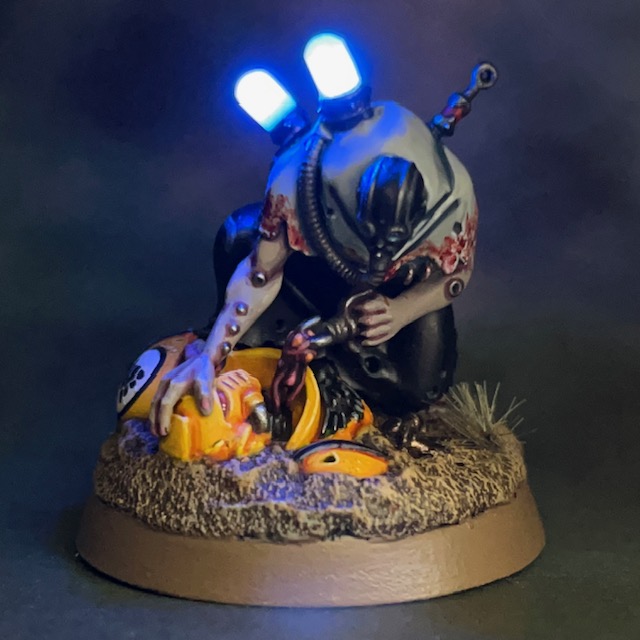
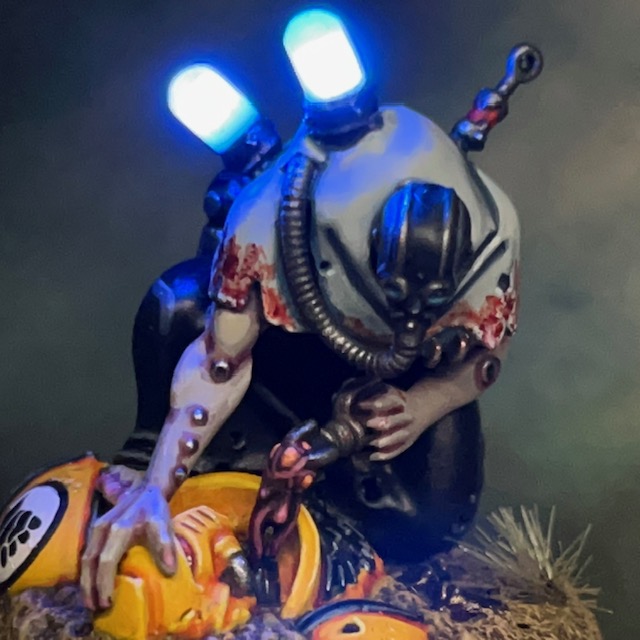
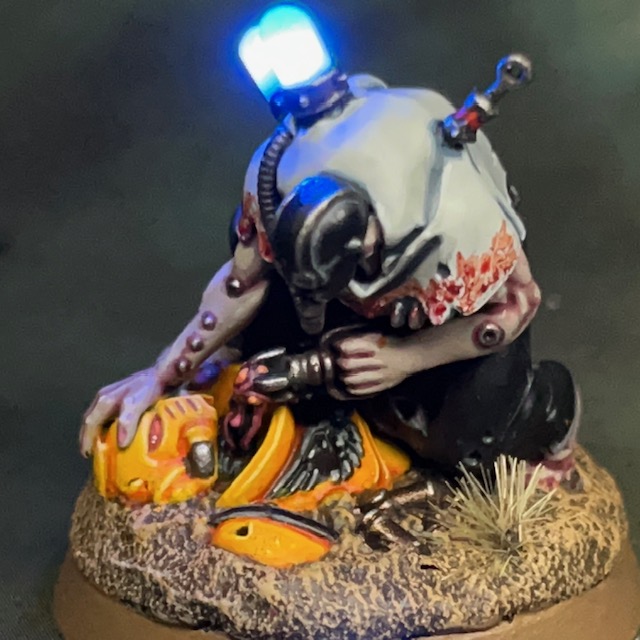
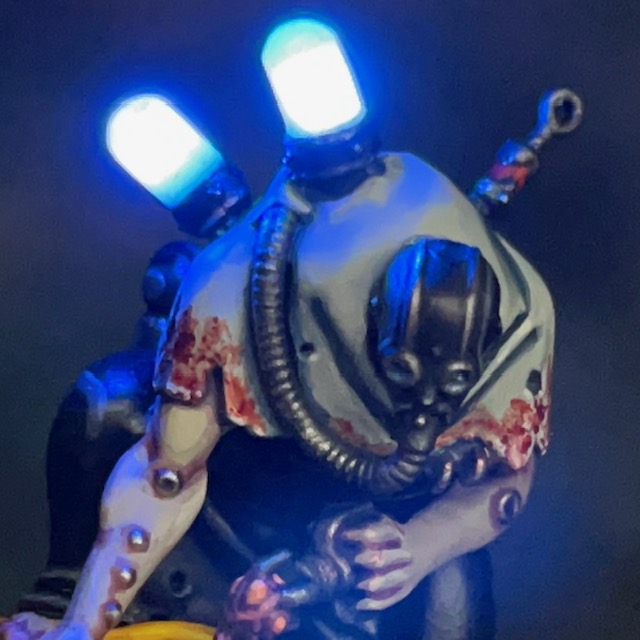
Today we’re looking at the Surgeon Acolyte, minion of Fabius Bile. This isn’t the start of a new army and my fall to Chaos (yet), but part of a birthday gift ‘commission’ for a friend. Fabius Bile himself will be following soon, but I wanted to test the LED technique on the acolyte first. Rather than helmet eye lenses, or weapon muzzle flares, LEDs in this miniature are being used to represent ominous glowing vials of daemonic ichor, super soldier serum, or whatever it is you think are in the glass containers on the acolytes’ back. My friend, who will eventually be the owner of this miniature, specifically chose the blue colour for the LEDs.

Modelling & Painting

As with many of my LED techniques, I was looking for a uniform glow from the point of interest – in this case the ‘vials’. After all, it’s not supposed to be a single point light source that is glowing inside them, but rather every part of the liquid they contain that is emitting a sinister glow. This is why I didn’t simply stick two 3mm round LEDs on the model and call it a day, as in that case all the light would have been coming from one visible point (the p-n junction) in the centre of the LED. I’ve written a short-form tutorial for how I achieved the glowing vials below.

  1. I began by cutting off the plastic vials from the back of the model and inserting two 3V blue SMD chip LEDs in their place. These are connected to a battery in the base following the principles set out in my Simple LED Muzzle Flare tutorial.
  2. Next I coiled the excess LED wire on top of the battery holder and filled in the gaps between the dead space marine and the base with modelling putty. It’s good practice to test the LEDs repeatedly at this stage, just to check you haven’t created an accidental short circuit while hiding the wire.
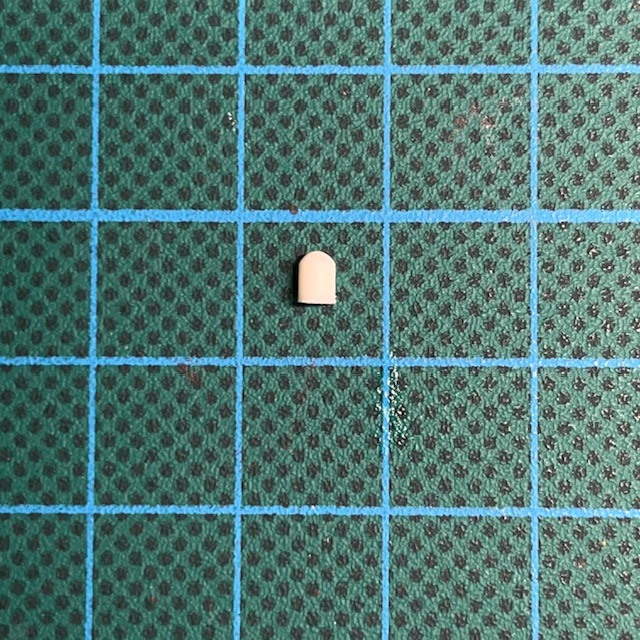
  1. Next I cast a 2mm diameter circular rod in polyurethane resin, following the principles set out in my Resin Casting For Special Effects tutorial.
  2. I then cut the rod to the same length as the plastic vials that were originally on the miniature. I used a combination of needle file and sand paper to round off one end, to more closely match the shape of the original vial. The other end was left flat.
  1. The next step was to drill a 1.5mm hole in the centre of the resin rod starting at the flat end, being very careful not to drill all the way through to the rounded end.
  2. I made sure the miniature was base coated at this point, especially around the areas where the resin vials would be attached. I knew it would be easier to glue them to a painted area rather than trying to paint the area after they were stuck down.
  1. Next I applied a thin ring of PVA glue to the flat end of the rod, and stuck it in place over the chip LED. I used PVA rather than super glue to help avoid any accidental frosting effects.
  2. Once the PVA glue had dried, I applied a thin blue glaze to the bare resin to give a pleasing tint to the resin when the LED is switched off.

When it came to painting the miniature, I largely stuck to the official colour scheme as I didn’t have any good inspiration for an alternative. I’ve noted a few of the colour recipes below, in case anyone is interested in replicating them, and as a reminder to myself. The model was undercoated with Chaos Black spray, and all colours mentioned are Citadel, unless otherwise noted.

  • Sickly Flesh
  • Rakarth Flesh basecoat
  • Carroburg Crimson shade
  • Rakarth Flesh thin layer
  • 50:50 Pallid Wych Flesh:Rakarth Flesh highlight
  • Pallid Wych Flesh fine highlight
  • Emperor’s Children Pink dots on finger and toe nails
  • Bloodstained Surgical Gown
  • Russ Grey basecoat
  • Drakenhof Nightshade shade
  • 50:50 Russ Grey:Ulthuan Grey layer
  • Ulthuan Grey layer
  • 50:50 Contrast Apothecary White:water shade
  • Skull White highlight
  • Khorne Red applied with sponge as ‘blood splatter’
  • Blood for the Blood God technical paint layered over Khorne Red areas
  • Black Rubber
  • Abaddon Black basecoat
  • Eshin Grey highlight
  • Dawnstone fine highlight

I gave my friend the choice of chapter for the space marine casualty, and he chose Imperial Fists. I think this was a good call as it’s a visually striking choice, plus I have a lot of experience painting yellow power armour. I used my Yellow Armour recipe found in this blog post. I may have actually spent more time painting the space marine than I did the rest of the model!

So there we have it, the Surgeon Acolyte is finished and ready to assist the big man himself! I’ll be back again soon with Fabius Bile, as well as plenty of other LED miniatures. As always, thanks very much for reading, and please don’t forget you can also follow my work on social media at TwitterMastodon and Instagram.