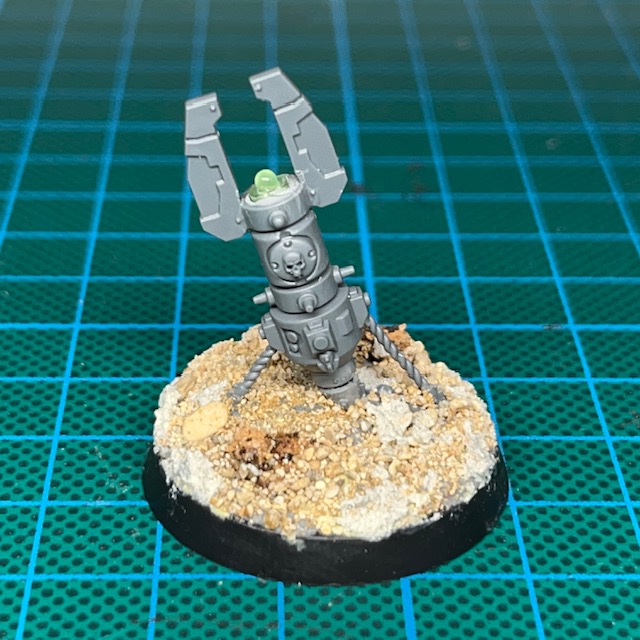
Just a short blog post today as I’m still working on the Terminators from the Leviathan box. But in the meantime, here’s the teleport homer that comes in the set, with added flashing LED beacon.
Modelling & Painting
Although I could have easily added a normal LED to the teleport homer (especially given ‘Rule 4′), I decided a flashing LED was the best choice here. The homing beacon is seen flashing in the Leviathan trailer, and I think it helps to give a cinematic sense of urgency and imminent threat.
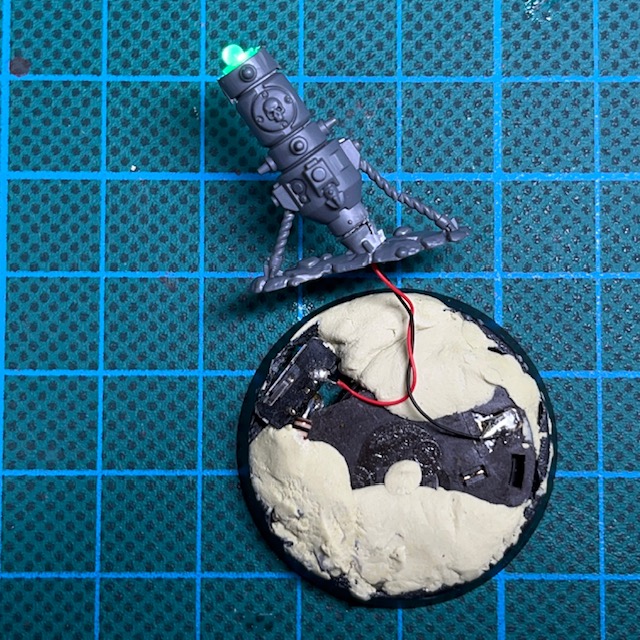
To create the beacon I just followed the principles of my LED Eye Lense Tutorial, although in this case I made a resin recast of the light bulb rather than a helmet. I had to change the base of the teleport homer to a 32mm from a 25mm to accommodate the required battery holder. If you don’t fancy making a resin recast of the bulb, then I have an alternative method of making LED bulbs in my Ork Comms Boy post.
The LED used is a 1.8mm 3V 1.5 Hz green LED from Small Scale Lights. The “1.5 Hz” or 1.5 hertz refers to the frequency with which it flashes – in this case, 1.5 times every second. The circuitry which allows the LED to flash is built into the LED itself, so no extra electronics were required. The wires from the LED run down through the body of the teleport homer and connect to the battery and switch in the base.
As you can see in the pictures below, I cut off the stabiliser wings to make drilling the hole for the LED easier. I then reattached them once it was successfully installed.
For the paint scheme, I simply followed my standard Flesh Eaters painting recipes that you can see in this post.
That’s it for today – I said it was a short one! But I hope you found that interesting. Please check back for some actual Terminators teleporting onto this beacon soon! As always, thanks very much for reading, and please don’t forget you can also follow my work on social media at Twitter, Mastodon, Threads and Instagram.
Today we’re looking at the first model that I’ve assembled and painted from the 10th Edition Warhammer 40,000 ‘Leviathan’ box – the Screamer Killer!
Hive Fleet Cerberus
My personal Tyranid swarm, Hive Fleet Cerberus, has been plaguing the galaxy for decades. In fact, they’re the only army I own that has – in some form or another – consistently seen the tabletop in every single edition of Warhammer 40,000. They took part in the global Ichar IV campaign back in the 1990s, so it has always been my ‘headcanon’ that Hive Fleet Cerberus was a splinter of Hive Fleet Kraken, skulking off to terrorise the Eastern Fringe in the aftermath of that epic conflict.
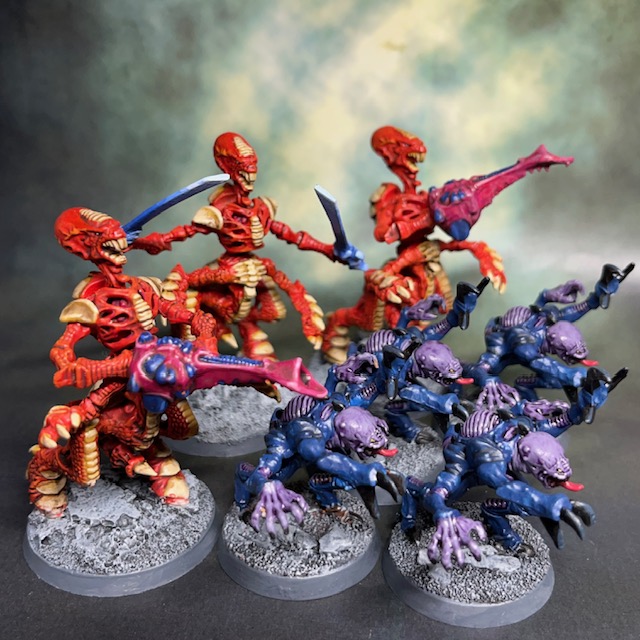
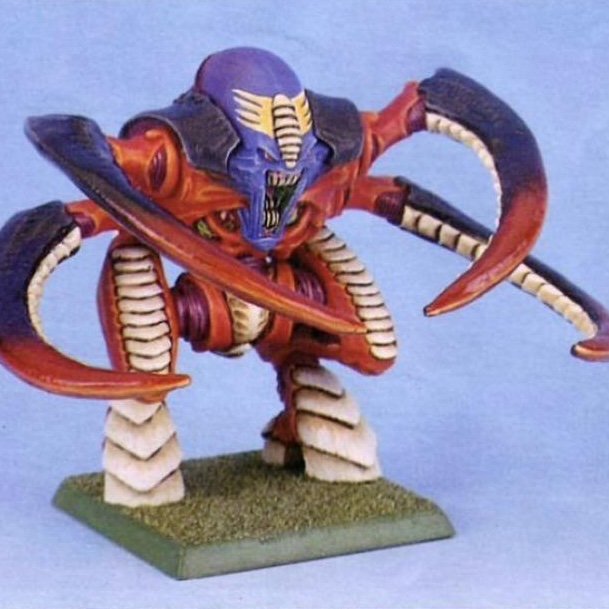
This army has soldiered on with some of the original Tyranid models for many years now (as shown below). These were among the first xenos models I ever purchased, and they will always hold a special place in my nostalgic gamer’s heart. For the last couple of new Warhammer 40,00 edition release boxes, I’ve sold the non-Marine models, but the arrival of Leviathan convinced me to not only keep them, but begin the long-overdue revamp of my Tyranid army. As the classic Screamer Killer was always one of my favourites, I decided this is where I should start the project.
Modelling
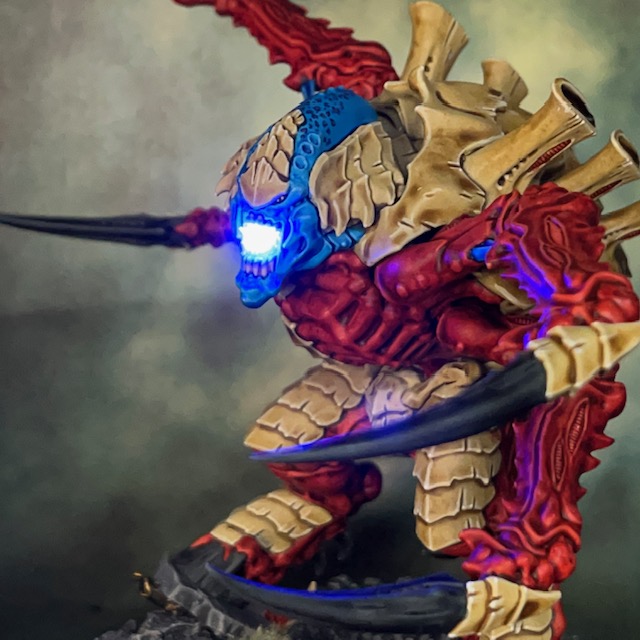
The most prominent feature of my Leviathan Screamer Killer is the LED bioplasma effect. This was achieved using the techniques described in my Simple LED Muzzle Flare tutorial, only with a blue 0805 chip LED instead of the yellow one listed in the tutorial. Additionally, the acrylic gel was given a blue glaze instead of the yellow.
These days I like to pick a limited colour palette of LEDs for army projects, just so the finished force does not look like a bunch of Christmas decorations with a huge mish-mash of different colours and lights. For Hive Fleet Cerberus I’ve settled on blue for energy weapons and psychic powers. I’m not sure what other colours I’ll use yet, but I’ll decide that as the need arises.
Painting
It’s often said that it’s best to start a new army paint scheme with the rank and file models, and not the leaders or large centrepieces, but as mentioned above I just couldn’t resist starting with the Screamer Killer. When it came to picking the colours for this revamp project I wanted to stick fairly close to the original scheme, so that meant red for flesh and bone for carapace. After some thought on what colour bioweapons should be, and considering both green and a beige ‘flesh’ colour, I eventually settled on blue. This forms a triadic colour harmony with the red and the yellowish tint of the bone. As an aside, I find this free Colour Wheel website a useful reference for choosing complementary colours schemes for painting projects.
You can see some examples below of classic Tyranids from Games Workshop publications painted in a red, yellow, and blue scheme. This colour combination definitely has a pedigree!
I decided to paint the Screamer Killer’s face blue for a number of reasons. Firstly, it was traditionally painted a different colour to the rest of the flesh and carapace on the classic model, so I felt that should be the case here as well. Secondly, as mentioned above, I’d settled on blue for bioweapons, and for this Tyranid, their face is the weapon! I added the purple mottling to the top of its head to provide some visual interest for what is otherwise a large, flat area.
I also made the sinews on the arms blue, as you may have noticed. This was because they felt distinct from the surrounding flesh, and in need of picking out in another colour. Again, as the claws are weapons, the blue seemed appropriate. Also, it adds some visual interest to what is otherwise a very large area of solid red when the model is viewed directly from the front.
When I list my painting recipes on this blog, I’m not only recording them for those of you who are interested in using them, but also as a reminder for myself! Below are the paint recipes for Hive Fleet Cerberus, and I’m sure I’ll be referring to this post frequently as the project progresses. All paints listed are from the Citadel range and are applied over an undercoat of Citadel Wraithbone spray.
Red Flesh
Contrast Blood Angels Red
Wild Rider Red highlight
Troll Slayer orange dot highlight on sharp points
Bone Armour
Contrast Skeleton Horde
Screaming Skull highlight
Skull White dot highlight on sharp points
Blue Bioweapons
Contrast Talassar Blue
Lothern Blue highlight
Blue Horror dot highlight on sharp points
Black Claws
Contrast Black Templar
Eshin Grey highlight
Dawnstone dot highlight on sharp points
Purple Mottling
Naggaroth Night irregular dot
Genestealer Purple layer inside dot
Yellow Eyes
Averland Sunset base coat
Agrax Earthshade shade
Yriel Yellow layer
Abaddon Black pupils
Urban Base
Mechanicus Standard Grey base coat on rocks
Warplock Bronze base coat on metal debris
Contrast Skeleton Horde on skulls
Nuln Oil shade all over
Dawnstone drybrush on rocks
Administratum Grey drybrush on rocks
White Scar drybrush on rocks
Retributor Armour highlight on metal debris
Screaming Skull highlight on skulls
Skull White dot highlight on skulls
Citadel Middenland Tufts
If you’re after tabletop ready models quickly, then I don’t think you can beat Contrast and one or two highlights as the best compromise between speed and acceptable quality. For projects with fewer models, like my Flesh Eaters space marines, then I do prefer traditional painting methods. But when you have to get a load of models done, especially highly textured models like Tyranids, then I just don’t have the hobby time these days to paint them in the traditional way.
That’s it for today, I hope you all found that interesting. Please check back soon for more miniatures from the Leviathan boxed set. As always, thanks very much for reading, and please don’t forget you can also follow my work on social media at Twitter, Mastodon and Instagram.








 Chris Buxey Paints